
Iran-Russia ties go beyond tactical cooperation: Top security official
 2 Min Read
Iran and Russia reaffirm their strategic alliance as a National Security official meets with Russian officials in Moscow following the new bilateral partnership agreement.
-
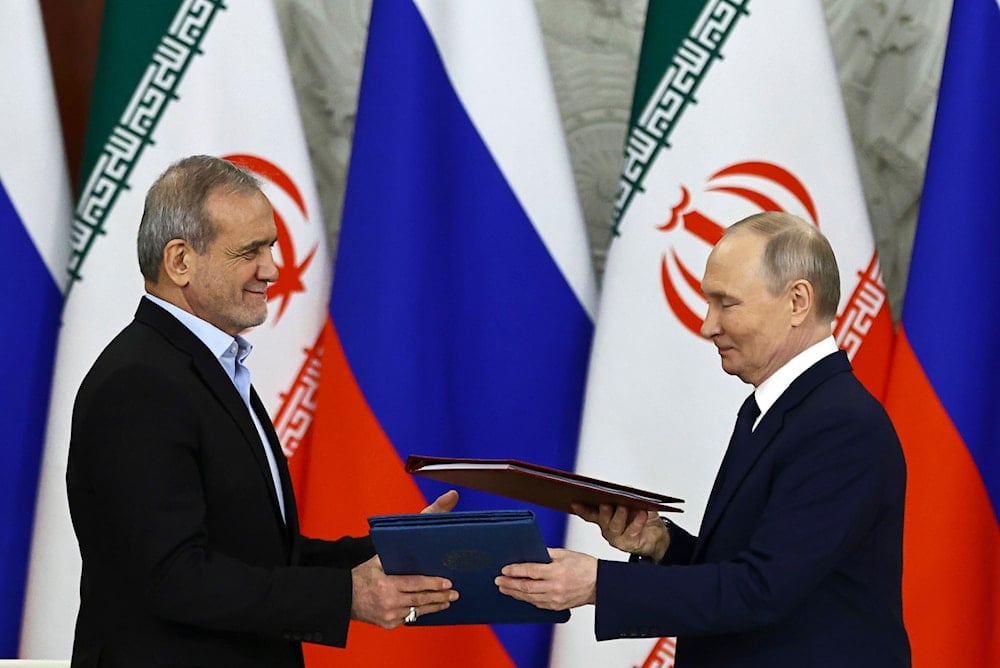
Russian President Vladimir Putin, right, and Iranian President Masoud Pezeshkian attend a signing ceremony at the Kremlin in Moscow, Russia, Friday, Jan. 17, 2025 (AP)
Ibrahim Azizi, head of Iran’s National Security and Foreign Policy Committee, met with the chairs of the Russian State Duma’s International Affairs and Defense Committees during his visit to Moscow.
Azizi emphasized that Iran and Russia are strategic allies, describing their relations as far beyond temporary or tactical cooperation. He added, according to the Iranian news agency IRNA, that Western hostility, particularly in the form of sanctions, underscores the importance of deepening ties between the two countries.
The meeting comes shortly after the Comprehensive Strategic Partnership Agreement between Russia and Iran officially took effect on October 2, marking a significant milestone in the bilateral relationship.
A look into Comprehensive Strategic Partnership
On January 17, 2025, the presidents of Russia and Iran signed the Comprehensive Strategic Partnership treaty in Moscow, a 20-year pact intended to deepen cooperation across many spheres, with automatic extensions every five years.
The agreement, consisting of 47 articles, outlines cooperation in more than 30 fields, including defense and security, energy, trade, investment, transport, science, technology, agriculture, culture, health, and peaceful nuclear energy. It also stipulates mutual commitment to respect sovereignty, not to intervene in internal affairs, and not to allow either side’s territory to be used against the other.
Under the security and defense chapter, the treaty envisages deep cooperation, including military-technical collaboration, joint exercises, intelligence sharing, and coordination on regional security threats. However, it does not impose an automatic mutual defense obligation, meaning that in case one party is attacked, the other is not required to launch military action.
Economically, the treaty aims to significantly boost bilateral trade and investment. In 2024, trade between Russia and Iran reportedly reached about US $4.8 billion, but officials expect that figure to grow several-fold under the new agreement. Discussions also include a Russian-Iranian gas deal potentially supplying Iran with up to 55 billion cubic meters annually.
In short, the treaty marks a shift from episodic cooperation to a long-term, wide-ranging partnership, creating a structural framework enabling Tehran and Moscow to coordinate politically, economically, and militarily, while insulating themselves better against Western pressure, sanctions, and geopolitical isolation.


