
Iran's mission to UN slams 'politicized, unprofessional' IAEA reports
 4 Min Read
Iran's UN mission dismissed IAEA compliance demands as meaningless, accusing the agency of politicized reporting as a UN Security Council referral push looms.
-
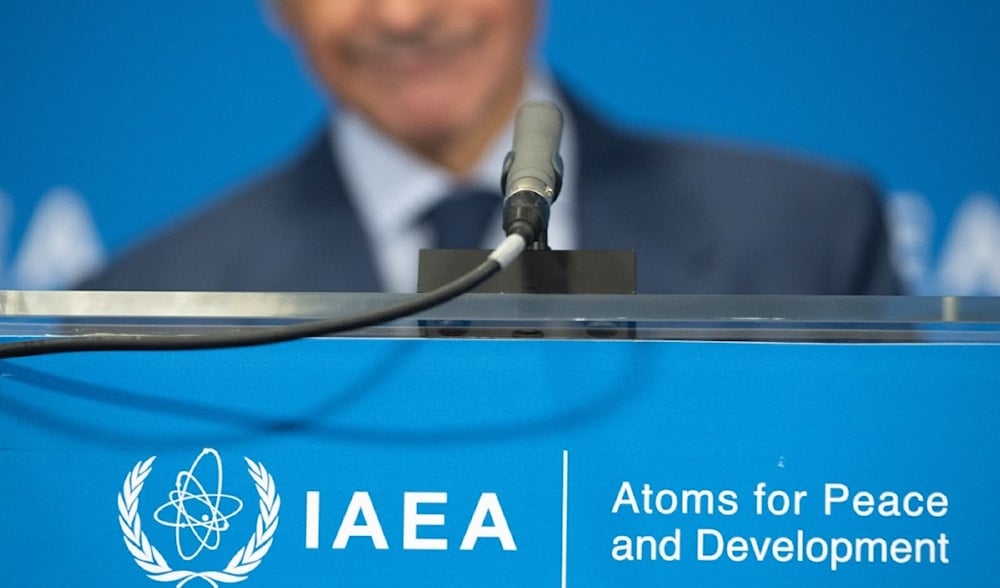
IAEA logo is pictured as its Director General Rafael Grossi speaks during a press conference after the Board of Governor’s Meeting at the agency's headquarters in Vienna, Austria on September 7, 2026. (Photo by Joe Klamar / AFP)
Iran's mission to the UN in Vienna said Monday that the IAEA must stop its "unprofessional, unobjective, semi-technical, and politically influenced reporting" before it can act on Iran, dismissing a renewed push for Tehran's unconditional compliance with agency safeguards as "meaningless."
In a post on X, the mission said a "call on Iran" to comply "in the current hazardous situation is meaningless," arguing the demand ignores that the IAEA itself initially suspended implementation of safeguards and withdrew its own inspectors "for safety reasons" after the US and "Israel" carried out their unlawful aggression.
A "call on Iran" to unconditionally implement Agency safeguards in the current hazardous situation is meaningless. This call ignores the very fact that the Agency itself initially decided to suspend implementation of safeguards and withdrew inspectors “for safety reasons” after…
— Iran Mission UN Vienna (@PMIRAN_Vienna) September 7, 2026
The mission added that IAEA Director General Rafael Grossi must first call on the US and "Israel" to stop attacking or threatening to attack safeguarded peaceful nuclear facilities, so that the "essential grounds" for implementing agency safeguards are met.
Until the IAEA and the UN Security Council discharge their mandated responsibilities, the mission said, Iran has every right to protect its national interests on its own.
The statement came as a draft resolution drafted by the United States, Britain, France, and Germany, seen by AFP, proposes referring Tehran to the UN Security Council over its nuclear reporting obligations.
The mission called the draft, expected to be submitted and voted on this week, a "new desperate action" that would bring "no benefit." The text asks Grossi to submit it to all IAEA member states as well as the Security Council and the UN General Assembly.
Grossi: Engagement would bring 'positive repercussions'
Grossi told a press conference after opening the quarterly meeting of the IAEA board of governors on Monday that granting the agency access to Iran's key nuclear facilities would have "positive repercussions" for the country. "The best, shortest way for a positive outcome is for Iran to engage with us," he said.
Asked whether a Security Council referral was the right course of action, Grossi said his "job with Iran continues, irrespective of the resolution," adding "if Iran engages with us in a serious dialogue, if we can start getting access, I can guarantee to you that this will have very, very positive repercussions."
In a statement ahead of the meeting, Grossi called the lack of contact with Iran "regrettable," saying "these issues are not going to disappear until we address them, until we have the necessary access, until we can return."
Iran holds firm on access to bombed sites
Iranian officials have repeatedly ruled out IAEA access specifically to the facilities bombed by the US and "Israel."
During an interview on state television, Parliament Speaker Mohammad Bagher Ghalibaf was asked about the possibility of inspectors gaining access to the facilities. "That is a lie," he replied. Ghalibaf has also said Iran will not allow access to the damaged sites "under any circumstances" and will continue to confront outside pressure through strength.
Iranian Deputy Foreign Minister Kazem Gharibabadi said the question of IAEA access to the targeted facilities "will only be resolved as part of a final agreement with the United States."
Mohammad Eslami, head of the Atomic Energy Organization of Iran (AEOI), has laid out the legal basis for that position. He said a law passed by Iran's Parliament now governs Tehran's dealings with the IAEA, and that Iran has formally notified the agency of its stance under that framework.
Eslami distinguished facilities that were attacked and those that were not. Untouched sites have already received the inspections required under Iran's safeguards agreement, while any inspection of a bombed facility cannot proceed until the IAEA clarifies how it will handle the safety and security of these sites and announces a specific protocol, which he said the agency has not yet drawn up.
He added that Iran remains in a state of war and that the security of its nuclear sites cannot be treated as stable until that protocol exists. He said the United States and "Israel" are pressuring Iran to allow the visits in order to assess the sites' condition after the strikes.


