
Iran's precision strikes account for tenth of US war costs: FT
 4 Min Read
The US war on Iran cost up to $31 billion in five weeks, with Iranian strikes damaging key radar systems and exposing strategic vulnerabilities.
-
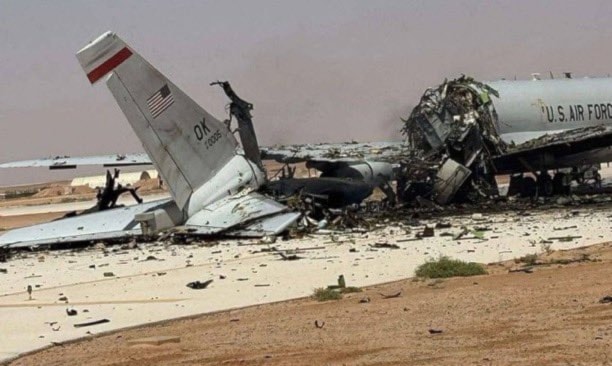
A destroyed United States Air Force Boeing E-3 Sentry airborne early warning and control aircraft is seen at the Prince Sultan Airbase in Saudi Arabia (Social media)
The United States' war on Iran is costing Washington hundreds of millions of dollars daily, with mounting financial and military losses degrading long-term strategic readiness, the Financial Times reported.
Citing defense analysts and former officials, the report estimates that the aggression, launched by US President Donald Trump in late February, has cost between $22.3 billion and $31 billion in just five weeks.
The financial toll includes between $2.1 billion and $3.6 billion in battle damage and equipment replacement. The substantial costs highlight Iran's effective retaliatory campaign, which has damaged and destroyed key US military installations.
Despite relatively limited publicly disclosed personnel losses compared to large-scale wars, the US has admitted to 13 fatalities and more than 300 wounded troops since late February. Analysts note that while these figures remain low by conventional war standards, the material losses, particularly high-value systems, are proving more consequential.
Estimates cited in the report suggest that the war is costing roughly $500 million per day, reflecting both operational expenditures and the high cost of maintaining advanced military systems in an active combat environment.
Iran targets critical US infrastructure
The report highlights that Iranian forces have focused on degrading key US military capabilities, particularly radar and communications systems across regional bases.
Among the most significant losses are advanced early warning systems and missile defense infrastructure, including AN/TPY-2 radars, which are essential components of the THAAD missile defense network. Each radar is estimated to cost around $485 million and can take up to three years to manufacture, with no surplus units readily available.
Damage to these systems has raised alarm among Western analysts, who warn that such losses could undermine the US ability to detect and intercept incoming missile threats, not only in West Asia but across other strategic theaters.
“This is a very scarce and highly capable radar,” Tom Karako, director of the missile defense project at the Center for Strategic and International Studies (CSIS), said.
“Repairing or replacing them is going to be a very high priority,” Karako underlined, adding, “You cannot take an Amazon Basics radar and substitute it for an AN/TPY-2.”
High-value assets under strain
The report also details damage to other critical assets, including a Boeing E-3 Sentry airborne warning and control aircraft, which may cost over $700 million to replace, as well as additional strikes on US bases in Jordan, Qatar, and Saudi Arabia. In the case of the E-3 Sentry, US officials initially leaked claims suggesting limited damage; however, images that later emerged from the strike site revealed the aircraft had been completely destroyed, underlining a deliberate effort to downplay the scale of losses inflicted by Iranian strikes.
Iran is also reported to have downed and destroyed multiple US drones and aircraft, including more than a dozen MQ-9 Reaper drones, at least one F-15E fighter jet, an A-10 Thunderbolt II attack aircraft, two MC-130J Commando II aircraft, at least two H-6 Little Bird helicopters, several KC-135 Stratotankers, urther adding to the financial and operational burden of the US military. Fighter jets and other aircraft were also damaged or destroyed via air defenses or US-claimed "friendly fire". This includes an F-35 stealth fighter jet, three F-15E fighter jets, and two MH-60 Black Hawks.
In some cases, US forces reportedly destroyed their own equipment on the ground to prevent capture.
Beyond the region
Beyond immediate battlefield losses, analysts cited in the report warn that the war is placing a strain on US military resources needed for other potential conflicts, particularly in Asia.
The depletion of interceptor stockpiles and damage to advanced radar systems have raised concerns about Washington’s preparedness in the event of confrontation with China, with some officials warning that continued attrition could shift the broader balance of power.
“There is growing concern about overstretch,” the report notes, as the US continues to expend high-end systems at a pace that may be difficult to sustain.
“The Thaad early-warning radar and the E-3 would certainly have been useful in a war with China,” Fabian Hoffmann, a missile defense expert at the Oslo Nuclear Project, told FT.
Read more: US projects power militarily; China rises via trade, infrastructure


