
US seeks $25.4bln interceptor boost as war on Iran drains stockpiles
 4 Min Read
The US seeks $25.4 billion to expand THAAD and Patriot interceptor stockpiles after heavy depletion during operations against Iran, highlighting growing strategic strain.
-
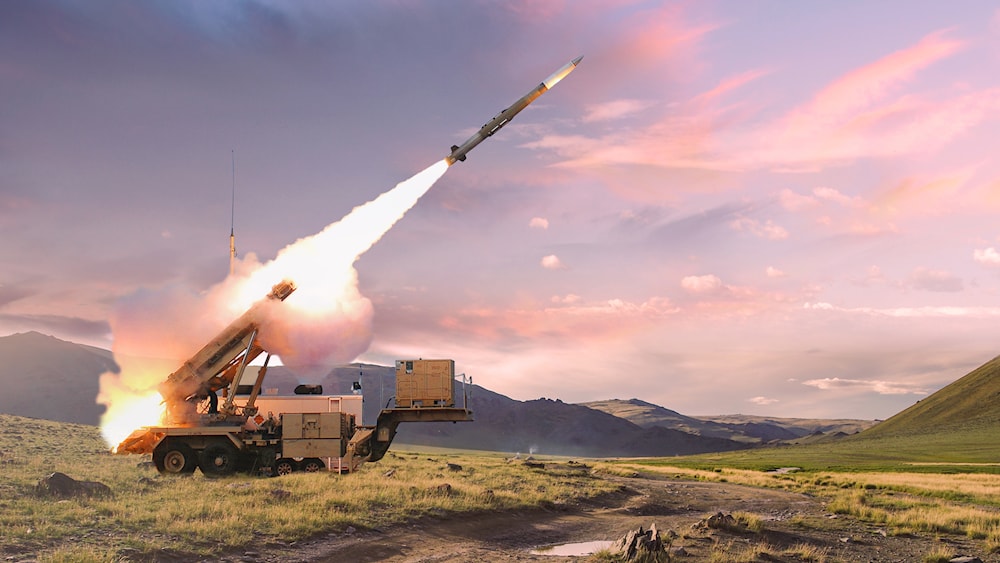
A Patriot air defense missile launcher fires a PAC-3 missile as seen in this poster, created on January 29, 2025 (Lockheed Martin via AP)
The United States Department of War is requesting a sweeping increase in funding for advanced missile interceptors, citing mounting stockpile pressures following extensive use during the ongoing war on Iran.
According to budget documents for fiscal year 2027, the Pentagon is seeking a combined $25.4 billion to expand procurement of the Terminal High Altitude Area Defense (THAAD) system and the Patriot Advanced Capability-3 Missile Segment Enhancement (PAC-3 MSE), marking one of the largest interceptor funding surges in recent years.
Stockpile depletion drives funding push
The request follows reports of significant attrition in US interceptor inventories, due to the aggression on Iran, as the Iranian armed forces responded to US-Israeli aggression by launching hundreds of missiles and thousands of one-way attack drones against "Israel" and US interests in the region. Iran's retaliatory strikes led to high consumption rates of missile interceptors, exposing gaps in strategic reserves, especially for Gulf countries. US defense officials have warned that the pace of interceptor use has outstripped replenishment capacity, raising concerns over long-term readiness.
The issue is compounded by an inability to match the scale and speed of Iran’s missile and drone production, which has placed sustained pressure on US air defense systems deployed across multiple theaters.
THAAD program sees dramatic expansion
The most notable increase is centered on the THAAD system, which is being shifted from the Missile Defense Agency to direct Army control. Funding for THAAD is set to rise by 1,289%, jumping from $823 million in fiscal year 2026 to $11.4 billion in 2027.
The move reflects a broader restructuring of US missile defense priorities, with the Army assuming a more prominent role in high-altitude interception amid intensifying operational demands. THAAD, a versatile system designed to intercept ballistic missiles during their terminal phase—after re-entry as they descend toward their targets—remains central to this shift.
In standard engagements, US forces typically launch two interceptors per incoming missile, significantly increasing operational costs, with each interceptor priced between $12.7 million and $15.5 million. The system has also faced sustained targeting by Iran’s Islamic Revolution Guard Corps (IRGC), which has destroyed several of its accompanying AN/TPY-2 radars in the Gulf and Jordan. In the 12-day war on Iran, in June 2025, 150 of nearly 1,000 interceptors in stock were used up by the US in an effort to protect "Israel".
PAC-3 MSE expansion extends to Navy
The PAC-3 MSE interceptor program is also set for substantial growth across multiple branches. The US Army is requesting $12.2 billion for the system, reflecting a 642.9% increase compared to the previous fiscal year.
In a significant development, the US Navy is seeking $1.73 billion to begin integrating PAC-3 MSE interceptors into its fleet, marking the first time the land-based system would be adapted for naval deployment.
The scale of the proposed funding underscores growing concern within US defense circles over interceptor sustainability in high-intensity conflict scenarios. The heavy reliance on advanced interceptors during the war on Iran has highlighted structural challenges in maintaining sufficient stockpiles to protect strategic assets and troops, as US-Israeli aggression in the region persists.
Read more: Poland rules out sending Patriot missiles to US amid war on Iran


