
Iran’s UN mission submits legal document on impact of US sanctions
 3 Min Read
Iran’s Permanent Mission in Geneva urges UN human rights mechanisms to examine how US financial, banking, and transport restrictions affect civilians.
-
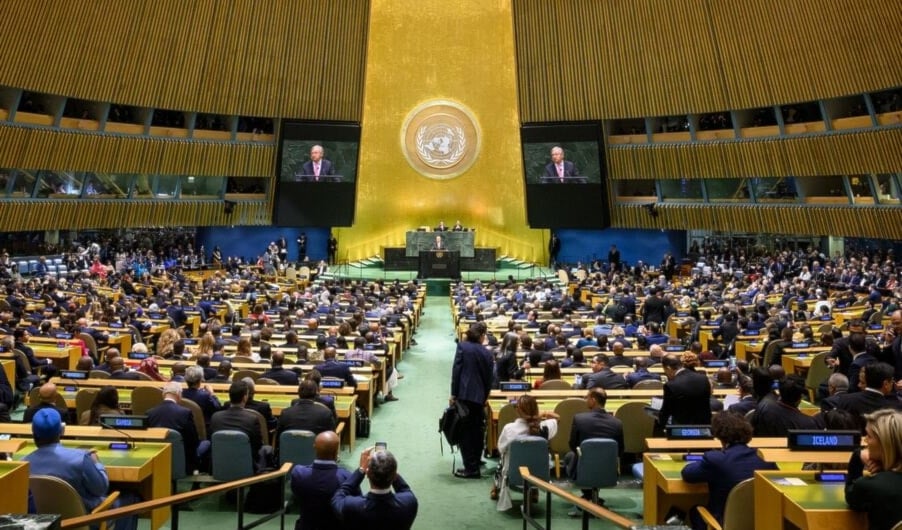
UN Secretary-General António Guterres (on podium) opens the 81st Session of the General Assembly Debate on September 22,9, 2026 (UN/Loey Felipe)
Iran's permanent mission to the UN Office in Geneva submitted on Sunday a legal document to a number of United Nations human rights mechanisms addressing the impact of the economic and financial sanctions imposed by the United States on the lives of civilians in Iran.
In a statement, the mission said the submission comes amid an escalation of US “economic terrorism", alongside the military aggression against the country. It said these measures extend the pressures of war into the humanitarian and livelihood spheres.
The document outlines banking and financial restrictions, secondary and extraterritorial sanctions, restrictions on air and maritime transportation, and the revocation of previously issued licenses, as well as the adoption of a presumption of denial in the issuance of licenses and measures related to the maritime blockade.
Furthermore, the mission called on the UN human rights mechanisms to examine the direct repercussions of these measures on civilians.
Pezeshkian: US sanctions on Iran constitute direct terrorism
Iranian President Masoud Pezeshkian stressed earlier today that, throughout all the meetings and talks it has held, Iran has sought to emphasize its victimization and the crimes committed by the Americans and the Zionists.
Pezeshkian said the United States is responsible for directing most terrorist operations around the world and for training terrorists, stressing that the sanctions imposed by Washington and directly targeting the Iranian people constitute terrorism in its own right.
The Iranian president added that this requires Islamic countries to unite and cooperate in confronting it.
What you need to know
The United States imposed sanctions earlier this month on all remaining Iranian airlines that had not previously been targeted under its aviation-related sanctions. Washington also sanctioned foreign companies and intermediaries it accused of supporting Iran's aviation sector.
The US war on Iran has been ongoing since late February, with the US-Israeli war leading to the martyrdom of Iran's senior figures and military officials at the beginning of the wider aggression.
Iran responded by carrying out strikes against US assets in the region and later taking control of the Strait of Hormuz, a key waterway for global energy shipments. The war and its consequences have contributed to a sharp rise in oil prices as the war expanded across West Asia.
The confrontation has also brought Washington's sanctions campaign against Tehran into direct tension with China's economic ties with Iran, with Beijing repeatedly rejecting unilateral US sanctions and calling for diplomatic efforts to resolve the war.
Read more: Russia, China veto UNSC extension of Iran sanctions panel


