
Iran, Saudi Arabia, Pakistan, Turkey agree to continue security talks
 4 Min Read
Tehran hosted the first quadrilateral meeting of Iran, Saudi Arabia, Pakistan, and Turkey, with participants pledging further talks to strengthen regional security.
-
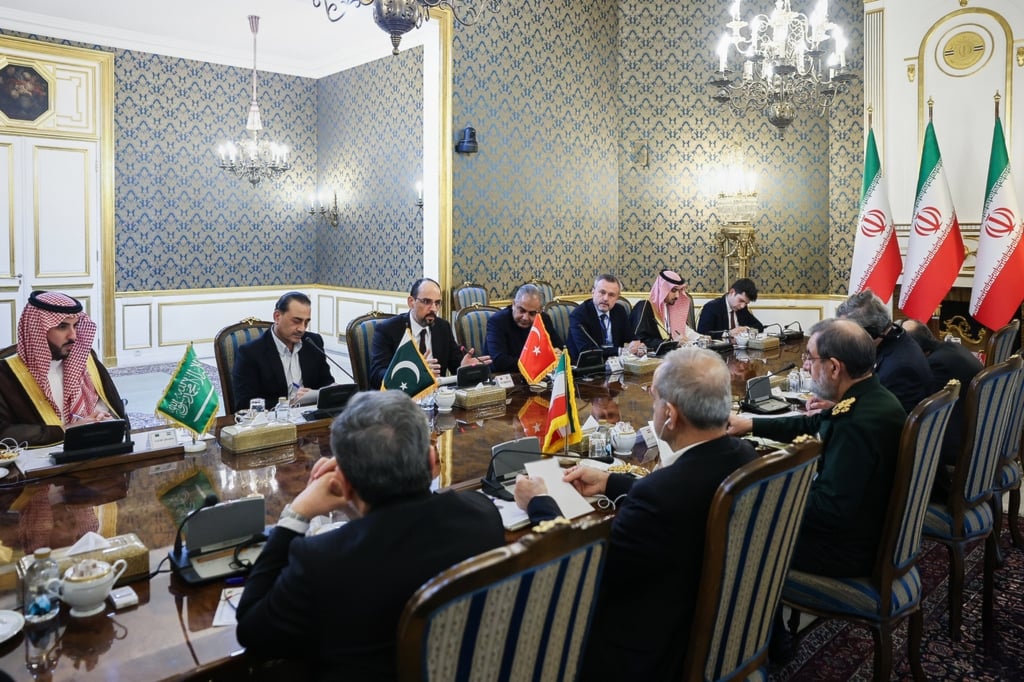
Ibrahim Kalin, head of Turkey's intelligence service, rear third left, speaks in a meeting of high-level delegations from Saudi Arabia, Pakistan and Turkey with Iranian President Masoud Pezeshkian, and other top Iranian officials in Tehran, Iran, Oct. 26, 2026. (Iranian Presidency Office)
Iran, Saudi Arabia, Pakistan, and Turkey have agreed to continue discussions on strengthening regional cooperation, peace, and security following their first quadrilateral meeting in Tehran on Monday, October 26.
The meeting brought together senior security and military officials from the four regional countries, reflecting their continued engagement on regional stability and security cooperation, according to a statement issued after the meeting.
Mohsen Rezaei, Secretary of Iran’s Supreme National Security Council, hosted the meeting. The participants included Saudi Defense Minister Prince Khalid bin Salman, Pakistan’s Armed Forces Commander Asim Munir, and Ibrahim Kalin, head of Turkey's intelligence service.
According to the statement, the four sides agreed to continue consultations aimed at strengthening cooperation among their countries, including on regional peace and security.
Four regional powers pursue security cooperation
The Tehran meeting established a quadrilateral framework for continued discussions among Iran, Saudi Arabia, Pakistan, and Turkey. The participants’ agreement to maintain consultations provides a basis for further engagement on shared regional security concerns.
The gathering brought together representatives responsible for national security, defense, and intelligence, underscoring the security-focused nature of the discussions.
The four countries’ commitment to continue discussions marks the initial step in a process intended to strengthen regional cooperation and promote peace and stability.
Pezeshkian calls for regional unity against Israeli aggression
During the meeting on Monday, Iranian President Masoud Pezeshkian said Tehran was ready to pursue deeper regional cooperation with “firm conviction and determination,” calling on neighboring countries to resolve their differences and coordinate efforts to confront shared security threats.
He emphasized the importance of dialogue among regional countries, arguing that their collective capabilities could provide a foundation for justice, development, and lasting stability. He also reaffirmed Iran’s willingness to address differences with its neighbors and expand cooperation on the basis of mutual interests, national sovereignty, and respect for the rights of regional peoples.
Pezeshkian pointed to the “fundamental common ground among countries in the region,” stressing that “brotherhood and unity must be at the heart of our relations.” He added that regional states “must stand together against threats targeting our countries.”
Condemning the violence carried out by the Israeli regime with US support, Pezeshkian cited its actions in Gaza, Lebanon, and elsewhere across the region, arguing that a coordinated regional response was needed more than ever.
“We are confident that if the countries of the region stand together and adopt a unified position, these attacks cannot recur,” he said, adding that achieving this required a shared understanding of regional objectives.
The Iranian president urged neighboring states to prioritize common interests over their differences, reaffirming Tehran’s readiness to strengthen cooperation to protect regional peoples, safeguard national sovereignty, confront aggression, and support peace.
Saudi Arabia says Tehran visit seeks to ease regional tensions
On its part, Saudi Arabia’s Foreign Ministry said the visit by bin Salman and representatives of countries party to the Mecca Defense Pact was intended to reduce tensions among regional parties and encourage diplomatic solutions.
The ministry said the visit aimed to support dialogue and mediation efforts led by Qatar and Pakistan, stressing the role of regional states in maintaining security and preventing further military escalation.
Riyadh also called on the parties involved to engage positively with the visit’s outcomes and pursue negotiations capable of ending the crisis and preventing renewed escalation.


