
Iran says nuclear program will continue despite pressure, attacks
 4 Min Read
Iran's Atomic Energy Organization spokesperson Behrouz Kamalvandi said Tehran's peaceful nuclear program will continue despite military threats, sabotage, and international pressure.
-
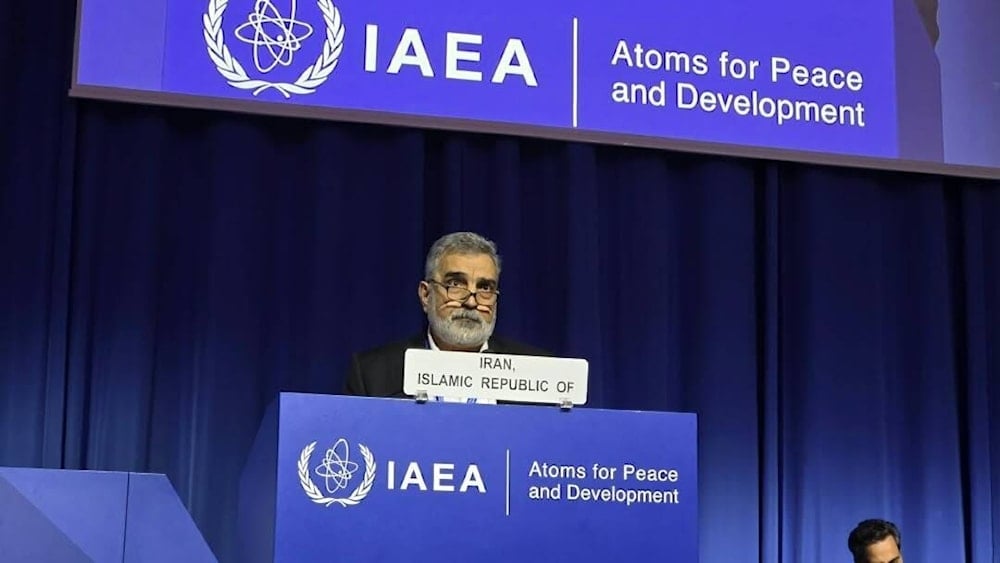
AEOI spokesperson Behrouz Kamalvandi addresses the IAEA’s 70th General Conference. (IRNA)
Iranian Atomic Energy Organization (AEOI) spokesperson Behrouz Kamalvandi said Tuesday that Iran’s nuclear program would not be halted by external pressure, military attacks, or acts of sabotage, stressing that Tehran’s activities remain peaceful.
Speaking during the 70th General Conference of the International Atomic Energy Agency (IAEA), Kamalvandi said Iran “will not surrender” and reiterated that the country’s nuclear program is aimed at civilian purposes and pursued within the framework of its rights under international agreements.
He argued that attempts to damage Iran’s nuclear infrastructure through military strikes, sabotage, or assassinations would not eliminate the country’s scientific capabilities or nuclear expertise.
“Military attacks, sabotage and assassinations cannot eliminate Iran’s nuclear knowledge and industry,” Kamalvandi said.
Iran rejects claims of hidden nuclear activity
Addressing concerns over Iran’s underground nuclear facilities, the AEOI spokesperson said the location of sensitive sites in protected areas does not mean they were concealed from international oversight.
“Locating nuclear facilities in safe and appropriate places does not mean concealing or hiding them,” he said.
Kamalvandi stressed that despite being underground, Iran’s sensitive nuclear facilities had remained subject to International Atomic Energy Agency (IAEA) inspections, adding that inspectors had been present at those sites.
He said Iran’s decision to fortify and protect key facilities was a natural response to years of military and security threats against the country.
“Iran has long faced continuous military and security threats, and it is natural that it fortifies its vital facilities against potential enemy attacks,” he said.
Tehran criticizes IAEA response to attacks
During his address, Kamalvandi also criticized the IAEA’s silence regarding attacks targeting Iran’s nuclear facilities, accusing some countries of undermining international law and the global non-proliferation framework.
He said the failure to condemn military attacks, sabotage operations, and other actions against Iran’s nuclear infrastructure raised questions about the agency’s neutrality.
Kamalvandi argued that silence from states and international institutions while the UN Charter, the IAEA Statute, and the nuclear non-proliferation regime are being challenged does not represent impartiality.
Tehran highlights NPT commitments
Kamalvandi also defended Iran’s record under international nuclear agreements, saying Tehran was among the earliest members of the Nuclear Non-Proliferation Treaty (NPT) and has continued to meet its obligations.
He questioned whether the IAEA had ever issued a report proving that Iran diverted nuclear material toward military purposes.
“Have IAEA inspectors issued any report to date indicating a diversion in Iran’s nuclear program?” he asked.
Iran has repeatedly maintained that its uranium enrichment program is intended for peaceful uses, including energy production, scientific research, and nuclear medicine, while rejecting accusations that it seeks to develop nuclear weapons.
Iran recalls JCPOA commitments
The AEOI spokesperson also addressed the 2015 Joint Comprehensive Plan of Action (JCPOA), saying Iran had remained committed to the agreement until the United States withdrew from it in 2018.
Tehran has argued that its subsequent expansion of nuclear activities came in response to Washington’s withdrawal and the reimposition of sanctions, while Western governments have accused Iran of moving beyond the limits established under the deal.
Kamalvandi stressed that Iran’s nuclear achievements, including in electricity generation and medical applications, demonstrate the peaceful nature of its program.
Read more: Baghaei: US actions main cause of insecurity in Strait of Hormuz


