
Iran set to work on increasing its missiles' range: Army spox
 3 Min Read
Iran plans to increase the range and speed of its missiles following the war with the US, Mohammad Akrami Nia says.
-
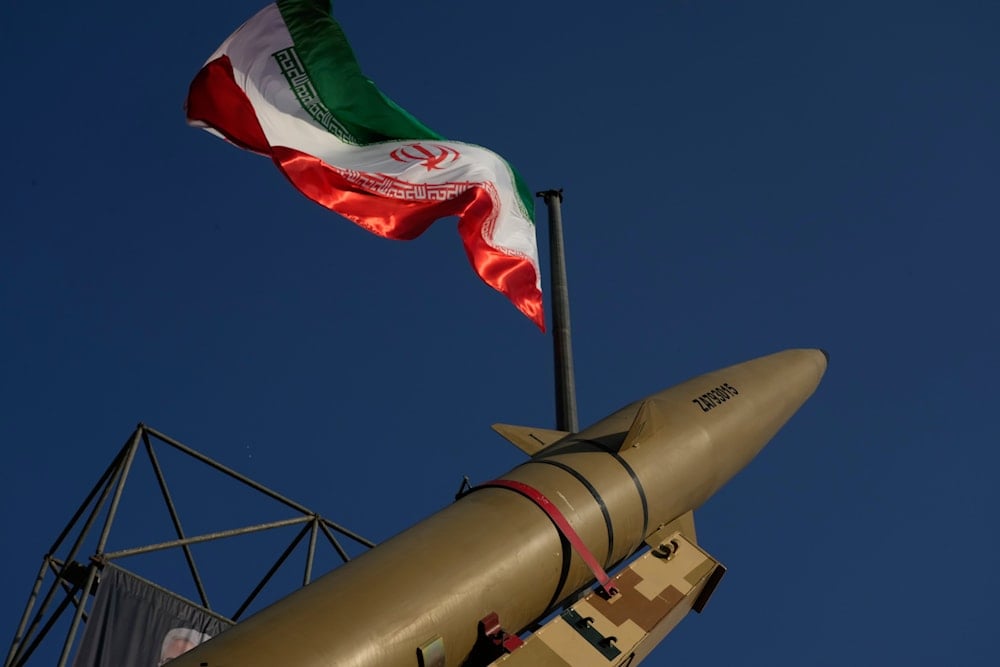
An Iranian missile is displayed under the country's national flag in a military exhibition commemorating the anniversary of the start of the 1980-88 Iraq-Iran war at Baharestan Square, in Tehran, Monday, Sept. 28, 2026 (AP)
Tehran will work to increase the range of its missiles following the war with the United States, Iranian Army spokesperson Mohammad Akrami Nia said on Sunday, noting that US forces are currently stationed at distances of up to approximately 1,000 kilometers from Iran's coastlines.
Speaking to Fars News Agency, Akrami Nia said Iran concluded during the war that there is a "definite necessity" to increase the range of its missiles, confirming that work in this direction is already underway.
Akrami Nia explained that the development of missile speed and range will cover all missiles of the Iranian army, in line with the presence of US forces at distances of up to approximately 1,000 kilometers from Iran's coastlines.
The remarks come amid escalating US economic pressure on Iran, with expanded economic sanctions imposed on various sectors, in addition to the ongoing blockade of Iranian ports and coastlines, following the US-Israeli war on the country.
Recently, the two sides exchanged proposals and responses regarding reaching a roadmap toward an agreement to end the war, through regional mediators led by Qatar, which Trump turned down again.
US made proposals through intermediaries: Ghalibaf
Iranian Parliament Speaker Mohammad Bagher Ghalibaf said on Sunday that Washington has presented proposals through mediators, despite recent media claims by the United States to the contrary, and called on the US to accept that the era of wasting time and imposing unilateral demands has passed.
Speaking during a parliament session, Ghalibaf said Iran is fighting and holding talks with the United States at the same time, based on a strategy of firmness and rationality.
He stressed that Tehran is "present on the field with its full strength and will confront the enemy with new surprises," vowing that it will never allow enemies to achieve their illusions and plans under the guidance of the Leader of the Revolution and the Islamic Republic.
Ghalibaf explained that Iran's position is evident, specifying that "the Strait of Hormuz will not be opened until our seven conditions stated in the Islamabad Memorandum of Understanding are met."
The parliament speaker also indicated that the United States is seeking to manipulate Iran's strategic calculations by broadcasting conflicting news, stressing that these efforts will remain nothing but an illusion.
Nuclear issue excluded from Iran's seven-day proposal: Baghaei
Meanwhile, Iranian Foreign Ministry and negotiating delegation spokesperson Esmaeil Baghaei said on Sunday that Iran's seven-day proposal presented in New York did not address the nuclear issue or include any trade-off between international inspections and sanctions relief.
Baghaei clarified that the plan involved no arrangement linking International Atomic Energy Agency (IAEA) inspections to the easing of sanctions.
His remarks came as Iran considers its response to the US position conveyed through Qatari mediation.
"The Qatari mediator conveyed the US position to us during the meeting," he said, adding, "We are considering our response on this matter."


