
US made proposals through intermediaries, contrary to claims: Ghalibaf
 5 Min Read
Iran's Parliament Speaker says Tehran is fighting and negotiating simultaneously, while demanding the US meet MoU conditions before reopening the Strait of Hormuz.
-
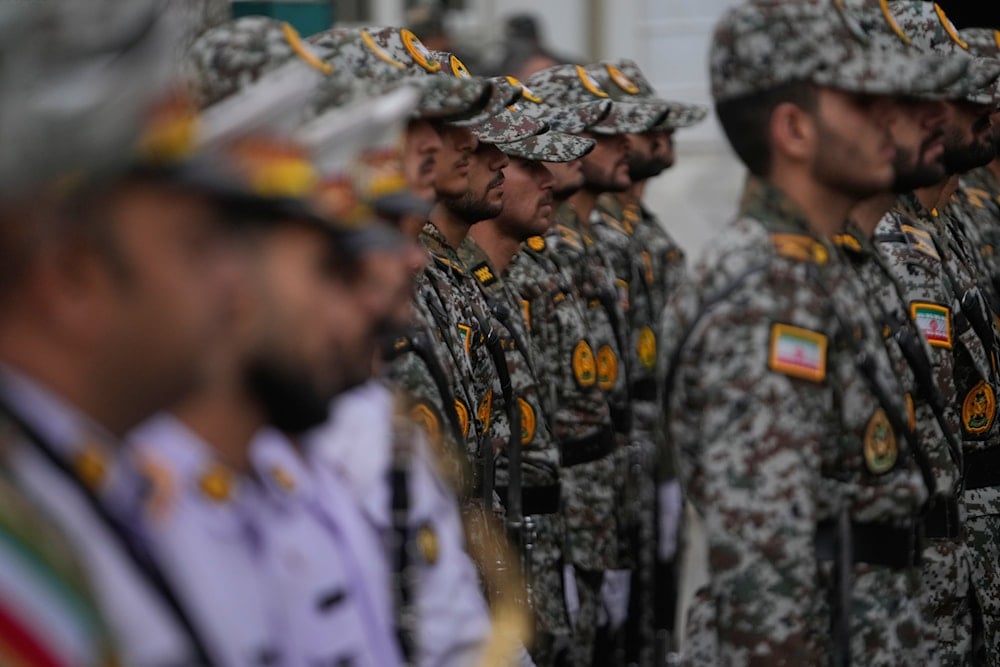
Iranian army cadets stand during the opening ceremony of one of the military training centers for volunteers being set up throughout squares in downtown Tehran, Iran, Saturday, Oct. 3, 2026 (AP)
Iran is fighting and holding talks with the United States at the same time, based on a strategy of firmness and rationality, Iranian Parliament Speaker Mohammad Bagher Ghalibaf said on Sunday.
In a speech during a parliament session, Ghalibaf revealed that Washington has presented proposals through mediators, despite their recent media claims otherwise, calling on the US to accept the fact that the era of wasting time and imposing unilateral demands has passed.
He stressed that Tehran is "present on the field with its full strength and will confront the enemy with new surprises," vowing that it will never allow enemies to achieve their illusions and plans under the guidance of the Leader of the Revolution and the Islamic Republic."
Iran's position is evident, Ghalibaf explained, specifying that "the Strait of Hormuz will not be opened until our seven conditions stated in the Islamabad Memorandum of Understanding are met." The parliament speaker also indicated that the United States is seeking to manipulate Iran's strategic calculations by broadcasting conflicting news, stressing that these efforts will remain nothing but an illusion.
Iran will use diplomacy to consolidate military superiority
Ghalibaf stressed that Iran will use diplomatic tools to consolidate its military superiority and impose the rights of the Iranian people, reiterating the equation that "the victor in talks is the one who has prepared for war." He affirmed that Tehran is neither eager nor afraid in this confrontation.
Furthermore, he noted that Iran and the Resistance front are today at the peak of their power, while the domestic front enjoys the highest degrees of national cohesion and field cohesion, adding, "Despair and impotence have not only inflicted the Zionist entity, but have also reached the Americans to the point of impotence in the face of the resistance of the Iranian people."
Decline of Israeli deterrence, 'national security' doctrine
As the third anniversary of Operation Al-Aqsa Flood approaches, Ghalibaf said October 7 constitutes "a fundamental turning point that divided the region's history into a before and after, after Palestinian fighters transformed the Israeli security establishment’s false sense of security into a permanent state of fear.”
The parliament speaker concluded his remarks by affirming that "the Israeli entity has been exposed before global public opinion and has suffered an irreparable defeat," noting that "the pillars of the national security doctrine of the Zionist entity collapsed completely on October 7 and cannot be rebuilt by any operation or budget."
These statements come amid escalating US economic pressure on Iran, with the imposition of expanded economic sanctions on various sectors, in addition to the ongoing blockade on Iranian ports and coasts, following the US-Israeli aggression against the country.
Recently, the two sides exchanged proposals and responses regarding reaching a roadmap for an agreement to end the war, through regional mediators, foremost among them Qatar.
Trump rejects Iran's Strait of Hormuz plan, mulls renewed war
This closely follows US President Donald Trump's rejection of a proposal from Tehran for a seven-day Hormuz reopening plan, as he considers new strikes after the US midterm elections, The Wall Street Journal reported on September 26, citing US officials.
According to the WSJ, Trump doubts that Iran will accept the conditions set by Washington and has told his aides that further strikes are likely. The report also said the United States informed Iran and mediators involved in the talks that Trump does not plan to lift the naval blockade of the Strait of Hormuz.
Iranian Foreign Minister Abbas Araghchi said Tehran delivered a seven-day plan to the United States through Qatar that would pave the way for reopening the Strait of Hormuz, stressing that maritime traffic cannot return to normal under economic pressure.
Speaking to reporters outside the United Nations headquarters in New York, Araghchi accused Washington of resorting to threats and assassinations against Iran, saying that more than 5,000 Iranians were killed during the US-Israeli aggression against the country.
Tehran has also outlined seven conditions for restoring maritime traffic through the strategic passage, demanding that Washington fulfill these conditions before the reopening of the strait.
These conditions include:
- Ending all military and hostile actions, including those in Lebanon;
- Releasing frozen Iranian assets;
- Lifting the naval and oil blockade;
- Removing economic and political sanctions;
- Withdrawing US naval and air forces from near Iran;
- Providing compensation for war-related damages
- Ending US threats and insults.
"When the United States accepts our conditions, the seven-day plan to open the strait begins," Araghchi said.


