
Iran sets penalties for ships violating Hormuz transit rules
 3 Min Read
Iran's parliamentary National Security Committee approved provisions imposing penalties of 20% of cargo or its value and temporary detention on vessels violating proposed Strait of Hormuz transit regulations.
-
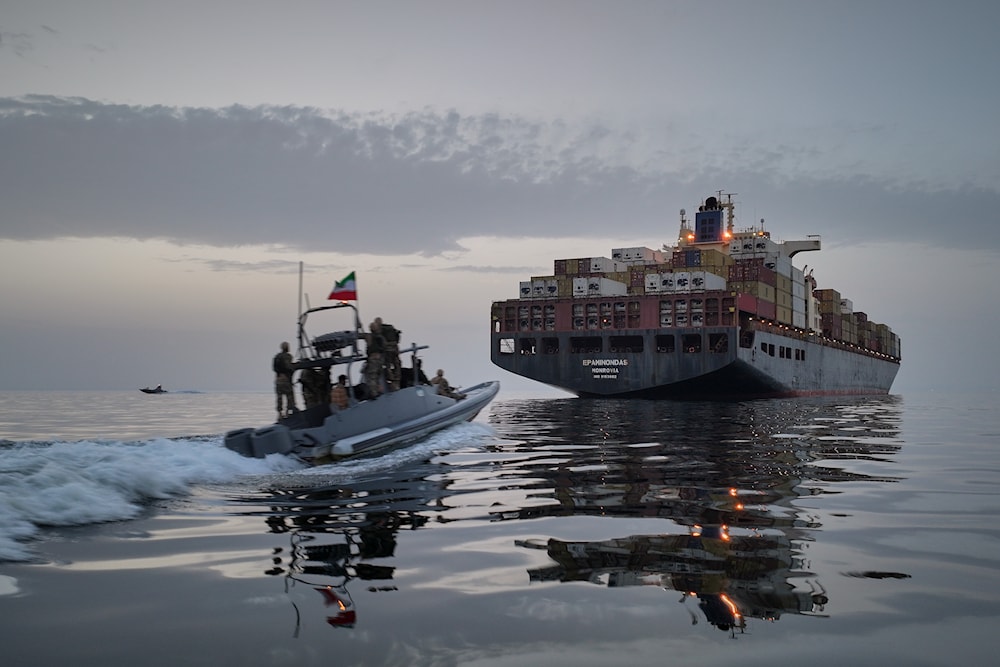
FILE - In this photo released by Tasnim News Agency, a Revolutionary Guard Navy (IRGC) speedboat approaches the cargo ship Epaminondas during what state media described as the seizure of one of two vessels accused of violations in the Strait of Hormuz, April 21, 2026 (Meysam Mirzadeh/Tasnim News Agency via AP, File)
Iran’s Parliamentary National Security and Foreign Policy Committee approved new provisions on Tuesday establishing penalties for vessels that violate regulations governing passage through the Strait of Hormuz, including fines equivalent to 20% of their cargo or its value and temporary detention until the penalty is paid.
Committee spokesperson Hassan Qashqavi said Articles 13, 14 and 15 of the proposed Strategic Action Plan for Ensuring the Security and Sustainable Development of the Strait of Hormuz were approved during the committee's latest meeting. Article 16 is expected to undergo further discussion at a later session.
Violating vessels face fines, temporary detention
Under Article 13, vessels that fail to comply with regulations governing their passage through the Strait of Hormuz would be subject to penalties stipulated under Iran's Islamic Penal Code.
Qashqavi said violating vessels would be required to surrender an amount equivalent to 20% of their cargo or 20% of its value and could be temporarily detained until the required penalty is paid.
The provision also requires Iran's judiciary to establish specialized judicial branches to handle cases arising from the legislation.
These branches would include judges and experts specializing in maritime law and the law of the sea, creating a dedicated legal mechanism for addressing violations related to navigation through the strategic waterway.
Penalties for obstructing implementation
Article 14 addresses actions that impede implementation of the proposed legislation.
According to Qashqavi, any individual or legal entity whose actions or failure to act prevent the law from being implemented properly, completely or within the required timeframe would face a Grade 5 punishment under Article 19 of Iran's Islamic Penal Code, unless another law provides for a more severe penalty.
The article also stipulates that any bilateral or multilateral international agreement concerning the Strait of Hormuz must be concluded within the framework of Articles 77, 125, 176 and 57 of the Iranian Constitution.
The provisions cited cover constitutional requirements concerning international agreements, state authority and national security decision-making.
Armed Forces to submit quarterly reports
Under Article 15, Iran's Armed Forces General Staff would be required to provide Parliament's National Security and Foreign Policy Committee with a report every three months detailing implementation of the legislation.
The reports may be submitted directly by the General Staff or through the Ministry of Defense.
The latest approvals form part of a broader parliamentary effort to establish a regulatory framework for navigation through the Strait of Hormuz.
Earlier provisions considered and approved by the committee include mechanisms for charging vessels for services provided by Iran and restrictions affecting countries, organizations and entities that Tehran considers to have imposed unilateral sanctions or carried out hostile actions against the Islamic Republic.
The Articles approved by the committee remain part of proposed legislation and would still require completion of the legislative process before becoming law.
Read more: Iran says Hormuz to reopen within 7 days if US lifts blockade: Reuters


