
Iran shot down US Apache over Strait of Hormuz, Trump claims
 5 Min Read
President Trump has announced that Iran shot down a US Apache helicopter over the Strait of Hormuz, that the two pilots are safe, and that the United States "must, of necessity, respond to this attack."
-
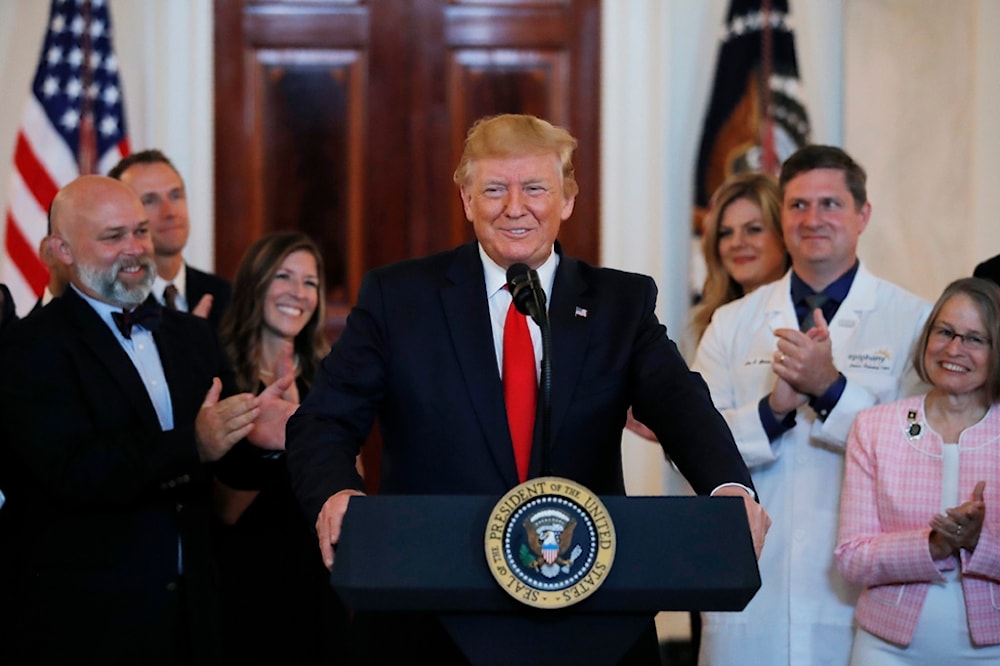
President Donald Trump speaks during a ceremony at the White House in Washington, June 24, 2019. (AP)
US President Donald Trump has announced that Iran shot down an American Apache helicopter over the Strait of Hormuz, adding that both pilots are safe and uninjured, but that the United States "must, of necessity, respond to this attack."
In a post on Truth Social, Trump wrote: "I have just been informed by our Great Military that last night the Iranians shot down one of our highly sophisticated Apache Helicopters while patrolling over the Strait of Hormuz. There were two pilots involved, both are safe and uninjured. Nevertheless, the United States must, of necessity, respond to this attack."
The US president provided no further details about his claims, including when exactly it occurred or the specific location within the Strait of Hormuz. He concluded his post with: "Thank you for your attention to this matter!"
Iran has not yet commented on the claim
There was no immediate comment from Iranian officials regarding Trump's allegation. Tehran has consistently maintained that its actions in the Strait of Hormuz are lawful defensive measures under international law, taken in response to unprovoked US-Israeli aggression that began on February 28.
Iran has previously warned that any US military vessels or aircraft entering Iranian territorial waters or airspace would be met with a decisive response.
Tehran has also repeatedly stated that it will not allow the strait to become a source of instability and that it retains the right to defend its sovereignty.
Incident threatens fragile ceasefire
The reported downing of a US military aircraft threatens the already fragile ceasefire that has been in place since April 7, following the initial phase of the US-Israeli war on Iran.
The United States has maintained an illegal naval blockade on Iranian ports, while Iran has kept the Strait of Hormuz closed to normal military and commercial traffic it deems hostile.
Trump's vow to respond raises the possibility of a new escalation in the war, which has already caused thousands of casualties, disrupted global energy markets, and drawn in multiple regional powers. Any US military response could potentially shatter the ceasefire entirely and lead to a wider regional war.
Context: Trump has claimed Iran deal 'imminent' 38 times since March without result
Trump's latest threat to respond to the downing of the Apache helicopter comes amid a long pattern of unfulfilled promises about ending the war and securing a deal with Iran. President Trump has repeatedly claimed that a deal with Iran is imminent, making at least 38 direct statements since March suggesting that an agreement is just days away, that Tehran is desperate to cut a deal, or that the war is nearly over, yet no deal has materialised, according to an analysis by The Washington Post's Aaron Blake.
More than two months have passed since Trump announced a ceasefire with Iran on April 7, declaring that the two sides were "very far along" and needed only two weeks "for the Agreement to be finalized and consummated." No resolution has come. Blake's analysis finds that Trump has made such claims at least 38 times, including in social media posts, public appearances and phone calls with the media. There is no indication that a deal is any closer today than it was on April 7.
Trump's predictions began on March 23, less than a month into the US-Israeli war on Iran, when he claimed "major points of agreement", even as Iran denied that any negotiations were taking place. After announcing the ceasefire on April 7, Trump's predictions grew more frequent and more specific, including claims that Iran had "agreed to everything" and that a deal would come "in the next day or two." On April 17 alone, he made three separate claims about an imminent agreement.
Two months later, Trump continues to insist a deal is imminent. As recently as Tuesday, after attending the NBA Finals, he told reporters that the sides were "in final throes of what will be a very, very good deal," adding that the Strait of Hormuz "will open up immediately upon signing, which could be in two or three days."
Blake concludes that Trump's repeated claims should no longer be taken seriously. Despite 38 promises, no deal has materialised, and Iran continues to insist on the release of frozen assets, recognition of its control over the Strait of Hormuz, and the complete lifting of sanctions before any agreement can be finalised. Trump's latest claim about an Apache shootdown, and his vow to respond, follows the same pattern of unverified assertions and threats that have characterised his approach to Iran throughout the war.


