
Sheikh al-Qomi calls on Muslim nations to convey the truth | Exclusive
 7 Min Read
Iranian cleric Sheikh Mohammad al-Qomi discusses Iran’s culture, hybrid warfare, youth engagement, and regional resistance strategy in an in-depth interview with Al Mayadeen.
-
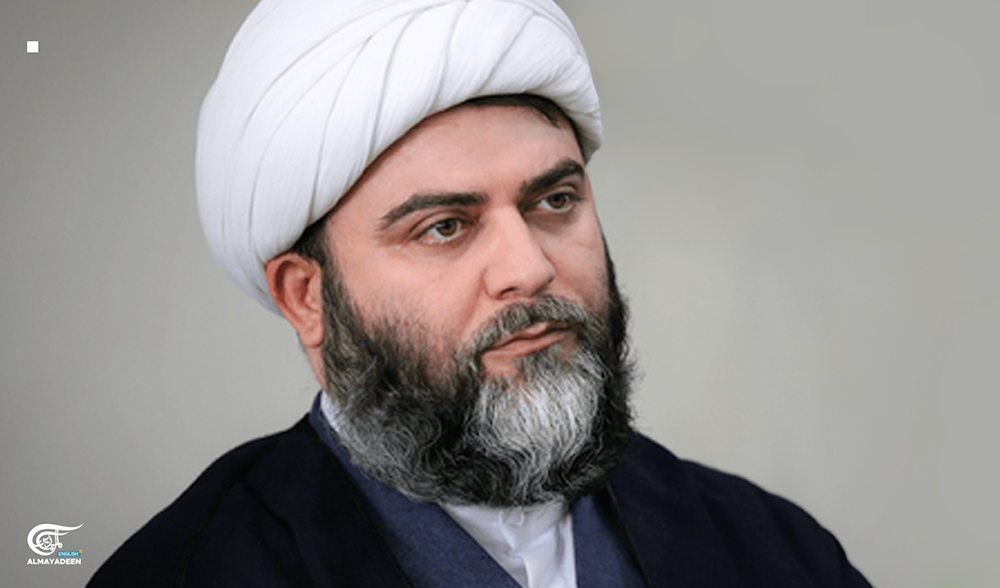
Senior Iranian cleric Sheikh Mohammad al-Qomi. (Illustrated by: Al Mayadeen/Fatima Attieh)
In a wide-ranging interview with Al Mayadeen, senior Iranian cleric Sheikh Mohammad al-Qomi outlined a deeply entrenched model of cultural and political mobilization in the Islamic Republic, arguing that cultural work, warfare, and public resistance are ultimately rooted in popular will rather than institutional direction.
Speaking amid preparations for the funeral procession for Iran's martyred leader, Sayyed Ali Khamenei, al-Qomi expanded on Iran’s concept of "popular war" and doctrine of Jihad al-Tabyeen (Jihad of Clarification), the role of cultural institutions, and Tehran’s regional alignments, particularly with Lebanon and the Palestinian cause.
Culture as an extension of popular will
Sheikh al-Qomi stressed that cultural activity in Iran originates from the people themselves, while institutions play a supportive role rather than a directive one.
“I would like to emphasize that cultural work springs from the people themselves”, he said, adding that when Iranians decide to protest against American arrogance, cultural and religious institutions act as enablers rather than leaders.
These institutions, he said, provide “the platform through which the people can express their positions in popular demonstrations and on the ground,” including artistic and media forms such as graphics, caricature, performances, anthems, and music.
In an exclusive interview with Al Mayadeen, the Head of the Islamic Development Organization, Sheikh Mohammad al-Qomi, stresses that Iran's ongoing confrontation with the United States and "Israel" is fundamentally driven by a popular, society-wide mobilization.
— Al Mayadeen English (@MayadeenEnglish) July 3, 2026
Speaking on the… pic.twitter.com/TYa7GT6euy
“The people are the true agents of cultural action, while cultural institutions provide the support and the means,” he said, arguing that this framework allows public expression to develop more freely and effectively.
He added that when people take to the streets “driven by their zeal and sense of dignity,” institutional work becomes easier and more expansive, while restricting public participation limits expression.
‘Jihad of Clarification’ deeper after war
When asked about the concept of Jihad al-Tabyeen (Jihad of Clarification), introduced by Sayyed Ali Khamenei, Sheikh al-Qomi said the doctrine had become more essential in the aftermath of the US-Israeli aggression on the region.
“It has become both deeper and more necessary,” he said, praising Iranian society as “exceptional and noble” and receptive to Quranic teachings and resistance narratives.
He argued that the Iranian public does not fall for political manipulation, saying it cannot be deceived by statements from Western or Israeli leaders. “We are not deceived by the posts or statements of Netanyahu or Trump,” he said, adding that the public increasingly seeks “profound awareness and careful analysis.”
Sheikh al-Qomi described Jihad of Clarification as simultaneously a religious duty and a social necessity, saying it has gained greater influence following the martyrdom of its leader. He added that citizens are now actively applying this framework in public life, taking ideas to the streets and spreading them across society.
A ‘hybrid war’ across multiple fronts
Asked whether the war was primarily military or also narrative-based, Sheikh al-Qomi said it should be understood as a “hybrid war.”
“We describe it as a hybrid war, a multifaceted war fought simultaneously across different fronts,” he said, defining it as economic, military, political, and media-based at once.
He stressed that Iran’s relationship with Lebanon extends beyond military cooperation, emphasizing shared political and social destiny. “There is an expression in Persian: ‘We are partners in blood,’” he said. “It means that our blood has become intertwined.”
Sheikh al-Qomi also invoked another phrase: “Our destiny is one,” comparing Iran and its regional allies to a single family sharing the same fate. "The happiness of one belongs to all, just as hardship is borne collectively by every member of the family."
He stressed that the aggression has reinforced a shared trajectory with Lebanon across all dimensions of the confrontation.
‘Popular war’ led by Iranian society
Throughout the interview with Al Mayadeen, Sheikh al-Qomi devoted significant attention to the popular nature of Iran’s wartime posture, arguing that the Iranian people themselves form the backbone of national resistance.
“We have an initiative in Iran known as Fida Iran [Devotion to Iran], in which 32 million Iranians participated,” he said, revealing that the participants pledged readiness to sacrifice themselves in defense of the country against the US, "Israel", and any other adversary.
He described the war as fundamentally “popular,” with citizens participating across military, economic, cultural, and technological domains.
Sheikh al-Qomi added that civilians volunteered alongside missile units, assisted families of the martyred, underwent rapid training, and engaged in cyber and artificial intelligence-related fields.
He said that Iran’s armed forces, including the Islamic Revolution Guard Corps and the army, operate in specialized domains, while society as a whole sustains psychological, economic, and industrial resilience.
“We are speaking about a very different kind of war, one whose central axis is the people and the institutions that support them. The people have entered this war with determination, it is an entirely different kind of conflict”, he said.
Palestine's liberation is a belief, not a slogan
Turning to the Palestinian struggle, Sheikh al-Qomi said global support for Palestine was growing among “free and sincere” populations across the world, despite fear among some political leaders.
He linked recent regional developments, including the events of Al-Aqsa Flood, Lebanon’s Resistance, and Iraq and Iran’s positions, to strengthening the Palestinian cause. “The Palestinian cause grows more significant with each passing day,” he said, adding that the “liberation of al-Quds and the collapse of Israel” is inevitable.
“For us, this is not a slogan but a belief. We are convinced this will happen, and that day is not far away,” he said.
Speaking to Al Mayadeen, the Head of the Islamic Development Organization, Sheikh Mohammad al-Qomi, said that despite the hesitation of certain global and regional officials, public alignment with the Palestinian cause continues to expand globally.
— Al Mayadeen English (@MayadeenEnglish) July 3, 2026
Reflecting on regional… pic.twitter.com/vZke92DZe8
Youth, media influence, and ideological shifts
Sheikh al-Qomi also addressed concerns over youth engagement in Iran’s digital environment, arguing that foreign media seeks to distort perceptions of the Islamic Republic.
He said Iranian society has historically resisted oppression and cannot spiritually accept domination or arrogance.
While acknowledging that propaganda had influenced segments of youth in the past, including slogans such as “Neither Gaza nor Lebanon, my soul is a sacrifice for Iran,” he said perceptions have since dramatically shifted.
Many young Iranians, he said, changed their views after recognizing Palestinian and Lebanese “sacrifice” and “oppression.” He also cited initiatives in which Iranian women donated gold and personal valuables to Gaza and Lebanon as evidence of shifting sentiment.
“Truth will not remain hidden behind clouds forever,” he said, adding that the Iranian youth ultimately “seek truth and defend it.”
Lebanon, mourning, and shared destiny
Addressing preparations for the funeral procession for Sayyed Ali Khamenei, Sheikh al-Qomi emphasized Iran’s close ties with Lebanon and shared regional struggles. “We are brethren. Our flesh and blood are one. Our destiny is one,” he said.
He stated that both Iranian and Lebanese people share in mourning across regional losses and reaffirmed continued commitment to resistance, adding that the gathering is intended to signal that such events do not mark the end of Resistance, but rather reaffirm its continuity.
Quoting a Quranic verse as a central slogan of the procession, “Say, I advise you to do one thing: rise for God, in pairs or individually, and then reflect,” he described it as a guiding principle for mobilization.
He concluded the interview with Al Mayadeen by invoking a broader ideological framework established by Iran’s founding leadership, stating, "Our late Imam and founding leader said that we have created a new framework in the world, defending every oppressed person and confronting and fighting every oppressor."
Al Mayadeen English’s envoy to Iran, Karim Sharara, reports from Tehran’s Vali Asr Square, where preparations are in full swing for the funeral procession of Iran’s martyred leader, Sayyed Ali Khamenei.
— Al Mayadeen English (@MayadeenEnglish) July 2, 2026
While the cities of Qom and Mashhad have nearly completed their… pic.twitter.com/SZ8QPYwjrh


