
'US interests sacrificed for Israel'; Iravani at UN slams US hypocrisy
 8 Min Read
Iran's UN envoy accused Bahrain of facilitating aggression on Tehran, defended Iran's military response, and called for full implementation of the Islamabad MoU.
-
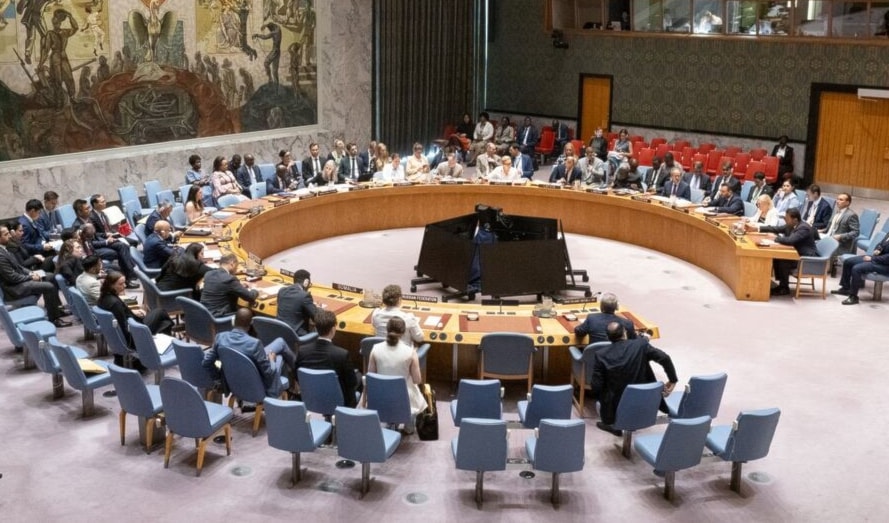
A wide view of the UN Security Council meeting on the situation in West Asia (UN)
The UN Security Council convened the emergency session at the request of Bahrain and Jordan as the US-Iran ceasefire faced renewed pressure following US aggression against Iran and its repercussions on commercial shipping in the Strait of Hormuz.
During the session, Iran's Permanent Representative to the United Nations, Amir Saeid Iravani, accused Bahrain of facilitating aggression against Iran and defended Tehran's military response during an emergency meeting of the UN Security Council, where member states debated renewed tensions despite a fragile ceasefire.
Iravani said the US representative had presented false information and was speaking on behalf of a country that, alongside "Israel", had carried out unlawful aggression against Iran in violation of international law.
He said the United States and "Israel" had targeted schools and hospitals and had publicly boasted, through statements by the US president and senior aides, about the killing of thousands of Iranian civilians.
'Double standards, hypocritical behaviour'
"The facts are clear," Iravani said. "Amid negotiations, together with the Israeli regime, the United States betrayed diplomacy twice and launched two wars of aggression against Iran in blatant violation of the UN Charter and international law."
"Iran is the main victim of the wars of aggression launched by the United States and the Israeli regime. The role of the victim and the aggressor must not be reversed," he stressed.
Rejecting accusations leveled by Western Security Council members and Bahrain, Iravani said, "Instead of addressing the root cause of the current crisis, they have ignored the unlawful aggression committed against Iran and sought to shift blame onto the victim."
"Their double standards and hypocritical behaviour have deprived them of any credibility to lecture others," he emphasized.
Tehran defends right to self-defense
Despite those actions, the top Iranian figure said Iran had continued negotiations in good faith through talks facilitated by Pakistan that resulted in the June 17 memorandum.
Iravani added that Iran would continue pursuing negotiations under the sponsorship of Pakistan and Qatar, stressing that the memorandum requires the United States to negotiate in good faith. If Washington adopts a distorted interpretation of the agreement, Iran would reserve the right to respond.
He went on to say that Iran remains committed to ensuring safe and free passage during a 60-day period in accordance with the memorandum while rejecting any transit arrangement that does not conform to the Iranian-Omani framework.
"The priority must be the full implementation of the MoU and the continuation of negotiations towards a comprehensive deal," he stated, urging the Security Council to support the process, encourage full compliance with the memorandum and "refrain from provocative actions that could undermine diplomacy or further escalate tensions."
Gulf Security and Bahrain
The top Iranian official also asserted that countries including Bahrain had facilitated the aggression on Iran, saying "this is beyond any doubt."
He argued that Gulf states should recognize that the US military presence brings "nothing but insecurity."
"The US has no coastal border in our region. It is not their waters. It is not their neighborhood," he said.
It is worth noting that Iran has repeatedly said that US military bases and economic assets in the Gulf region have been used to launch acts of aggression against Iran, including strikes that have resulted in civilian casualties. In this framing, any Iranian action targeting such facilities is a retaliation against hostile military activity originating from or enabled by those bases.
Responding to the US representative, Iravani added that "American interests are being sacrificed for the Israelis'."
He also said the world would witness the popularity of Iran's political system during the funeral of the martyred leader, Sayyed Ali Khamenei.
On Wednesday, Iravani warned against a public threat by Israeli War Minister Yoav Katz against Iranian Leader Sayyed Mojtaba Khamenei, saying Tehran viewed the remarks with "utmost seriousness."
UN calls for restraint and continued diplomacy
Elizabeth Spehar, Assistant Secretary-General for Political and Peacebuilding Affairs, warned that each new strike risked triggering a broader regional war and confirmed that indirect US-Iran talks in Doha remain underway.
The UN Secretariat condemned attacks on civilian infrastructure, called for unrestricted freedom of navigation, and welcomed the mutual ceasefire agreement and ongoing mediation efforts under Qatari sponsorship.
'A victory for diplomacy': Pakistan
On his part, Pakistan's Permanent Representative, Ambassador Asim Iftikhar Ahmad, described the Islamabad Memorandum of Understanding as "a victory for diplomacy."
He said Pakistan had intensified diplomatic engagement to facilitate implementation of the agreement and confirmed that Pakistan and Qatar held separate meetings in Doha with US and Iranian negotiators.
"The fact that the talks are continuing and the parties are at the negotiating table is a significant positive outcome," he stressed. "The channels of communication remain open."
US once again threatens Iran amid talks
US Ambassador Michael G. Waltz claimed Iran's actions had disrupted global commerce.
"Iran cannot, and we cannot allow it to, hold the world's economy hostage," he said, adding that Tehran had prevented ships from transiting the Strait of Hormuz.
"It didn't matter if the ship was carrying fertilizers to farmers in Africa, aid to Sudan, fuel to Japan, or whether they were involved in this conflict or not," he alleged.
Waltz disputed Iran's assertion that it had targeted only military sites, citing findings by the UN Trade and Development Agency that "closure of the Strait of Hormuz would have lasting consequences for 61 developing economies."
"So many innocent civilians around the world are being affected," he further claimed.
Referring to UN resolution 2817 (2026), Waltz said, "Bahrain, our Gulf Arab allies and others rallied a record-breaking 136 co-sponsors who spoke with one voice."
"Iran must stop its attacks on its neighbors and leave an international waterway open for all," he said.
Despite recent diplomatic agreements, including the memorandum of understanding signed two weeks earlier, Waltz claimed that Iran "still hasn't shown the world a basic level of decency and respect."
"I cannot stress enough the possibility of real transformative positive opportunity for the nation and people of Iran is on the table," he said, threatening that "President Trump’s patience is not unlimited."
What actually happened
The latest escalation followed a series of earlier incidents rather than emerging suddenly.
On June 20, Iran’s Islamic Revolution Guard Corps (IRGC) Navy affirmed that the Strait of Hormuz is closed to all ships and naval vessels, in response to Israeli aggression.
Israeli occupation forces (IOF) carried out a fresh wave of attacks across southern Lebanon and western Bekaa at the time, killing at least 37 people and extending a pattern of aggression that has persisted despite an alleged ceasefire in place since April 17, 2026.
In a statement, the IRGC Navy cited Israeli crimes in Lebanon and Washington’s violation of its ceasefire commitments as the catalysts for the closure of the strategic waterway.
Furthermore, it has warned vessels not to approach the Strait of Hormuz, "otherwise, their security will be at risk."
The US Central Command (CENTCOM) announced that it carried out additional strikes between June 27 and June 29 against Iranian military infrastructure in southern Iran, claiming the operation was conducted in response to "Iranian attack on an oil tanker."
According to CENTCOM, the strikes targeted military surveillance infrastructure, communications systems, air defense sites, drone storage facilities, and naval mine-laying capabilities.
The latest act of aggression follows US strikes on Iranian military sites a day earlier, which Washington said were carried out in response to Iran's alleged targeting of a commercial vessel transiting the Strait of Hormuz.
CENTCOM previously said those attacks targeted missile and drone storage facilities, as well as coastal radar installations, claims that remain unverified and could be seen as a pretext for violating the ceasefire.
In response, the Islamic Revolution Guard Corps (IRGC) said it had targeted US military sites in the region and warned that any further American attacks would trigger a broader retaliation.
The latest escalation comes despite the signing of a memorandum of understanding intended to end hostilities and launch a 60-day negotiation process toward a comprehensive agreement. Iranian officials have described the US strikes as a clear violation of that understanding and warned that any future breaches would be met with a decisive response.


