
Hormuz traffic at zero as renewed US aggression fuels instability
 6 Min Read
Shipping activity in the Strait of Hormuz declines significantly following renewed US aggression against Iran, intensifying concerns over oil supply security.
-
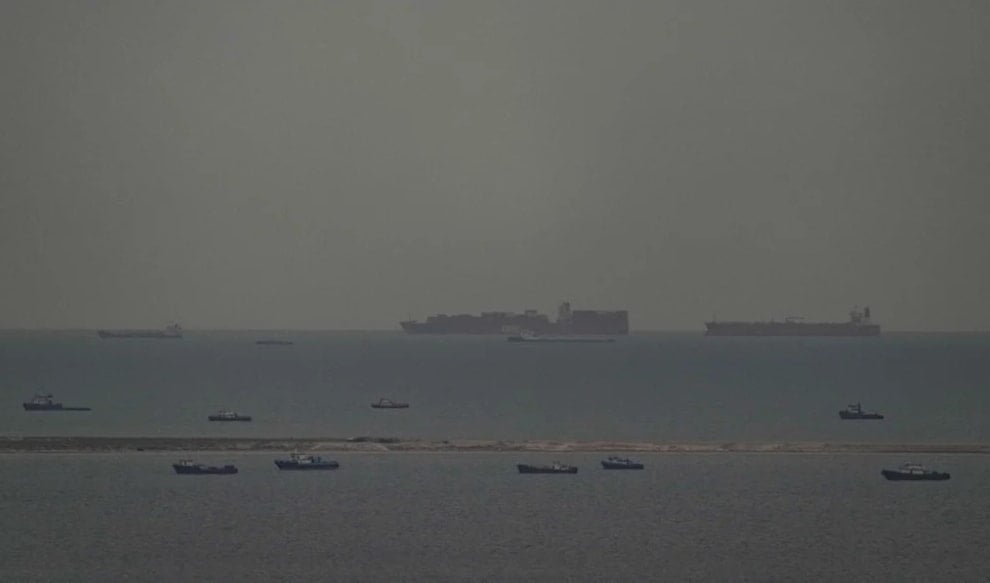
Fishing boats dot the sea as cargo ships, in the background, sail through the Gulf toward the Strait of Hormuz off the United Arab Emirates, March 27, 2026 (AP)
The Strait of Hormuz remains in a severely disrupted maritime state, with the latest HormuzTracker dashboard showing no active commercial vessel transits in real time.
According to the live AIS-based monitoring system, the current snapshot indicates:
- Active ships transiting now: 0
- Outbound vessels today: 0
- Inbound vessels today: 0
- 24-hour crossings: 0
- Hourly movement: No recorded traffic in the last 8 hours
This confirms a continued complete halt in detected commercial navigation activity, with no crude oil tankers, LNG carriers, bulk carriers, or container ships recorded moving through the Strait during the latest update window.
Traffic trend remains at zero activity
The tracker’s “Today's Transit Summary” shows that all vessel categories, including crude tankers and product/LPG carriers, remain at zero live movement and zero completed exits, indicating that the chokepoint is still effectively non-operational for outbound shipping at this time.
This continues a broader pattern observed in the system’s historical data, where recent days have consistently shown either extremely reduced flows or complete stagnation, depending on AIS detection availability and routing restrictions.
Operational interpretation
With no vessels broadcasting active movement in the monitored radius, the Strait is currently functioning as a non-flow maritime corridor, where:
- Commercial outbound shipping remains paused;
- No energy cargo movements are detected;
- AIS signals show no verified crossings in the latest cycle.
-
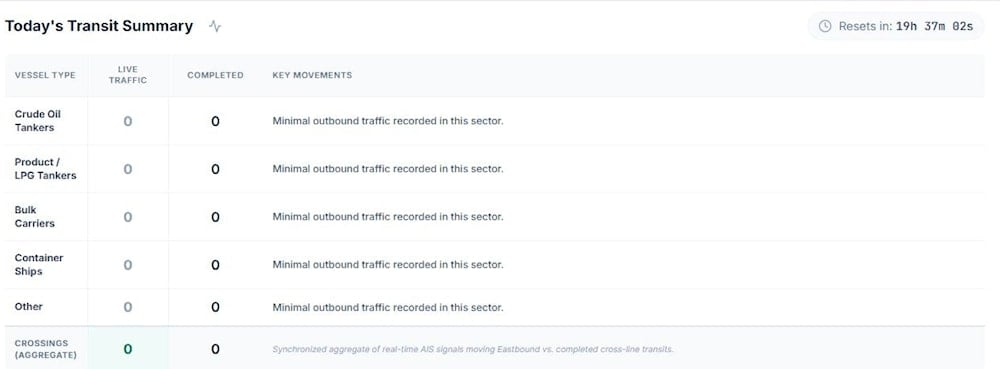
Transit summary of the Strait of Hormuz on June 30, 2026 (hormuztracking.com)
As of today’s tracker update, the Strait of Hormuz is in a zero-traffic phase, with maritime movement effectively halted according to live AIS detection data from HormuzTracker.
Vessel transits fall sharply following US aggression
The number of vessels passing through the Strait of Hormuz fell from a high of 74 ships on June 24 to just 22 by June 28, according to maritime analytics firm Kpler. The decline of approximately 70% over four days coincided with a new wave of US aggression on Iranian targets carried out between June 27 and June 29, 2026.
The Strait of Hormuz is a narrow waterway between Iran and Oman through which roughly 20% to 25% of global seaborne oil trade passes. When shipping operators reduce crossings or pause operations, the consequences quickly extend to global fuel prices, supply chains, and wider energy markets.
Oil prices started to rise on June 29 as traders factored in the renewed risk of disruption to supply flows.
As concerns over supply security returned, oil benchmarks moved higher on June 29. Market participants adjusted pricing in response to the increased likelihood of further interruptions to shipments moving through the strait.
What actually happened
The latest escalation followed a series of earlier incidents rather than emerging suddenly.
On June 20, Iran’s Islamic Revolution Guard Corps (IRGC) Navy affirmed that the Strait of Hormuz is closed to all ships and naval vessels, in response to Israeli aggression.
Israeli occupation forces (IOF) carried out a fresh wave of attacks across southern Lebanon and western Bekaa at the time, killing at least 37 people and extending a pattern of aggression that has persisted despite an alleged ceasefire in place since April 17, 2026.
In a statement, the IRGC Navy cited Israeli crimes in Lebanon and Washington’s violation of its ceasefire commitments as the catalysts for the closure of the strategic waterway.
Furthermore, it has warned vessels not to approach the Strait of Hormuz, "otherwise, their security will be at risk."
The US Central Command (CENTCOM) announced that it carried out additional strikes between June 27 and June 29 against Iranian military infrastructure in southern Iran, claiming the operation was conducted in response to "Iranian attack on an oil tanker."
According to CENTCOM, the strikes targeted military surveillance infrastructure, communications systems, air defense sites, drone storage facilities, and naval mine-laying capabilities.
The latest act of aggression follows US strikes on Iranian military sites a day earlier, which Washington said were carried out in response to Iran's alleged targeting of a commercial vessel transiting the Strait of Hormuz.
CENTCOM previously said those attacks targeted missile and drone storage facilities, as well as coastal radar installations, claims that remain unverified and could be seen as a pretext for violating the ceasefire.
In response, the Islamic Revolution Guard Corps (IRGC) said it had targeted US military sites in the region and warned that any further American attacks would trigger a broader retaliation.
It is worth noting that Iran has repeatedly said that US military bases and economic assets in the Gulf region have been used to launch acts of aggression against Iran, including strikes that have resulted in civilian casualties. In this framing, any Iranian action targeting such facilities is a retaliation against hostile military activity originating from or enabled by those bases.
The latest escalation comes despite the signing of a memorandum of understanding intended to end hostilities and launch a 60-day negotiation process toward a comprehensive agreement. Iranian officials have described the US strikes as a clear violation of that understanding and warned that any future breaches would be met with a decisive response.
Why shipping firms are pulling back
The fall from 74 daily transits to 22 in just four days reflects real-time risk assessments being made across multiple shipping operators.
Historically, traffic through the Strait of Hormuz has declined sharply during periods of active US-Israeli aggression on Iran and partially recovered during ceasefires. The current movement aligns with that established pattern.
Rerouting vessels around the Arabian Peninsula is possible but adds weeks to voyage times and significantly increases costs, making it viable for only some cargo types. For time-sensitive crude shipments, such diversions are far more difficult to justify.
Implications for energy markets and global trade
In the short term, disruptions of this kind are typically offset by strategic reserves and adjustments in spot markets. However, prolonged interruptions lasting weeks rather than days can begin to create genuine supply shortages that cannot be fully covered by reserves alone.
The mid-June ceasefire showed that diplomatic de-escalation remains possible. However, repeated breakdowns in such agreements may weaken confidence in future truce efforts.
Energy companies with large tanker fleets operating in the Gulf, refiners dependent on Gulf crude, and broader portfolios with exposure to the energy sector are all facing a risk environment that has deteriorated significantly over the course of just four days due to the US not being committed to the MoU.
Read next: Iran ties US compliance to progress on MoU implementation


