
Iran urges Americans to question legality of US war
 3 Min Read
Iran urges Americans to question the legality of the US war, citing aggression, failed talks, and ongoing Hormuz blockade tensions.
-
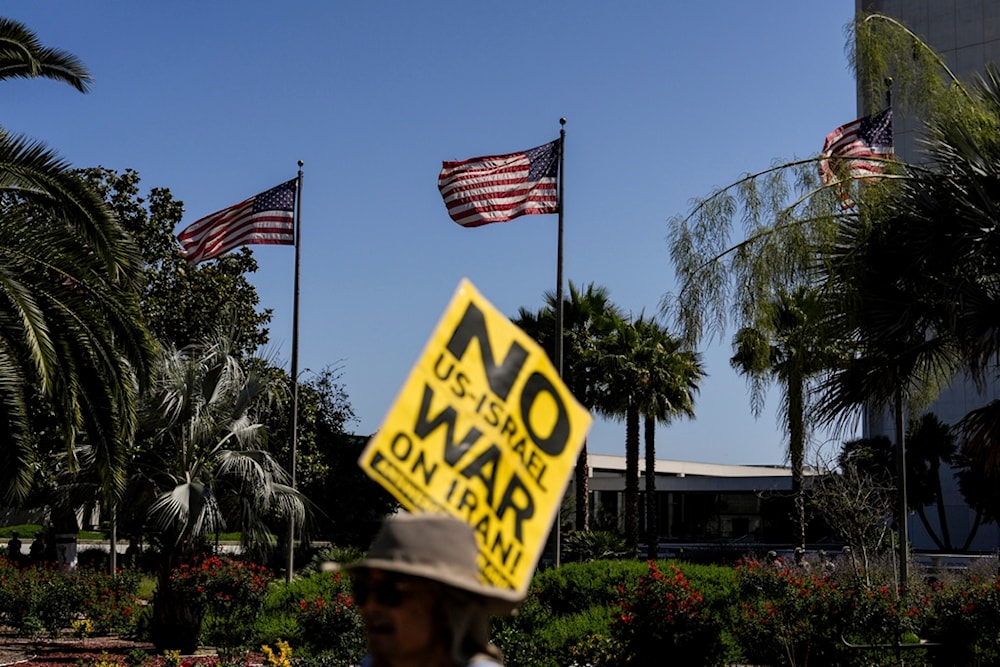
An anti-war demonstrator holds a sign outside the Wilshire Federal Building in Los Angeles on June 22, 2025, following US airstrikes on Iran. (AP Photo/Jae C. Hong)
Iran’s Foreign Ministry spokesperson Esmaeil Baghaei has called on the American public to scrutinize the legality of Washington’s military campaign against Iran, urging accountability for what he described as an unlawful war.
In a statement published on X, quoting comments by US Senator Kirsten Gillibrand, Baghaei said, "It is beyond dispute that the US administration’s 'war of choice' against Iran was a clear, unprovoked act of aggression".
It is beyond dispute that the U.S. administration’s “war of choice” against Iran was a clear, unprovoked act of aggression.
— Esmaeil Baqaei (@IRIMFA_SPOX) May 1, 2026
The American public has both the undeniable right and the solemn duty to demand accountability from their ruling authorities for waging this illegal war… pic.twitter.com/VpOJ0tSwIc
He stressed that Americans have both the right and the responsibility to question their leadership over the decision to launch the war and its consequences.
'War of choice' framed as Illegal Aggression
Baghaei characterized the US-led campaign, conducted in coordination with "Israel", as a deliberate and unjustified escalation. He argued that the war represents a violation of international norms, asserting that it was initiated without provocation and has resulted in widespread destruction.
The Iranian official also pointed to what he described as atrocities committed during the war, reinforcing Tehran’s position that the war lacks legal and moral justification.
The war began on February 28, when the United States and "Israel" launched a large-scale offensive against Iran. The attack included strikes that led to the martyrdom of senior Iranian leadership figures, including Sayyed Ali Khamenei and high-ranking military commanders.
In response, Iran’s armed forces carried out approximately 100 waves of counterattacks over a 40-day period, targeting US and Israeli military assets and inflicting significant damage. The scale of the response marked one of the most intense confrontations between the sides in recent history.
Read more: Iran’s heavy missile, drone fire triggers Israeli laser deployment: FT
Ceasefire talks and diplomatic breakdown
A two-week ceasefire was brokered on April 8 through Pakistani mediation, leading to negotiations in Islamabad. During the talks, Iran presented a ten-point proposal centered on the withdrawal of US forces and the lifting of sanctions.
Despite 21 hours of negotiations held on April 11 and 12, the talks ended without agreement. Iranian officials cited deep mistrust regarding Washington’s willingness to adhere to any commitments. The collapse of negotiations further heightened tensions and reduced prospects for a near-term diplomatic resolution.
Hormuz blockade and ceasefire conditions
Amid the ongoing standoff, US President Donald Trump announced a naval blockade targeting the Strait of Hormuz, aimed at intercepting vessels associated with Iran.
Tehran has made clear that any return to ceasefire negotiations is contingent upon lifting the blockade, which it views as a violation of the existing truce.
Iranian officials argue that continued maritime restrictions undermine diplomatic efforts and signal a lack of commitment to de-escalation


