
Iran won't participate in 'US theatre' as long as key obstacles remain
 3 Min Read
Iran has not yet confirmed participation in Pakistan-mediated talks with the US, insisting that negotiations cannot proceed while the US maritime blockade remains in place.
-
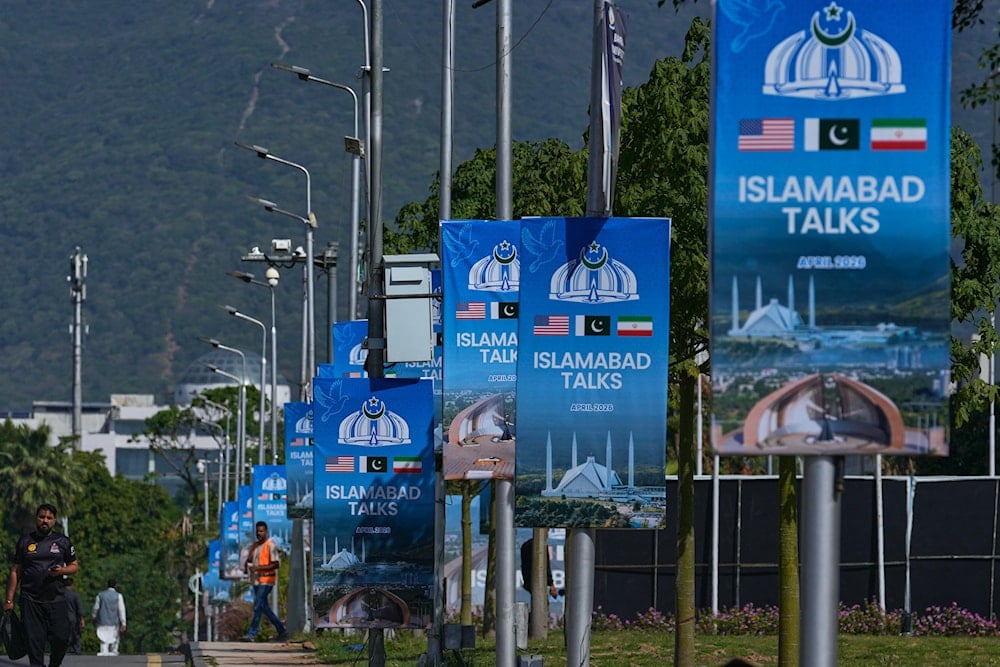
Workers walk past billboards near the Serena Hotel ahead of the second round of negotiations between the US and Iran, in Islamabad, Pakistan, Monday, April 20, 2026 (AP)
While the United States has sent a delegation to Pakistan for potential negotiations, Iran has not yet made a final decision on participation and is still reviewing the possibility of joining talks, Tasnim news agency reported, citing sources and regional officials.
Earlier, US President Donald Trump announced that a high-level delegation led by JD Vance is heading to Pakistan for ceasefire talks with Iran.
Iranian sources emphasized that any participation in negotiations is conditional on the fulfilment of several preconditions, among them the US maritime blockade on Iran, which Tehran emphasized poses a central obstacle in the diplomatic process.
The matter has reportedly been conveyed through Pakistan, which is acting as a mediator, and Islamabad has, in turn, raised the issue in contacts with US officials.
Iranian officials also argue that additional US demands outlined in recent exchanges have further complicated prospects for progress, leaving an unclear path toward any agreement.
US blockade on Iran could see changes
Al Mayadeen’s correspondent in Islamabad reported that a US aircraft carrying a large delegation has landed in Islamabad, where talks are set to take place under regional mediation efforts.
The arrival of a US delegation in Pakistan indicates that President Donald Trump may be preparing to announce a specific initiative related to the blockade of Iranian ports, according to our correspondent.
However, he noted that, so far, the talks remain unilateral, with no confirmed direct engagement between the United States and Iran at this stage.
Talks 'waste of time' if US does not abandon unrealistic expectations
On the other hand, according to the sources cited by Tasnim News Agency, Iranian negotiators believe that unless Washington adopts a more “realistic” approach, talks would be unproductive.
Tehran has warned that talks would amount to a “waste of time” if the United States continues with its unrealistic expectations or strategic miscalculations. Iranian officials also said they will not engage in what they described as a “US theatre” unless key obstacles are removed and a credible framework for an acceptable agreement emerges.
At the same time, Iran is said to be considering the possibility that public announcements about negotiations may be a “deceptive tactic", while maintaining that it remains prepared for all scenarios, including military confrontation.
Egypt, Pakistan intensify diplomatic effort
Despite the lack of a final Iranian decision, diplomatic efforts are ongoing. Egyptian Foreign Minister Badr Abdelatty held a phone call with his Pakistani counterpart Mohammad Ishaq Dar as part of ongoing consultations on the latest regional developments and efforts to de-escalate tensions.
During the call, both ministers discussed initiatives aimed at advancing a diplomatic track between the United States and Iran. They expressed hope that a second round of negotiations could help reach understandings that would consolidate a ceasefire, reduce escalation, and bring an end to the war.
Both sides reaffirmed that dialogue and negotiation remain the only viable path toward resolving the crisis, and agreed to continue close coordination and consultations on regional developments in order to support stability and security.


