
Iranian Armed Forces say 600-800 US troops killed, 17 bases destroyed
 4 Min Read
Iran said between 600 and 800 US troops were killed and 17 bases destroyed as its retaliatory campaign intensifies following the US-Israeli war launched on February 28.
-
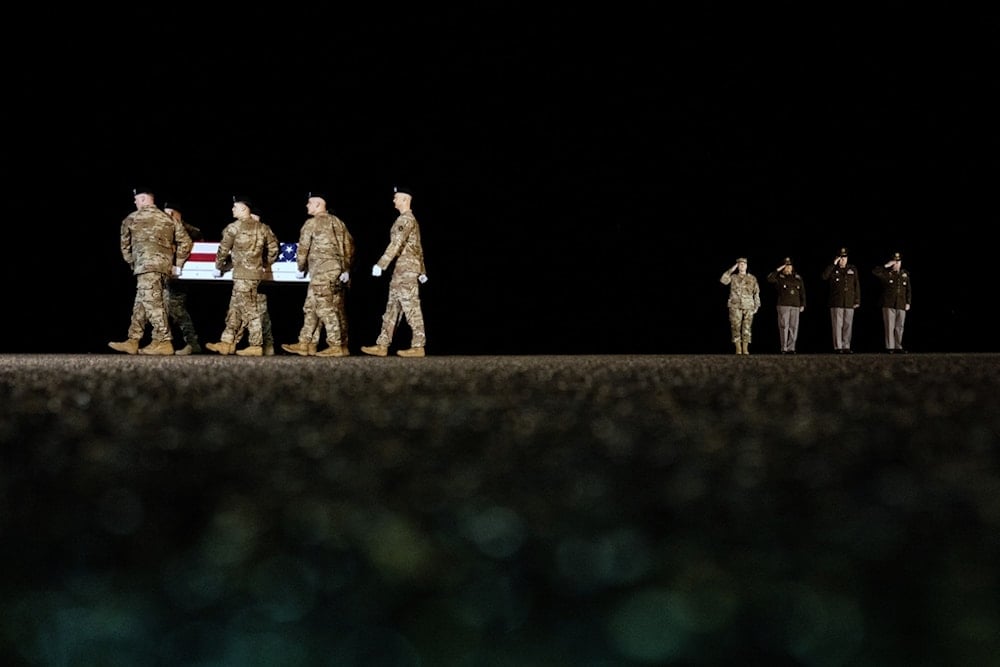
An Army carry team moves the flag-draped transfer case containing the remains of U.S. Army soldier Maj. Sorffly Davius, of Cambria Heights, N.Y., who died in Kuwait, during a casualty return, Monday, March 9, 2026, at Dover Air Force Base, Del (AP Photo/Julia Demaree Nikhinson)
Iran’s armed forces said Thursday that US forces have suffered significant losses across the region since Washington and "Israel" initiated an unprovoked war on February 28.
Speaking on Iranian state television, armed forces spokesman Abolfazl Shekarchi said the scale of US casualties has been substantial. "I am only giving the minimum figures when I say that between 600 and 800 American soldiers were killed, and nearly 5,000 were left injured," Shekarchi said.
He added that 17 US military bases in the region had been destroyed, describing the US army as a "paper tiger" in the face of sustained Iranian retaliation.
Bases rendered uninhabitable
Recent reporting by The New York Times further indicates that repeated Iranian missile and drone strikes have rendered several US bases across West Asia largely uninhabitable, forcing troops to disperse and operate from improvised locations, including hotels and office buildings. Large segments of the US military apparatus are now functioning in a decentralized manner, with some personnel relocated as far as Europe, while others remain in the region but outside traditional command structures.
According to the report, key installations in Kuwait, Qatar, Bahrain, and Saudi Arabia sustained significant damage, including airfields, fuel depots, communications systems, and radar infrastructure. The degradation of these facilities has complicated command, control, and coordination, reducing overall operational effectiveness.
US officials cited in the report acknowledged that while dispersed operations allow continuity, they limit the deployment of heavy equipment and expose structural weaknesses in Washington’s regional posture. Prior to the war, around 40,000 US troops were stationed across the region, many of whom have since been repositioned following sustained Iranian strikes.
War disrupts diplomacy
The escalation traces back to February 28, when the US and "Israel" launched large-scale unprovoked attacks on Iranian territory, including in Tehran, causing civilian losses and targeting key state and civilian sites.
The attack came despite ongoing nuclear negotiations in Geneva, which had shown signs of progress and were expected to continue, with mediation efforts led by Oman still active at the time.
Iran responded with coordinated missile and drone operations targeting Israeli-occupied territory and US military installations across the region, expanding the confrontation into a broader regional conflict.
Iran sets terms
According to informed sources, Tehran’s response calls for an immediate halt to assassination operations, binding guarantees against renewed aggression, and the provision of compensation and reparations. It also demands a comprehensive cessation of hostilities across all fronts, including those involving allied resistance groups.
Iran further stressed that its sovereignty over the Strait of Hormuz is non-negotiable and must be formally recognized, framing control over the waterway as a mechanism to ensure compliance with any future agreement.
At the same time, Iranian officials have cast doubt on Washington’s intentions, describing the diplomatic track as a potential cover for further escalation. They point to previous instances in which negotiations coincided with military action, reinforcing what they describe as a pattern of “deception.”
Tehran has maintained that negotiations cannot take place under bombardment and has rejected the US proposal in its current form as “one-sided and unfair.” Officials insist that any diplomatic process must be based on mutual terms rather than coercion, and that the war will end only once Iran’s conditions are met.
As the war enters its fourth week, Iran maintains that it will continue operations until its own conditions are met, framing its response as both defensive and necessary in the face of an attack that it says derailed a viable diplomatic path.
Read more: US mulls redirecting Ukraine-bound weapons amid war on Iran strain: WP


