
Iranian missiles hit Bir al-Sabe', Tel Aviv, disrupt Knesset session
 3 Min Read
Iranian missile barrage hits Bir al-Sabe', Tel Aviv, and other areas, causing explosions, injuries, and halting a Knesset session, according to Israeli media reports.
-
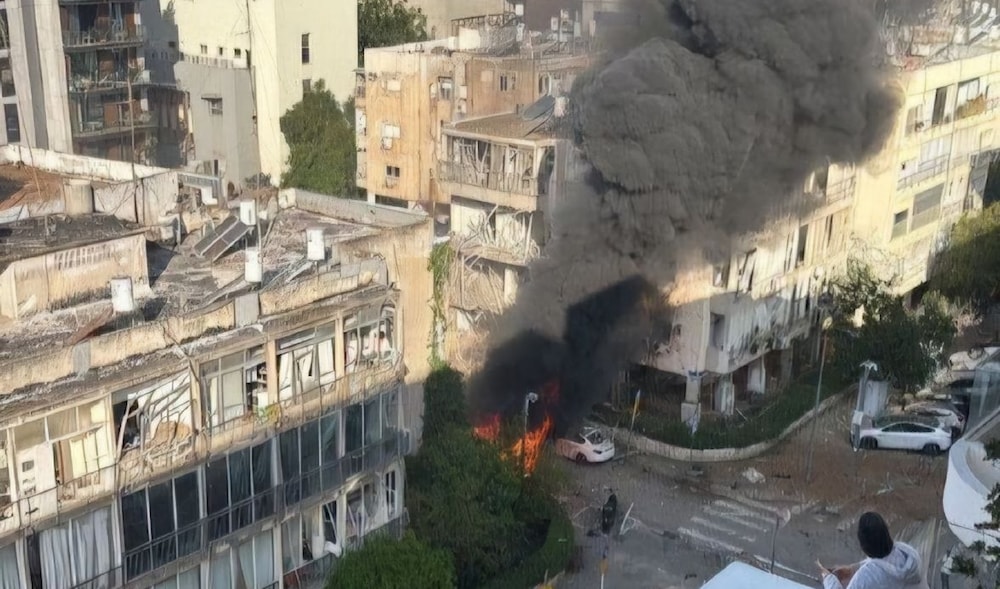
Image circulating online of the damage in Tel Aviv following Iranian missile strikes, March 24, 2026 (Social media)
Israeli media reported on Tuesday morning that powerful explosions were heard in Tel Aviv, Bir al-Sabe', the western Negev, and Arad following a wave of missiles launched from Iran toward “Israel”. The reports described the latest barrage as the largest since the start of the war, noting that it resulted in injuries.
Israeli media also said that an Iranian cluster missile made impact in northern Tel Aviv, with large forces being deployed to the site where injuries were reported. Around 10 strong explosions were heard across central areas. The widespread impact triggered heightened alert levels and reinforced the sense of escalation across multiple fronts.
#WATCH | Footage shows a direct hit by an Iranian missile in Tel Aviv. pic.twitter.com/cwAsBrCRFJ
— Al Mayadeen English (@MayadeenEnglish) March 24, 2026
Sirens were activated in approximately 180 locations across northern areas after the reported launch of a cluster-type missile from Iran, according to Israeli media. Additional reports indicated that cluster munitions fell in several locations, further intensifying the scope of the attack.
At the same time, the Israeli army said search and rescue forces were deployed to multiple sites in the South that sustained damage. Media outlets also reported a missile impact in Bir al-Sabe', adding to the growing list of affected locations.
Israeli newspaper Haaretz said that Iranian strikes on “Israel” have not stopped on the 25th day since the start of the escalation. Israeli media reported a direct hit on a building, with seven additional locations struck by fragments from the Iranian missile.
#WATCH | Footage circulating online shows the aftermath of a missile impact in Tel Aviv.
— Al Mayadeen English (@MayadeenEnglish) March 24, 2026
Israeli media reported that a road linking Tel Aviv to the occupied north has been closed as a result of the Iranian missile strike.
Israeli media also reported a direct hit on a building,… pic.twitter.com/P15B5dAk36
It also indicated that large forces were en route to the site in northern Tel Aviv, confirming that a road connecting Tel Aviv to the north was closed due to the Iranian missile strike.
Knesset session halted amid air raid warning
In parallel developments, Israeli media reported that a session at the Knesset was suspended after a warning issued by the Internal Front Command. The alert underscored the immediate security concerns triggered by the missile barrage.
Meanwhile, "Israel’s" Health Ministry stated that 5,047 injuries have been recorded since the beginning of the war, reflecting its cumulative toll.
IRGC launches wave 78 of Operation True Promise 4
Iran’s Islamic Revolution Guard Corps (IRGC) announced the launch of the 78th wave of Operation True Promise 4 overnight, targeting multiple sites across the occupied Palestinian territories and US military bases in the region, amid continued escalation in response to American-Israeli aggression.
The IRGC confirmed that the wave struck targets in Umm al-Rashrash (Eilat), Dimona, and areas north of Tel Aviv, in addition to US military bases across the region.
The operation employed precision-guided Emad and Qadr multi-warhead ballistic missiles, alongside suicide drones, according to an official IRGC statement.
#WATCH | Heavy destruction reported in the Nesher settlement in Haifa, after an Iranian cluster missile struck a building. pic.twitter.com/0gugqcnkJd
— Al Mayadeen English (@MayadeenEnglish) March 23, 2026
The IRGC stressed that Iran is “conducting negotiations with the aggressors using missiles and firepower,” asserting that its actions are carried out “from a position of strength and field dominance".
The statement described the latest wave as “a new chapter in the history of the war”, adding that it reflects both military capability and public backing, referencing “the Iranian people’s raised fists in the streets.”


