
Iranian separatist groups refuse to leave Iraq border area
 5 Min Read
Iranian separatist fighters are massing along the Iraq-Iran border, as talks with Iraqi officials over their withdrawal stall.
-
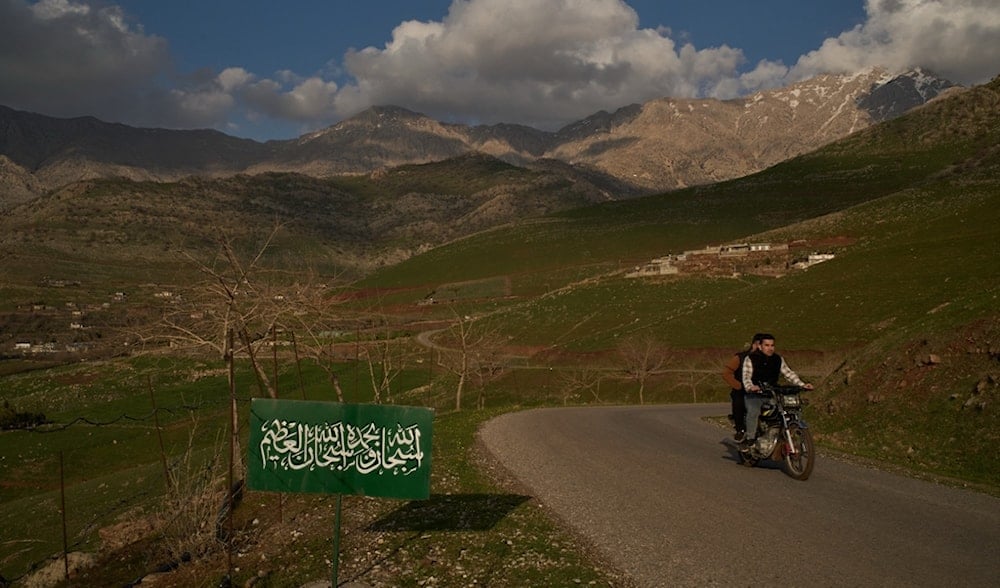
A man rides his motorcycle past a sign bearing a prayer in Arabic along a road near the Iraq-Iran border in the mountainous Kurdish region near Halabja, Iraq, Tuesday, March 17, 2026. (AP Photo/Leo Correa)
Tensions are mounting along Iran's border with the Kurdistan Region of Iraq amid a growing presence of Iranian separatist fighters, after several of their camps and positions were evacuated following airstrikes, Al Mayadeen Plus' correspondent in Sulaymaniyah reported.
Negotiations are underway between the separatist groups' leadership and Iraqi security officials over relocating their fighters away from the border and ensuring compliance with the security agreement signed with Tehran, though the talks have yet to produce a final agreement.
The separatist groups have informed the Kurdistan Regional Government that they will not withdraw from their positions, rejecting guarantees offered in exchange for their return to the camps they vacated during the latest war, per our correspondent.
Under the Iraqi Constitution, primary responsibility for securing the border area falls to the federal government's National Guard, followed by the Kurdistan Regional Government, a source told Al Mayadeen Plus.
Weapons and financial support continue reaching the separatist groups through the Kurdistan Workers' Party (PKK), which maintains hideouts and weapons depots in areas under its control.
Three months of buildup along the border
The buildup toward the Iranian border has been underway for more than three months, stretching from the Qandil Mountains to the Penjwen area and the district of Said Sadiq, east of Sulaymaniyah, Al Mayadeen Plus' correspondent in Sulaymaniyah, Ali al-Tuwaijri, reported. The separatist groups have been digging tunnels and caves and constructing mountain roads in the area.
Some of the fighters involved had previously accompanied PKK members stationed on Mount Gara and Mount Matin in Duhok province before withdrawing to the Qandil area roughly three months ago and joining the border buildup alongside the separatist groups.
The PKK has handed over some of its weapons to the Kurdistan Free Life Party (PJAK), which Iran has proscribed as terrorist, out of distrust in the Turkish initiative, transferring the weapons before its disarmament process began, according to security sources.
PJAK is considered one of the PKK's closest affiliates, with its financing, training, and directives coming directly from PKK leadership, and has also been reinforced with a large number of fighters now massed along the Sulaymaniyah-Iran border.
Read more: Exclusive to Al Mayadeen+: Washington freezes Peshmerga aid
Iraqi, Kurdish officials respond as talks stall
Both the federal government and the Kurdistan Regional Government have been formally notified of the buildup by Iranian security authorities, after several fighters were arrested crossing into Iran through smuggling routes, with their interrogations revealing details of the buildup, the correspondent said.
During a recent visit to Erbil, Iraqi National Security Adviser Qasim al-Araji met with Kurdistan Regional Government Interior Minister Reber Ahmed and stressed the need to comply with the security agreement signed between Iraq and Iran, which requires the withdrawal of all fighters and the handover of heavy and light weapons to either the Kurdistan Regional Government or the federal government.
Over the past three weeks, undisclosed meetings and message exchanges have taken place between the Kurdistan Regional Government's security agencies and the separatist groups' leadership, though the groups have complied with neither the regional nor the federal government's orders.
Political parties in the Kurdistan Region with close ties to the federal government are now calling for additional border guard units to be deployed and demanding that the federal government assume responsibility for securing the region's borders, citing its constitutional jurisdiction.
Iranian separatist groups in Iraqi Kurdistan
The standoff over Iranian separatist groups in Iraq's Kurdistan Region traces back to a joint border security framework signed by Baghdad and Tehran on March 19, 2023, under which Iraq pledged to prevent armed groups from using its territory to launch cross-border attacks against Iran.
The agreement was formalized into a memorandum of understanding in August 2025, covering security coordination and the activities of five Iranian Kurdish opposition parties.
Despite relocation efforts that began in 2023, the groups have repeatedly failed to fully comply, and the issue resurfaced during the 2026 US-Israeli war on Iran, when several factions began preparing for possible cross-border operations.
Iran has since carried out a sustained campaign of strikes and ground operations against separatist positions in Erbil and Sulaymaniyah, including a wave of drone and missile attacks that killed nine members of the Komala Party in July and a series of ground operations in August targeting intelligence officials linked to the groups, among them a Democratic Party of Iranian Kurdistan operative.
Iran has also been constructing a security wall stretching more than 250 kilometers along its border with the Kurdistan Region.


