
IRGC commander praises forces for subduing strongest army in history
 3 Min Read
IRGC Commander Ahmad Vahidi says Iranian forces subdued the US military during six months of confrontation, praising their performance under difficult conditions.
-
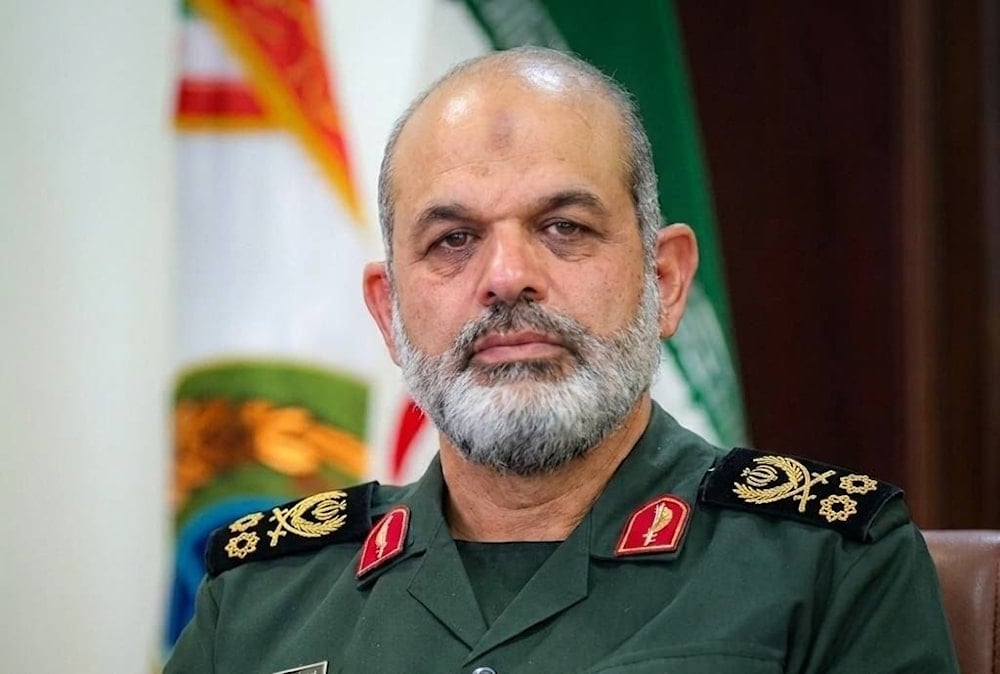
IRGC Commander-in-Chief Major General Ahmad Vahidi, undated (IRIB)
The Commander-in-Chief of Iran’s Islamic Revolution Guard Corps (IRGC), Major General Ahmad Vahidi, said Saturday that IRGC forces had “subdued the strongest army in the history of the world” during months of confrontation, praising their performance under difficult conditions.
In a message to IRGC forces marking the beginning of the Hijri month of Rabi' al-Awwal, Vahidi commended their efforts throughout the last six months.
He said the IRGC confronted the US military under exceptionally difficult circumstances, including extreme summer heat, heavy seasonal rainfall across the southern islands and coastlines, and freezing conditions in the northern highlands.
“You subdued the strongest army in the history of the world by relying on God and through your victorious fighting under extremely difficult conditions, including the scorching summer heat and heavy seasonal rains in the islands and southern coasts, as well as the cold of the high northern mountains, while successfully carrying out your offensive and defensive operations under a barrage of fire,” Vahidi said.
The IRGC commander praised the forces for maintaining their operational capabilities while carrying out both offensive and defensive operations under sustained fire.
War exposed US strategic weakness
Earlier, IRGC spokesperson Brigadier General Hossein Mohebbi said the war against Iran had “exposed the strategic weakness of the United States,” while also demonstrating the impact of Iran’s power on military, economic, and political equations.
Mohebbi said Iran had “fought a war with one of the strongest countries in the world,” adding that the conflict unfolded across multiple arenas. He identified the emergence of US “strategic vulnerability” as one of the defining characteristics of the latest war.
The remarks by Vahidi and Mohebbi reflect Tehran’s assessment of the confrontation as a test of Iran’s military capabilities and deterrence posture against the United States, while emphasizing the IRGC’s ability to sustain operations under prolonged and difficult conditions.
Read more: Iran reiterates it maintains control over Strait of Hormuz
Strait of Hormuz remains under Iranian control
As for the Strait of Hormuz, Iranian Deputy Foreign Minister for Legal and International Affairs Kazem Gharibabadi on Saturday responded to US President Donald Trump’s remarks about the strait, saying the waterway cannot be seized through a social media post, an aircraft carrier, or a speech.
Gharibabadi added that Iran does not fear threats or displays of force, stressing that such demonstrations would not intimidate Tehran. "Accept the truth once and for all... You have suffered heavy and strategic defeats," Gharibabadi said.
He further asserted that the Strait of Hormuz "was Iranian, is Iranian now, and will remain Iranian," adding that the waterway would only be opened or closed on Iran’s orders. "As long as you refuse to accept the reality of your defeat and continue weaving illusions, Iran will continue imposing the blockade," Gharibabadi said.


