
IRGC declares Iran's security a 'red line', vows to protect Revolution
 3 Min Read
Iran's leadership and the IRGC say the country remains under external pressure and in a state of conflict, warning that national security is a red line as authorities move to contain unrest amid economic protests.
-
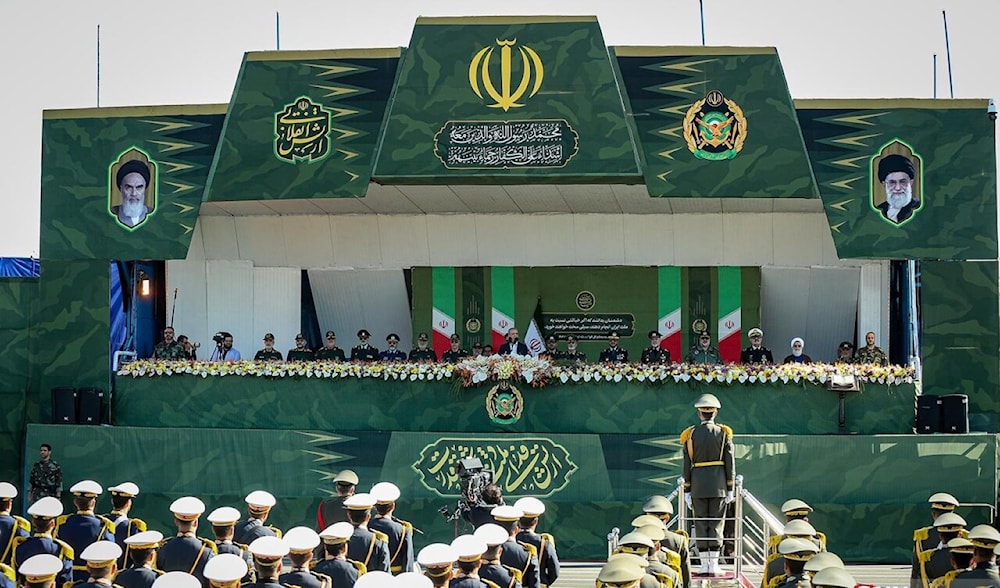
Ceremony to commemorate the Army Day of the Islamic Republic of Iran in 2025. (Wikimedia Commons)
Iranian state television reported that the Islamic Revolutionary Guard Corps (IRGC) has reaffirmed its unwavering commitment to safeguarding the gains of the 1979 Revolution, stressing that "the country’s security is a red line," as Iran confronts a deliberate and coordinated campaign aimed at destabilizing the nation.
The statement comes as security institutions reaffirm their constitutional mandate to defend national sovereignty, protect public order, and confront internal sabotage and external aggression targeting the country’s stability.
Earlier on Saturday, Ali Larijani, Secretary of Iran’s Supreme National Security Council, said the country "is still in the midst of a war," noting that "no peace and no ceasefire" have been reached.
He warned that Iran remains under sustained political, economic, and security pressure, arguing that it is neither logical nor responsible to manufacture new crises at a time when the country is confronting a hybrid war involving sanctions, information warfare, and covert operations.
Larijani said recent unrest is not organic but is being directed and fueled from abroad, with the clear aim of exhausting the state and fracturing social cohesion.
Sanctions Exploited Unrest
In recent days, Iran has witnessed economic protests triggered by the sharp depreciation of the rial, rising living costs, and the cumulative impact of years of sanctions. Senior officials have publicly acknowledged the legitimacy of economic grievances and reiterated citizens’ right to peaceful protest.
At the same time, officials and state-linked media say hostile foreign actors have deliberately sought to exploit these grievances by inserting organized sabotage, arson attacks, and violence against public and security institutions into otherwise lawful demonstrations.
Iranian authorities say evidence points to the involvement of paid and armed elements, including separatist and terrorist-linked networks operating with foreign backing, as well as coordinated digital campaigns designed to amplify unrest and incite chaos.
Security agencies have announced the detention of riot organizers and individuals accused of receiving foreign-linked funding, warning that externally backed violence will be met with firm and lawful measures.
Foreign Destabilization
Officials have repeatedly stressed the need to distinguish between legitimate public dissent and efforts to weaponize economic hardship as part of a broader strategy aimed at destabilizing the country, weakening Iran’s regional position, and pressuring it into political concessions.
Tehran has condemned blatant foreign interference in its internal affairs, warning that such actions threaten not only Iran’s security but regional stability as a whole.


