IRGC launches wave 79 of Operation True Promise 4, targets US bases
 5 Min Read
The IRGC announced wave 79 of Operation True Promise 4, targeting the Israeli occupation and US military installations across the region with missiles and drones.
-
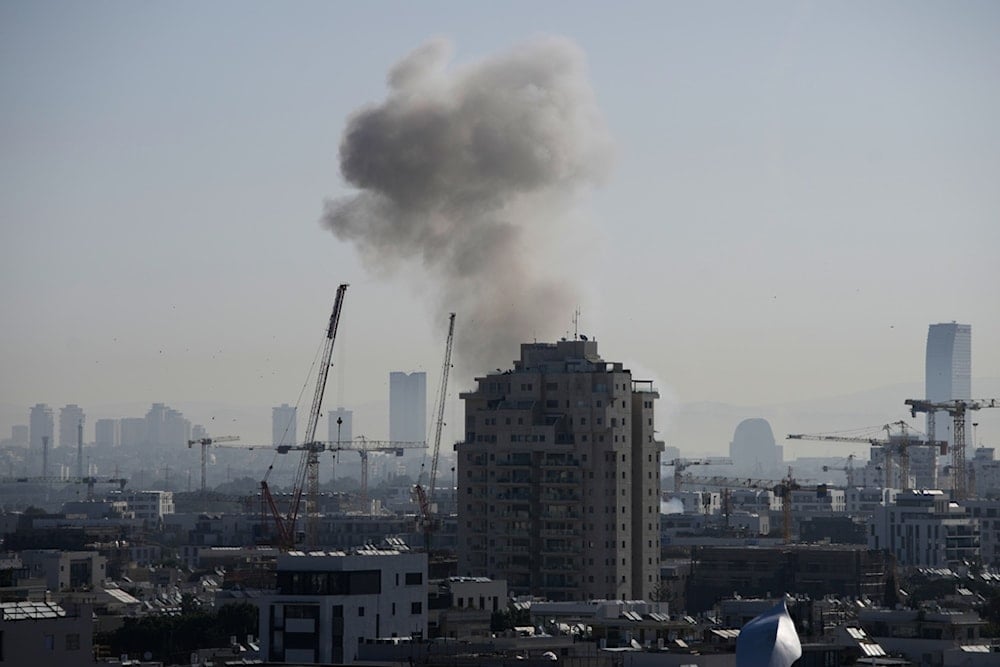
Smoke billows following an Iranian missile strike in Tel Aviv, occupied Palestine, Tuesday, March 24, 2026 (AP)
The Islamic Revolution Guard Corps (IRGC) announced that it had launched wave 79 of Operation True Promise 4, targeting “Israel” and US military bases across the region.
According to the IRGC statement, the operation specifically targeted satellite reception stations in Eilat, which are used by the Israeli occupation forces.
#WATCH | An Iranian missile, with a split warhead, struck Bnei Brak.
— Al Mayadeen English (@MayadeenEnglish) March 24, 2026
"Israel's" Magen David Adom reported that there are several injured settlers across Greater Tel Aviv.#OccupiedPalestine pic.twitter.com/mbrEWOvKoZ
The statement also confirmed attacks on multiple US military facilities, including Camp Arifjan and Ali Al Salem Air Base in Kuwait, and Isa Air Base in Bahrain.
Wave 79 of the operation involved the deployment of long- and medium-range missile systems, utilizing both solid and liquid fuel types, alongside one-way attack drones, according to the IRGC.
#WATCH | An Iranian missile, with a split warhead, struck Bnei Brak.
— Al Mayadeen English (@MayadeenEnglish) March 24, 2026
"Israel's" Magen David Adom reported that there are several injured settlers across Greater Tel Aviv.#OccupiedPalestine pic.twitter.com/mbrEWOvKoZ
In a follow-up, the spokesperson for the central Khatam al-Anbiya Headquarters announced today, Tuesday, that the Iranian Armed Forces carried out a series of extensive offensive and defensive operations.
In a statement, he confirmed: "The air defense systems of the Army and the Revolutionary Guards successfully shot down cruise missiles of the Tomahawk and JASSM types, in addition to hostile drones that attempted to breach the airspace over central and southern parts of the country."
The statement revealed details of Wave 78, carried out under the slogan "O Guide of the Bewildered", in which split warhead Emad and Qadr missiles targeted strategic locations in Eilat, Dimona, and northern Tel Aviv, as well as US military bases in the region, achieving precise hits.
In Wave 79, which bore the slogan "O Best of Conquerors", Iranian forces launched volleys of Sejil and Khyber Shekan missiles along with drones, striking aerospace facilities near Ben Gurion Airport, in-air refueling aircraft there, and military industries in Haifa.
The strikes also targeted intelligence sites in Ramat Gan and the al-Naqab, as well as a major logistical center in Be’er Sheva.
The spokesperson confirmed that the rising columns of smoke and the continued sheltering of settlers reflect the extent of disruption to the enemy’s defense systems, considering attempts to withhold information as evidence of the confusion and concern among both the occupation forces and the US military.
Iranian army announces strike on Erbil airport
The IRGC emphasized that the operation reflects its ongoing commitment to confront hostile forces in the region and to target military infrastructure deemed threatening to its national security interests.
The Iranian Army announced a surface-to-surface missile strike on Erbil Airport, targeting a "gathering of US forces and Israeli-backed separatist groups."
The army added that the targeted area is "one of the most significant support and command hubs for US operations, housing a wide array of military equipment and systems."
US options for talks narrow
For weeks, the United States and "Israel" have insisted that Iran's military capacity has been severely degraded. US President Donald Trump and War Secretary Pete Hegseth have repeatedly claimed that sustained strikes have crippled Iran's command structure and weakened its ability to respond. By their account, the conflict should already be moving toward an end.
Yet the opposite appears to be happening. The escalation continues faster, sharper, and with fewer clear exit points, according to an analysis by BBC's Amir Azimi published Monday.
On Saturday, claims surfaced that Iran launched two missiles toward the US-UK base on Diego Garcia in the Indian Ocean, a distance of approximately 3,800 kilometers, far beyond the 2,000-kilometer range previously attributed to Iran's arsenal.
Although it should be noted that Iran did not assume responsibility for this, the missiles did not reach the island, and the incident was heavily discussed in the media in terms of Washington's underestimation of Iranian capabilities.
Whether this reflects a previously undisclosed capability or one developed under bombardment, the implication is the same: military pressure has not halted Iran's progress.
Trump's ultimatum and retreat
Trump raised the stakes on Saturday night, issuing a 48-hour threat demanding that Iran reopen the Strait of Hormuz, warning that failure to comply would lead to the US "obliterating" Iranian power plants.
Iran rejected the demand and responded with a similar threat: any attack on its energy infrastructure would be met with strikes across the region. Iran's Defense Council also raised the possibility of mining parts of the Persian Gulf.
The exchange appeared to set both sides on a direct path toward a far more dangerous phase of the war on Iran. Yet only hours before the deadline was due to expire, Trump stepped back. In a post on Truth Social, he claimed there had been "very good and productive conversations" with Iran and announced a five-day pause on any planned strikes against Iranian energy infrastructure.
Iranian officials swiftly denied that any direct talks had taken place, be they direct or indirect.