
Israeli aggression kills 13-year-old child in Gaza
 3 Min Read
A 13-year-old Palestinian boy was killed in southern Gaza Strip as “Israel” continues demolitions and attacks across the Strip.
-
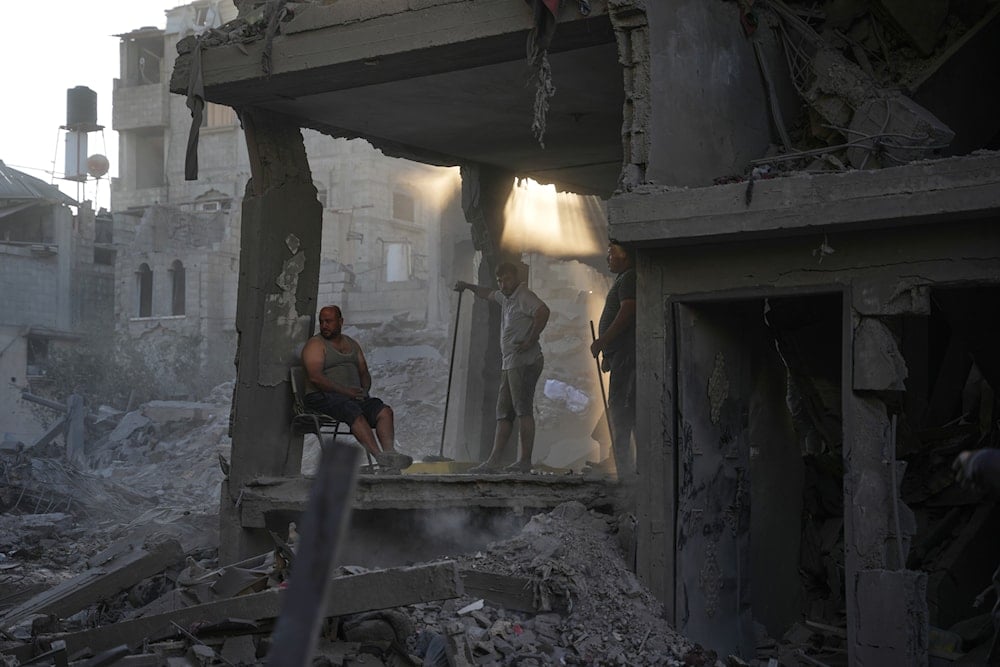
Palestinians clear the rubble of a building that was destroyed in an Israeli airstrike, at al-Maghazi refugee camp, central Gaza Strip, Friday, June 12, 2026 (AP)
A 13-year-old Palestinian boy has succumbed to injuries sustained by Israeli army fire in southern Gaza, as Israeli forces continue attacking residential buildings across the Strip, sources reported Sunday.
The child, identified as Amr Emad Al-Bishiti, died after being shot by Israeli troops in the Batn Al-Sameen area, south of Khan Younis, in southern Gaza.
In parallel, the Israeli military blew up residential buildings near the Tel Al-Zaatar area in Jabalia, northern Gaza. Similar demolitions were carried out east of Al-Tuffah neighborhood, east of Gaza City.
Witnesses reported that Israeli warships opened fire simultaneously with the launch of flare shells off the Gaza City seafront. Separately, Israeli military vehicles fired their guns north of the town of Beit Lahia, in northern Gaza.
Israeli aggression continues amid ceasefire
The latest attacks come despite a declared ceasefire agreement and are part of a systematic campaign by Israeli forces across the Gaza Strip.
According to the Palestinian Health Ministry in Gaza, since the ceasefire was announced on October 11 last year, at least 983 people have been killed, 3,122 others have been injured, and 783 bodies have been recovered.
The cumulative death toll since the start of the Israeli war on Gaza in October 2023 has now reached 72,993, with 173,230 injured, the ministry added.
This comes as mediators are attempting to advance the ceasefire into its second phase, after being stuck in the first phase since the announcement of the agreement on October 2025.
Hamas submits formal response to 15-point roadmap to revive ceasefire
Senior sources in the Palestinian Resistance have confirmed that Hamas submitted last week its formal response to a 15-point roadmap presented by international mediators, as a new round of ceasefire talks began in Cairo on June 7 to revive the stalled agreement.
According to a copy of the response obtained by Al Mayadeen, the Palestinian Resistance factions have outlined a structured framework focused on long-term stability and governance.
The proposed plan stipulates that the process of weapons exclusivity and control would only begin after the full completion of the first phase of the ceasefire agreement, including all its required obligations.
The first-phase requirements include adherence to Israeli military withdrawal lines, a complete cessation of attacks, and the full implementation of the humanitarian protocol. Additionally, the first phase calls for "the entry of a Palestinian national committee, the deployment of an international stabilization force, and the dismantling of armed militias."
The framework further details a phased plan for weapons control, which includes the storage of heavy weapons and the gradual dismantling of military infrastructure. These steps would follow a timetable to be agreed upon after the Israeli withdrawal.
Officials said the demilitarization timeline would be set in parallel with a gradual Israeli withdrawal from areas the Israeli military currently occupies in Gaza. The weapons-exclusivity process would officially begin once the national committee commences its work.
As of publishing, no official statement had been issued by the Israeli government regarding the Hamas response or the proposed roadmap.


