Al Mayadeen English

  • Ar
  • Es
  • x
Al Mayadeen English

Slogan

  • News
    • Politics
    • Economy
    • Sports
    • Arts&Culture
    • Health
    • Miscellaneous
    • Technology
    • Environment
  • Articles
    • Opinion
    • Analysis
    • Blog
    • Features
  • Videos
    • NewsFeed
    • Video Features
    • Explainers
    • TV
    • Digital Series
  • Infographs
  • In Pictures
  • • LIVE
News
  • Politics
  • Economy
  • Sports
  • Arts&Culture
  • Health
  • Miscellaneous
  • Technology
  • Environment
Articles
  • Opinion
  • Analysis
  • Blog
  • Features
Videos
  • NewsFeed
  • Video Features
  • Explainers
  • TV
  • Digital Series
Infographs
In Pictures
  • Africa
  • Asia
  • Asia-Pacific
  • Europe
  • Latin America
  • MENA
  • Palestine
  • US & Canada
BREAKING
Al Mayadeen Plus's correspondent: The Kurdistan Regional Government's control will be limited to urban and administrative centers, while it will retain administrative authority over areas within the region.
Al Mayadeen Plus's correspondent: The Kurdistan Region will also lose control of 32 official and unofficial border crossings.
Al Mayadeen Plus's correspondent: Federal forces will return to assert sovereignty up to the 36th parallel, effectively restoring the situation to what it was in 1991.
Al Mayadeen Plus's correspondent: These changes would mean that the Kurdistan Region loses some of its most important sources of economic and security leverage.
Al Mayadeen Plus's correspondent: The Khor Mor field will return to the management of the North Oil Company, while the Kurdistan Region will also lose control of the Shaikhan fields in Nineveh.
Al Mayadeen Plus's correspondent: Major oil fields expected to come under federal control include Bai Hassan, Jambur, Ain Zalah, Qayyarah, Batma, and Khurmala.
Al Mayadeen Plus's correspondent: Federal forces are expected to deploy at the Khor Mor field in the Chamchamal district and establish control over the Khurmala oil fields.
Al Mayadeen Plus's correspondent: Falih al-Fayyadh informed Masoud Barzani that Iraqi federal forces would return to assert sovereignty up to the Green Line.
Al Mayadeen Plus's correspondent in Sulaymaniyah: Information obtained by Al Mayadeen Plus indicates that Iraqi federal forces will return to the Kurdistan Region and regain control of oil fields.
Iran: Islamic Revolution Guard Corps: Any violation of Iranian airspace by any state or aggressor force will be met with a powerful and decisive response from our fighters

Israeli economy under strains as war costs mount sharply

  • By Al Mayadeen English
  • Source: Israeli media
  • 13 Apr 2026 06:34
  • 4 Shares
4 Min Read

Preliminary estimates show rising war costs for the Israeli regime linked to the wars on Iran and Lebanon, increasing deficits, defense spending, and economic losses.

Listen
  • x
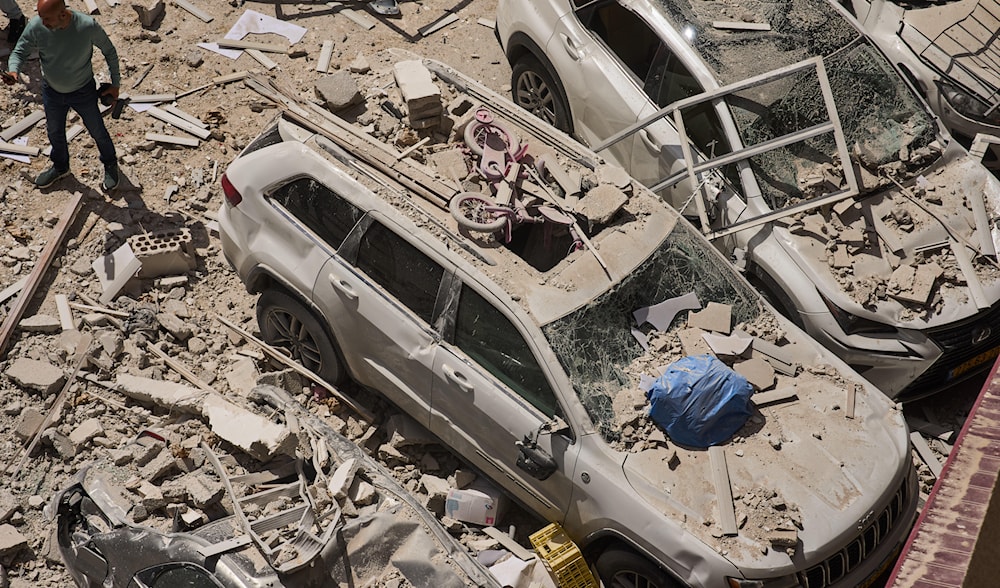
  • A man inspects the damage to cars and an apartment building struck by an Iranian missile in Ramat Gan, Occupied Palestine, April 6, 2026 (AP)
    A man inspects the damage to cars and an apartment building struck by an Iranian missile in Ramat Gan, Occupied Palestine, April 6, 2026 (AP)

Preliminary estimates indicate that the US-Israeli war on Iran has cost the Israeli budget approximately 35 billion shekels ($11.52 billion), including 22 billion shekels allocated to the security sector, with the amount already incorporated into the 2026 budget, according to the Israeli Finance Ministry.

In a statement on Sunday, the ministry confirmed that the government had approved additional emergency allocations in mid-March worth 2.6 billion shekels ($827 million) for urgent weapons procurement as the confrontation escalated.

According to the ministry’s estimates, the increased spending is expected to raise the fiscal deficit from the previously targeted 3.9% of GDP to a range between 4.9% and 5.6%.

The ministry also assessed that economic losses resulting from the war on Iran were around 9 billion shekels ($2.93 billion) per week.

Israeli wars strain its economy

In the same context, media reports citing Channel 12 said that the cost of 40 days of war on Iran and Lebanon could reach approximately $17.5 billion, including both military and civilian expenditures.

The Israeli Finance Ministry has estimated that the wars on Iran and Lebanon have cost “Israel” approximately $17.5 billion over the past 40 days, Anadolu reported on Thursday, citing Channel 12. The figure reflects combined military and civilian expenditures amid ongoing escalation on multiple fronts.

Direct military spending is estimated at around 40 billion shekels ($12.9 billion), while civilian costs, including compensation for affected businesses and local authorities, are projected at 13–14 billion shekels ($4.2–4.5 billion), bringing the total to roughly 54 billion shekels ($17.5 billion).

The ministry noted that the figures remain preliminary and do not account for future reconstruction costs or broader economic losses caused by the partial shutdown of the economy. To support military needs, an additional 7 billion shekels ($2.3 billion) has been allocated, covering weapons procurement, flight operations, reserve duty, and war-related damages.

Compensation under property tax is estimated at 12–13 billion shekels, alongside 1 billion shekels allocated for unpaid leave schemes and support to local authorities. As of Thursday morning, 28,237 claims for direct damage had been filed, with the highest numbers reported in Tel Aviv, Bir al-Sabe’, Arad, Petah Tikva, Dimona, and Beit Shemesh.

Meanwhile, Israeli media reported about two weeks ago that fuel prices had surpassed 8 shekels per liter, triggering growing public anger amid mounting economic pressures.

According to Israel’s i24NEWS, the increase was driven by a surge in global oil prices, with crude exceeding $100 per barrel compared to around $70 at the beginning of the year, directly impacting gasoline prices in the domestic market.

'Israel's' continuous wars strain its economy

"Israel’s" latest estimate of roughly $17.5 billion for 40 days of war on Iran and Lebanon demonstrates a growing strain on the entity's economy. The cost follows the 2024 wars on Gaza and Lebanon, which together reached about $31 billion, pushing war spending far above budgeted levels and contributing to a widening deficit.

Even short wars have left a mark: the 12‑day war on Iran in June 2025 led to GDP losses of around 1%, as economic activity slowed and business operations were disrupted. The cumulative impact of these wars since 2023 now exceeds $100 billion, when direct military spending and indirect costs such as lost productivity and reduced investment are combined.

Beyond military expenses, the repeated wars have affected Israeli households and businesses. Increased security spending has crowded out public investment, reservists’ mobilization has delayed business plans, and uncertainty has weakened consumer and investor confidence.

Economists warn that if such engagements continue, growth could slow further. Rising borrowing costs, reduced investment, and ongoing uncertainty show that the economic consequences of "Israel’s" conflicts extend far beyond the battlefield, highlighting the high cost of sustained military campaigns.

  • Israel
  • Israeli economy
  • Hezbollah
  • US-Israeli war on Iran
  • Lebanon
  • Israeli war on Lebanon
  • Iran

Most Read

A view of Iran's nuclear enrichment facility in Natanz, Iran, on April, 9, 2007 (AP)

Iran announces first nuclear fusion reactor, set to operate soon

  • Technology
  • 15 Nov 2026
Yemen’s Armed Forces engage Saudi forces, south of Taiz, Yemen, October 14, 2026. (Yemeni Military Media)

Field sources: YAF secure large areas of Dhubab at Bab al-Mandab

  • Politics
  • 15 Nov 2026
A document that was included in the U.S. Department of Justice release of the Jeffrey Epstein files, photographed Wednesday, Feb. 4, 2026, shows an April 2012 International Driving Permit for Epstein. (AP)

Epstein was strangled, forensic expert says after file review: BBC

  • Miscellaneous
  • 16 Nov 2026
Iranian Professor of English Literature and Orientalist Studies at the University of Tehran, Mohammad Marandi (Al Mayadeen)

Iran will not wait for 'bombs to fall' to retaliate | Excl.

  • Politics
  • 19 Nov 2026

Coverage

All
US Midterm Elections 2026

Read Next

All
Iranian domestically-built Zolfaghar, left, and Zolfaghar Bassir missiles are displayed by the armed forces in a temporary exhibition at Azadi square in Tehran, Iran, July 29, 2026. (AP)
Politics

IRGC targets US military bases in Bahrain with missiles and drones

IRGC camera footage shows the moment a US F-16 fighter jet was intercepted by Iran's air defenses over the Persian Gulf, released on Saturday, November 21, 2026 (Screengrab)
Politics

IRGC intercepts US F-16 fighter jet over Gulf: Footage

Iranian Foreign Minister Abbas Araghchi attends a press conference after a meeting with Russian Foreign Minister Sergey Lavrov at Iran's Foreign Ministry in Tehran, Iran, Oct. 19, 2026. (AP)
Politics

No Strait of Hormuz talks before Iran's demands are met: Araghchi

Entrance to Damon Prison near Haifa, 24 October 2017 (wikimedia commons)
Politics

88 Palestinian women held in Damon Prison amid medical neglect

Al Mayadeen English

Al Mayadeen is an Arab Independent Media Satellite Channel.

All Rights Reserved

  • x
  • Privacy Policy
  • About Us
  • Contact Us
  • Authors
Android
iOS