
Israeli elections: What are the three possible scenarios?
 3 Min Read
Polls point to a fragmented Knesset election on October 27, with Netanyahu’s bloc unlikely to secure a majority and Arab parties potentially pivotal to government formation.
-
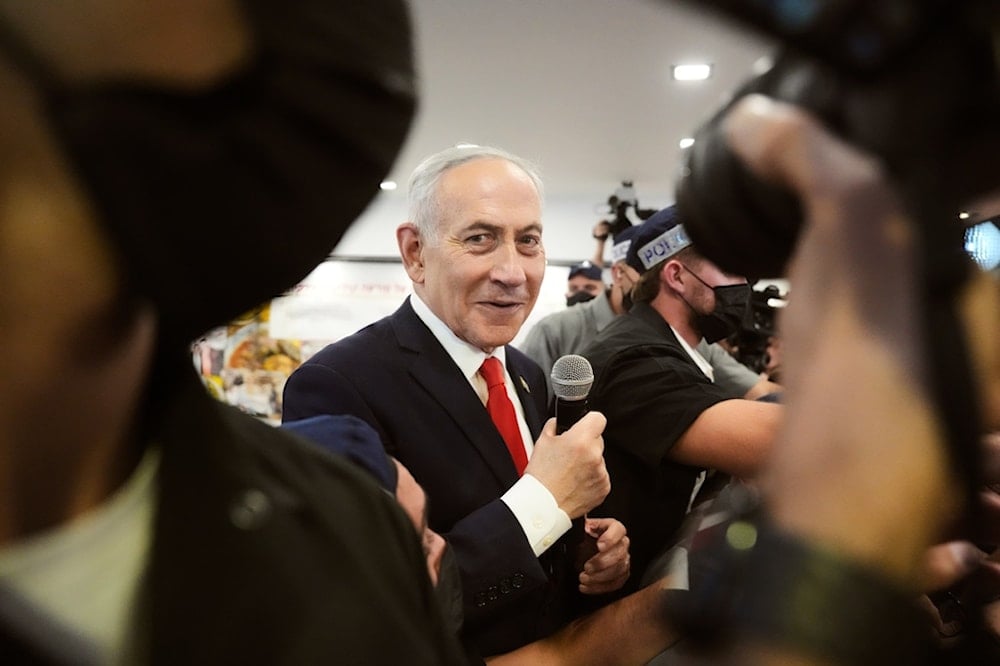
Israeli Prime Minister Benjamin Netanyahu, leader of the Likud party, speaks to supporters during a campaign appearance at a market in Tel Aviv, Occupied Palestine, Thursday, Oct. 22, 2026, ahead of the general election (AP Photo)
With parliamentary elections in 'Israel' scheduled for October 27, political scientist Zeev Khanin has outlined three possible outcomes, saying Israeli Prime Minister Benjamin Netanyahu’s bloc is highly unlikely to secure a majority in the 120-seat Knesset.
Speaking to RIA Novosti, Khanin, a professor at Bar-Ilan University, said the ruling coalition could struggle to win even 51 seats, leaving it unable to form a government independently. However, it could still prevent the opposition from securing a majority without support from Arab parties.
Read more: Opposition leader Eisenkot says Netanyahu unfit to lead
Netanyahu’s bloc unlikely to secure a majority
Khanin described a majority for Netanyahu’s bloc as the least likely scenario, saying that even the ruling camp does not expect to win the 61 seats required to control parliament.
He said the bloc could instead seek to deny the opposition a clear path to government, potentially leaving Arab parties in a decisive position during coalition negotiations.
The assessment points to a difficult electoral contest for Netanyahu, whose government has faced mounting political challenges as rival blocs seek to assemble enough seats to form the next administration.
Opposition victory depends on voter turnout
A second scenario outlined by Khanin is an opposition majority. Potential candidates to lead a new government include Gadi Eizenkot, head of the centrist Yashar party; former Prime Minister Naftali Bennett, leader of the Be-Yachad bloc; and Avigdor Liberman, chairman of Yisrael Beiteinu.
All three are associated with the center-right political camp.
Khanin said an opposition victory remained possible but would depend largely on voter turnout. Even if the opposition secures more seats, forming a government could require negotiations across political lines, particularly if Arab parties hold the balance of power.
Deadlock could lead to snap elections
The third scenario involves neither bloc securing a parliamentary majority without Arab-party participation. Under these circumstances, the contest could shift to control over the Knesset speakership and the formation of an interim government ahead of another election.
Khanin said the bloc able to appoint the new parliament’s speaker and establish an interim administration could gain an advantage before snap elections are held.
Recent polls cited in the report indicate that neither Netanyahu’s ruling coalition nor the united opposition is on course to secure the 61 seats needed for a majority, raising the prospect of prolonged political deadlock.
Read more: IOF impose security cordon on al-Khalil, shuts Ibrahimi Mosque


