
'We’re at an existential moment': Bennett ahead of elections
 5 Min Read
Former Israeli Prime Minister Naftali Bennett criticizes Benjamin Netanyahu’s leadership, Iran strategy, and domestic policies in an interview with The Times of Israel, outlining his political vision ahead of the upcoming elections.
-
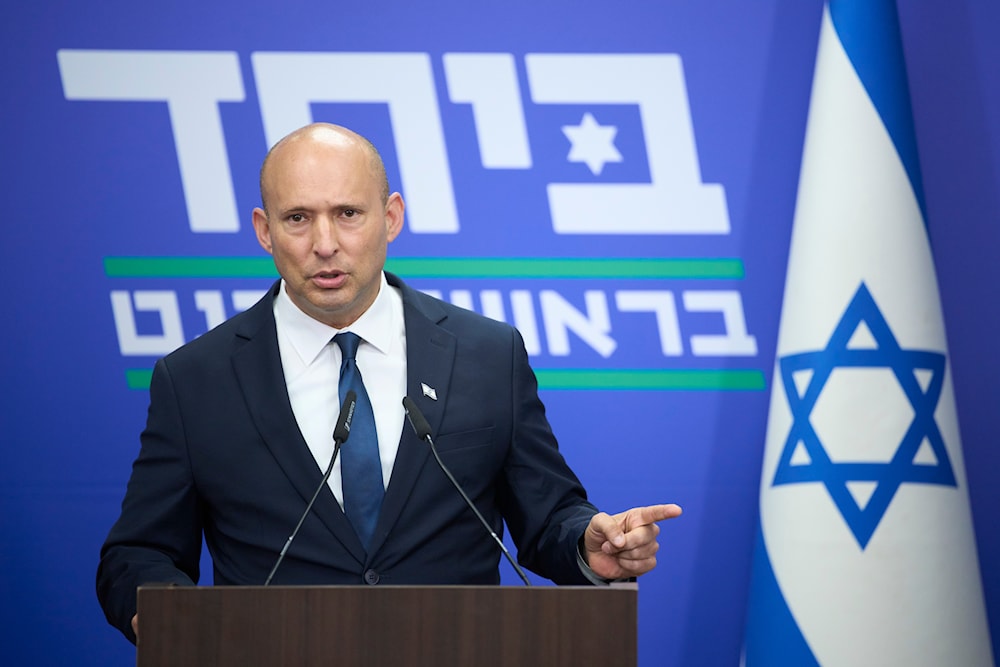
Former Prime Minister Naftali Bennett speaks to the media during the party session at the Knesset, "Israel's" parliament, in occupied al-Quds on May 20, 2026. (AP Photo/Ohad Zwigenberg)
Former Israeli Prime Minister Naftali Bennett criticized PM Benjamin Netanyahu's handling of the war on Iran and wider domestic issues, arguing that the current government's policies have weakened "Israel's" strategic position, economy, and international standing.
In an interview with The Times of Israel (ToI), Bennett criticized Netanyahu's overall approach toward Iran and its regional allies, as the US moves toward a framework agreement with Tehran aimed at ending the war.
Bennett said he would pursue the "Octopus Doctrine" if elected later this year, describing the approach as a long-term strategy designed to weaken the government in Tehran while "preventing Iran from acquiring nuclear weapons".
According to Bennett, prolonged military campaigns have imposed high costs on Israeli society, adding, "It’s never been Israel’s doctrine to have an ongoing war, which exhausts Israeli society, exhausts the reservists, exhausts the economy, and dramatically hurts our international standing".
Criticism of Netanyahu's leadership
Bennett's criticism extended beyond Iran policy, arguing that Netanyahu has lost the ability to effectively govern and address multiple challenges facing the occupation entity.
Four and a half months before elections that Bennett described as among the most consequential in Israeli history, he claimed the current government has failed to secure military victories, reduce crime, address economic pressures, integrate the ultra-Orthodox into wider settler society, and improve "Israel's" international image.
Speaking to ToI, he stressed that the political alliance he leads alongside former Prime Minister Yair Lapid, comes ahead of an "existential moment".
"Another four years with this government, we won’t have an economy, we won’t have a society," he said, arguing that unresolved disputes surrounding the ultra-Orthodox community would deepen existing social and economic strains.
"He simply can’t do it anymore. He can’t win wars. He can’t deal with crime. He can’t bring down prices. He can’t integrate the ultra-Orthodox into Israeli society", Bennett added.
A new political alliance
The new alliance brings together Bennett's political movement and Yesh Atid, the party led by Lapid. While Lapid remains a prominent figure within the partnership, Bennett has been designated as its candidate for prime minister.
However, a new public opinion poll by Israel Hayom indicates a significant advance for Gadi Eisenkot’s party, which has secured 20 seats for the first time since entering the political arena, overtaking the Bennett–Lapid list as efforts intensify to reshape political alliances ahead of the next Israeli election.
By contrast, the Bennett–Lapid alliance dropped to 19 seats, a decline of three compared with the previous survey.
Political repositioning
The interview highlighted Bennett's efforts to present himself as a figure appealing to a broader segment of Israeli society.
Bennett, who previously led the settlement movement and became the first kippah-wearing prime minister of "Israel", appeared to emphasize themes of "state institutions, civic equality, and national governance" rather than religious identity.
He argued that Netanyahu's reliance on far-right coalition partners Itamar Ben-Gvir and Bezalel Smotrich has constrained the government's decision-making. According to him, statements and actions by the two ministers have caused diplomatic damage without advancing "Israel's" interests.
Discussing relations with US President Donald Trump, Bennett praised several policies implemented during Trump's presidency, including the US' recognition of al-Quds as "Israel's" capital, the relocation of the US embassy, recognition of "Israel's" annexation over the occupied Syrian Golan Heights, the assassination of IRGC General martyr Qassem Soleimani, and the war on Iran.
At the same time, Bennett said that an Israeli prime minister must be prepared to challenge allies when national security considerations require it, suggesting that his business background would help him establish a productive working relationship with Trump.
Ultra-Orthodox draft exemptions
A major focus of Bennett's criticism was the occupation government's handling of military service exemptions for the ultra-Orthodox community.
During the interview, he described decades of policies toward the Haredi sector as a form of "slow-motion national suicide", arguing that successive governments had allowed a separate social and educational system to develop within the state.
Bennett expressed opposition to schools receiving funding while declining to teach subjects such as English, mathematics, civics, democracy, and Zionism.
He also criticized efforts by the current coalition to enshrine Torah study as a national priority through a Basic Law. "This bill has one goal: to renew the flow of billions of shekels a year to people who deliberately decide not to serve, not to work," Bennett said. "It uses the Torah as a tool for money."
Settler violence and law enforcement
Addressing violence by settlers against Palestinians, Bennett claimed most settlers in the occupied West Bank are law-abiding citizens who have allegedly experienced "years of attacks," framing them as defenders instead of attackers, as documented throughout decades. However, he condemned violence against Palestinians and against soldiers.
He argued that law enforcement should be applied consistently across all regions under Israeli control and pledged to restore what he described as "law and order".


