
Israeli occupation detains Press TV correspondent amid West Bank raids
 4 Min Read
Israeli occupation forces detained journalist Naqaa Hamed amid a wider campaign of raids, detentions, and military deployments across the occupied West Bank.
-
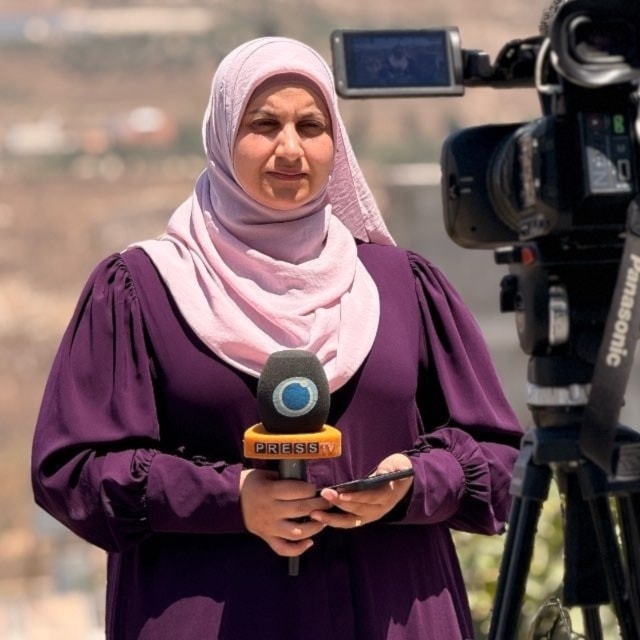
Press TV correspondent Naqaa Hamed, undated (Social media)
Israeli occupation forces detained Press TV correspondent Naqaa Hamed while she was returning from al-Khalil Governorate in the occupied West Bank, as occupation raids and detentions continued across several Palestinian cities and towns.
Local media reported that Hamed was detained along with her work crew after returning from al-Khalil, south of the West Bank, following settler incitement against her.
IOF raid several West Bank areas
The detention came as Israeli occupation forces carried out a broad campaign of raids across the occupied West Bank on Wednesday, raiding homes, detaining Palestinians, and deploying military units in several areas.
In Zaatara, east of Beit Lahm, the IOF deployed across several neighborhoods and raided a number of homes and facilities, searching the premises and damaging their contents.
In Nablus Governorate, two young men were detained during raids on Nablus city and the town of Asira al-Shamaliya, where several homes were also searched.
Israeli occupation forces storm the Al-Namsawi neighborhood in the west of the city of Nablus, in the occupied West Bank. pic.twitter.com/QeWo79Gr1Z
— Quds News Network (@QudsNen) September 15, 2026
In Yatta, south of al-Khalil, Israeli occupation forces raided the city with military vehicles and carried out an airborne deployment of soldiers from a helicopter. Footage showed military vehicles and troops moving through the city.
Israeli Settler militias set fire to a Palestinian agricultural structure in Masafer Yatta, south of Hebron in the occupied West Bank. pic.twitter.com/Z0dF7ZYYWv
— Quds News Network (@QudsNen) September 15, 2026
In southern al-Khalil, occupation forces detained a large number of Palestinians and subjected them to mistreatment before detaining a child and a young man. The two were held for more than four hours on al-Ikhwa Street.
Israeli occupation forces were dropped from a helicopter during a raid on the city of Yatta, south of Hebron, in the occupied West Bank. pic.twitter.com/9av5AG7IUL
— Quds News Network (@QudsNen) September 15, 2026
Extending detentions and raids
In Tulkarm Governorate, the IOF raided Deir al-Ghusun in the north and searched a home. A young man was also detained after forces raided his home in the al-Rashid neighborhood, east of Dhinnaba.
In Jenin Governorate, Israeli occupation forces entered the village of Zububa, west of Jenin, and raided several homes.
Israeli occupation forces are bulldozing Palestinian land planted with olive trees near the village of Aba, east of Jenin in the occupied West Bank. pic.twitter.com/ZbdGUxFQ47
— Quds News Network (@QudsNen) September 16, 2026
The IOF also raided Tuqu', southeast of Beit Lahm, and seized a motorcycle belonging to a delivery driver.
In the northern Jordan Valley, settlers were reported to have gathered near Palestinian homes in the Ain Ghazal area of Al-Farisiyah.
UN warns of record restrictions
Meanwhile, UN Women has warned that the West Bank is facing its most severe deterioration in two decades, as settler attacks, Israeli occupation military operations, and restrictions on Palestinian movement continue to intensify.
The UN agency said 925 movement obstacles are currently restricting Palestinians, the highest number recorded in 20 years. The measures include checkpoints, roadblocks, and trenches that hinder movement between Palestinian communities and access to essential services. UN Women said the worsening violence and restrictions are placing an especially heavy burden on women and girls.
The escalation is also accompanied by continued settlement expansion, land seizures, home demolitions, and attacks on Palestinian civilians and property.
Separately, the Wall and Settlement Resistance Commission warned that Israeli occupation authorities are increasingly using archaeological designations to restrict Palestinian use of land. The commission said recent notices issued in Qalqilya, Tulkarm, and Jenin do not formally amount to land seizures, but can prevent owners from building on or fully using their property.
Once land is designated as an archaeological site, construction and other uses require approval from an archaeology officer affiliated with the occupation’s so-called “Civil Administration.” The designations can also provide grounds for stop-work and demolition orders, according to the commission.
The commission said the measures form part of a broader system of administrative and planning restrictions that is expanding Israeli control over Palestinian land across the occupied West Bank.


