
Israeli police crack down on Haredi anti-conscription protests
 4 Min Read
Israeli police dispersed Haredi anti-conscription protests across several areas on Monday as tensions escalated over military draft enforcement, prompting ultra-Orthodox municipal leaders to suspend cooperation with law enforcement authorities.
-
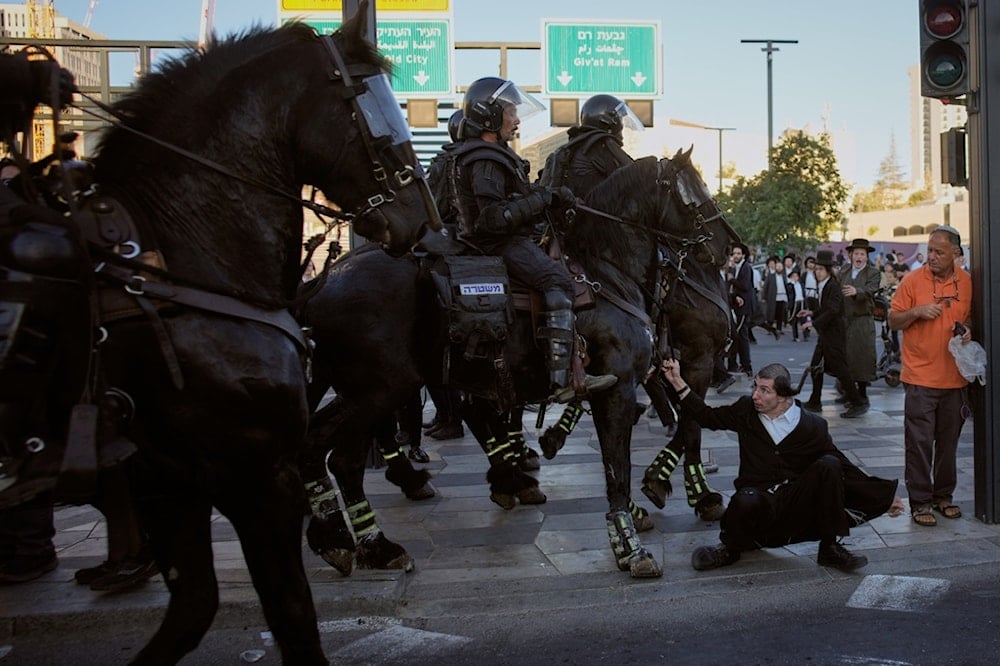
Israeli mounted police disperse Ultra-Orthodox Jews blocking a road during a protest against army draft in occupied al-Quds, Monday, June 1, 2026. (AP Photo/Ohad Zwigenberg)
Israeli occupation police used stun grenades on Monday to disperse Haredi settlers protesting against mandatory military conscription in occupied al-Quds, as demonstrations spread across multiple locations amid growing tensions over efforts to recruit ultra-Orthodox Jews into military service.
Hundreds of protesters took part in rallies and road blockades, denouncing what they view as an assault on their religious way of life. The demonstrations come amid an intensified campaign by Israeli authorities against Haredi draft evaders and a broader dispute over military service that has become one of the most divisive issues in Israeli society.
Demonstrations spread across occupied territories
Israeli media reported that anti-conscription protesters blocked the Gannot Junction on Highway 4, the Chords Bridge in occupied al-Quds, and the Hamazleg Junction in Netivot. Another protest was held in the northern city of Safed.
WATER CANNONS HAVE ARRIVED: Police deployed a water cannon at the protest in Ganot Junction, but demonstrators remained on the roadway and broke into dancing. pic.twitter.com/9NUjwNdsKT
— Moshe Schwartz (@YWNReporter) June 1, 2026
Israeli police said their forces were acting against what they described as "disturbers of public order and road blockers."
The latest protests follow clashes on Sunday evening in Beit Shemesh, where demonstrators reportedly stormed a police station, blocked roads, and threw stones. Israeli media said eight people were arrested and later released on Monday.
Conscription dispute deepens
The demonstrations are the latest manifestation of a long-running dispute over the military exemption traditionally granted to ultra-Orthodox Jewish men studying in religious institutions.
The issue intensified after Israeli authorities increased enforcement measures against individuals accused of evading military service, including the detention of Haredi youths wanted for failing to comply with draft orders.
Haredi leaders argue that compulsory military service threatens their religious lifestyle and undermines Torah study, which many within the community consider a central religious obligation. Anti-draft groups have repeatedly called on students to reject enlistment and resist recruitment efforts.
The controversy has gained further prominence as the Israeli military faces growing manpower pressures following months of war, prompting renewed calls from political and military circles for broader participation in military service.
Haredi municipalities suspend cooperation with police
In a significant escalation, Beitar Illit Mayor Meir Rubinstein, who also heads the Haredi Local Authorities Forum, announced that Haredi municipalities would suspend cooperation with Israeli police.
Rubinstein accused police of targeting the ultra-Orthodox community through the arrest of draft evaders, saying the force had effectively become "an enemy of the Haredi community."
According to "Israel's" Channel 13, Haredi municipal leaders said they would no longer cooperate with state authorities as long as arrests related to military conscription continue.
Rubinstein stated that the measures would include canceling agreements allowing police to use municipal buildings, ending community policing initiatives, and freezing cooperation on programs such as the "City Without Violence" initiative, social welfare coordination, and other joint projects.
He added that the deteriorating relationship with police could also affect the willingness of community members to report incidents to law enforcement, citing a complete loss of trust in the police institution.
Political challenge for Israeli authorities
The dispute has emerged as a major political challenge within "Israel," exposing growing tensions between the state and the ultra-Orthodox community.
While many secular Israelis and military reservists argue that military service should be shared equally across society, Haredi parties and religious leaders continue to oppose efforts to end long-standing exemptions for yeshiva students.
Read more: IOF risk personnel collapse by 2027 as manpower crisis deepens


