
Italy joins naval buildup near Hormuz in potential aggression on Iran
 3 Min Read
Italy announced the deployment of two naval minesweepers near the Strait of Hormuz as Western powers expand their military presence following the US-led war on Iran and ongoing maritime tensions in the Gulf.
-
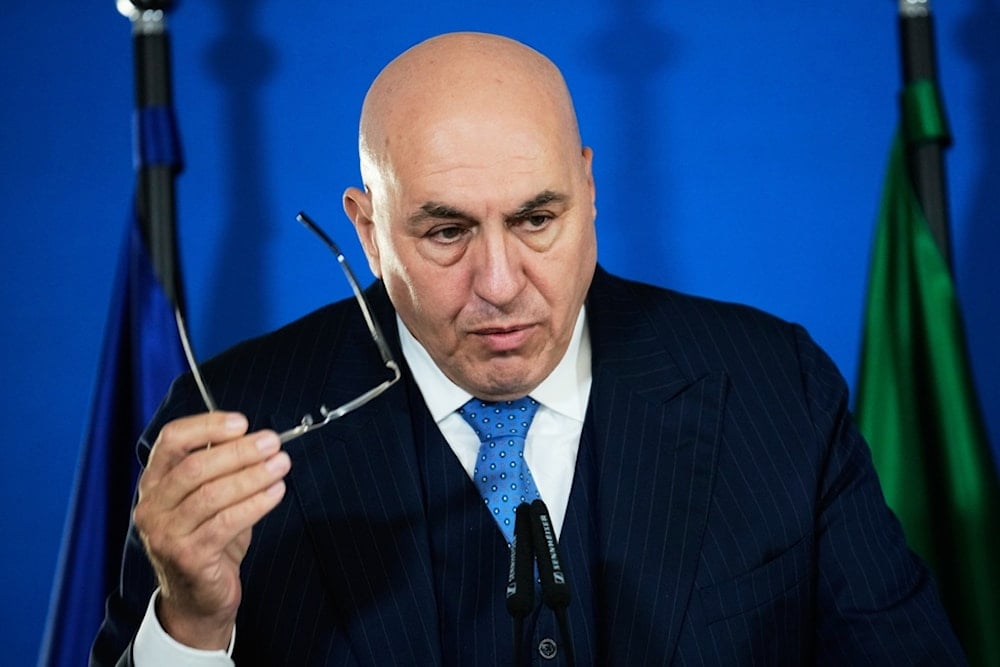
Italy's Defence Minister Guido Crosetto attends a press conference after the Five Defense Ministers meeting in Berlin, Germany, Friday, Nov. 14, 2025. (AP Photo/Ebrahim Noroozi)
Italy is preparing to deploy two naval minesweepers near the Strait of Hormuz as Western states continue expanding their military presence around one of the world’s most strategic waterways following the US-led war on Iran.
Addressing a joint session of the Italian parliament’s foreign affairs and defense committees on Wednesday, Italian Defense Minister Guido Crosetto said the vessels would participate in maritime operations tied to existing European military missions in the region.
“As a precautionary measure, we are arranging to deploy two minesweepers near the strait - first in the eastern Mediterranean, then in the Red Sea as part of ongoing missions such as Mediterraneo Sicuro and Aspides,” Crosetto was quoted as saying by the Ansa news agency.
The deployment comes amid a broader Western naval escalation in the region following recent talks led by Britain and France involving more than 40 countries on a proposed multinational mission.
The United Kingdom and France have framed the initiative as a “defensive” operation designed to protect maritime trade and energy flows, while London has already confirmed the deployment of HMS Dragon to the region ahead of the proposed mission.
Western naval escalation
The latest European military buildup follows months after the United States and “Israel” launched a large-scale aggression against Iran on February 28, triggering a regional confrontation that killed more than 3,000 people and pushed the Strait of Hormuz to the center of a global energy and maritime crisis.
Although Washington and Tehran later announced a ceasefire on April 8 and engaged in Pakistani-mediated talks in Islamabad, negotiations failed to produce a final breakthrough. Despite the ceasefire, the United States has continued enforcing a blockade targeting Iranian ports and maritime trade, while hostile Western powers have expanded naval operations across the Gulf, Red Sea, and eastern Mediterranean.
Commercial traffic through the Strait of Hormuz has remained heavily disrupted amid the confrontation, with shipping companies, insurers, and energy markets reacting to growing fears of further escalation and Western military intervention near Iranian waters.
The waterway carries a substantial share of global oil, petroleum products, and liquefied natural gas exports, making any disruption capable of triggering major international economic consequences, including rising fuel and transport costs worldwide.
Tehran warns Europe
Iranian officials have repeatedly warned against the growing presence of foreign warships near the strait, arguing that regional security should be managed by countries of the region rather than external powers aligned with Washington.
Iranian Foreign Ministry spokesperson Esmaeil Baghaei recently warned European governments against becoming involved in a US- and Israeli-driven war, stressing that additional foreign military deployments in the Gulf risk deepening instability and worsening the global economic fallout.
Tehran has also rejected Western claims portraying naval deployments as purely defensive, viewing the expanding military buildup as part of a broader campaign aimed at undermining Iran’s strategic position and pressuring the country following months of war and sanctions.
Read more: Iran rejects any US-aligned military presence in Hormuz: Gharibabadi


