
Japan leadership erases US from Hiroshima, Nagasaki history: Zakharova
 3 Min Read
Russia's Foreign Ministry has criticized Japan's leadership for omitting the United States from official commemorations of the Hiroshima and Nagasaki nuclear attacks.
-
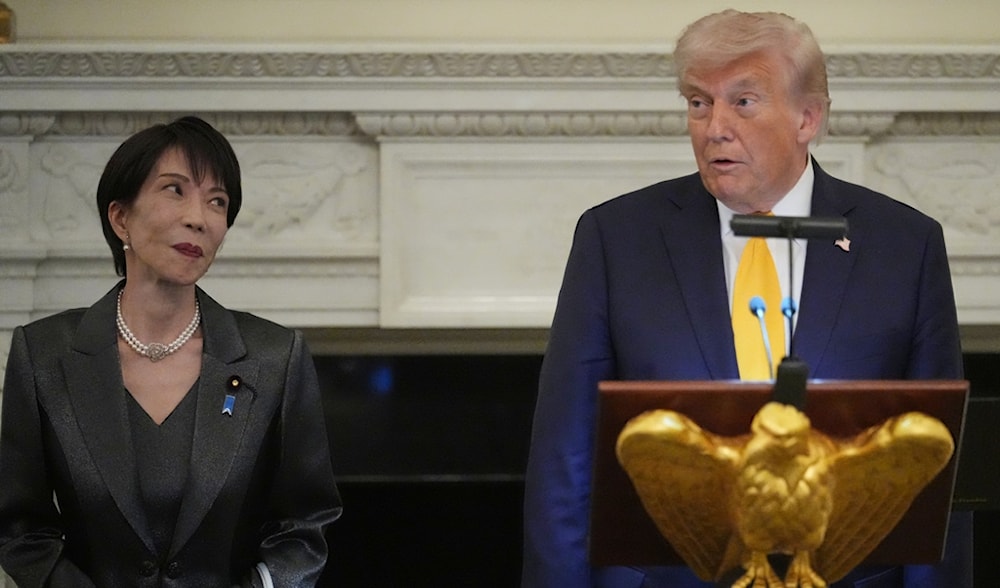
President Donald Trump attends a dinner with Japan's Prime Minister Sanae Takaichi in the State Dining Room of the White House on March 19, 2026, in Washington. (AP Photo/Julia Demaree Nikhinson)
Russian Foreign Ministry spokeswoman Maria Zakharova accused Japan's leadership of erasing the United States from the historical record of the atomic bombings, saying Tokyo now speaks as though Hiroshima and Nagasaki were struck by unidentified objects rather than US aircraft.
Writing on her Telegram channel on Sunday, Zakharova asked sarcastically whether Japan's current leadership believed the two cities were "hit by atomic UFOs".
Her comments followed the August 6 ceremony marking the 81st anniversary of the Hiroshima bombing, where Prime Minister Sanae Takaichi and Hiroshima Mayor Kazumi Matsui both spoke without identifying the country responsible for dropping the bomb on August 6, 1945.
Nagasaki mayor breaks the silence
Alternatively, Nagasaki Mayor Shiro Suzuki, in his address, stated plainly that a US military aircraft dropped the bomb on his city.
In his Declaration of Peace, delivered at a memorial ceremony for bombing victims, Suzuki said the single bomb dropped by a US aircraft on August 9, 1945 destroyed Nagasaki instantly. He noted that by the end of that year, the bombing had killed or injured roughly 150,000 people, about two-thirds of the city's population at the time.
Zakharova said Suzuki showed "courage" in naming the country responsible.
Meanwhile, Russian Foreign Ministry deputy spokesman Alexey Fadeev said Japanese authorities would eventually have no choice but to publicly acknowledge that the United States carried out the bombings.
A pattern of deference toward Washington
The omission fits a broader pattern critics have identified in Takaichi's foreign policy. Japanese opposition figures and commentators have described her approach to Washington as "fawning diplomacy," accusing her of following the United States' lead without pushing back on its positions. Her March 2026 visit to the White House drew domestic criticism after she reportedly made a series of concessions to President Trump without securing concrete commitments in return.
She also faced backlash for staying silent on the US-Israeli attacks on Iran during that visit, choosing instead to praise Trump. Japanese Communist Party chair Tomoko Tamura called the silence "deeply disgraceful."
Former senior Foreign Ministry official Hitoshi Tanaka has separately criticized Takaichi's cabinet for appeasing Washington even as it pursues constitutional revision and expanded arms exports under the banner of deterrence.
That posture stands in contrast to her stance toward Japan's neighbors. Her November 2025 remark that a Taiwan "emergency" could pose a "survival-threatening situation" for Japan triggered a prolonged diplomatic crisis with China and warnings from Japanese scholars and opposition parties that she was steering the country toward conflict. She has also used derogatory language against South Korea and rejected the Kono and Murayama Statements, which formally apologized for Japan's wartime atrocities.


