
Jordan's military deterrence erodes as Iran strikes US regional bases
 8 Min Read
Iranian strikes on US military positions in Jordan are testing Amman’s military posture and raising questions over its reliance on Washington.
-
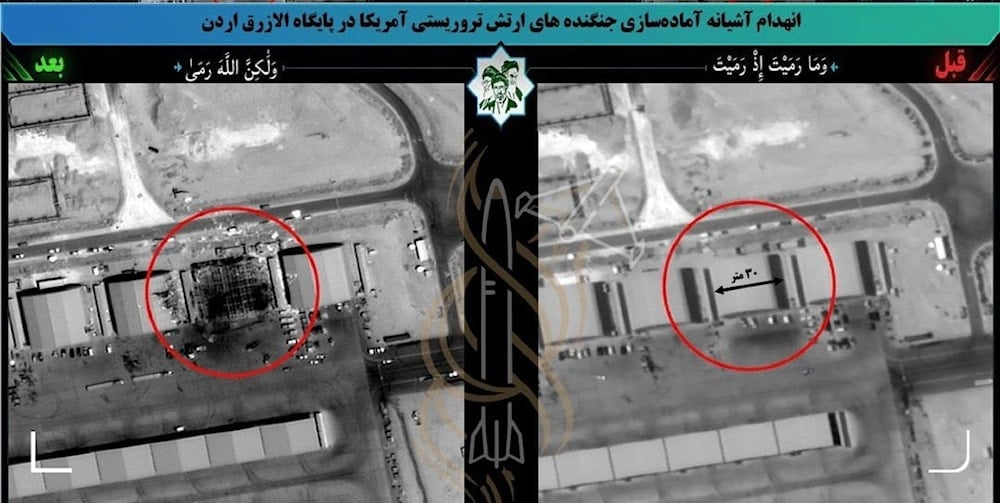
An image released on July 19, 2026, shows the damage caused to the Muwaffaq Salti Air Base in Jordan, which houses US fighter jets (X/@EGYOSINT)
In his analysis for the Atlantic Council, Aaron Magid argues that Jordan’s long-standing emphasis on military strength is increasingly at odds with its limited response to the current regional war. In Jordan’s military deterrence has collapsed, Magid examines how repeated Iranian strikes on US military positions in Jordan have tested Amman’s security posture, while the Jordanian Armed Forces (JAF) have largely limited their role to interception operations.
For decades, Jordan’s leadership has placed the military at the heart of the country’s national identity. King Abdullah II served more than 15 years in uniform after joining the British military and later the Jordanian Armed Forces, describing military service as an "honor to be proud of, a great responsibility, and a sacred national duty." His eldest son, Crown Prince Hussein, is also a JAF officer and was promoted to major in 2024 after serving as an infantry platoon commander.
The crown prince announced mandatory national conscription last year as part of an effort to build a "stronger" Jordan that would be "self-reliant". Amman has also maintained close military ties with Washington as a major non-NATO ally of the US, regularly acquiring advanced weapons and hosting US military forces and facilities.
That relationship has become particularly significant during the current war on Iran. Since February, Iran’s Islamic Revolution Guard Corps (IRGC) has launched hundreds of drones and ballistic missiles against US military positions across the region, including facilities in Jordan.
WATCH | Footage shows the moment Iran launched its combined missile-drone operation targeting the US-operated King Hussein and Al-Azraq airbases in Jordan. pic.twitter.com/gxlkEKNsZn
— Al Mayadeen English (@MayadeenEnglish) August 30, 2026
Jordan's military response
Magid contrasts Jordan’s current approach with the forceful response adopted after the Islamic State of Iraq and al-Sham (ISIS) killed Jordanian first lieutenant Muath al-Kasasbeh in 2015.
ISIS had captured the pilot and brutally executed him by burning him alive inside a cage. Jordan responded by promising an “earth-shattering response,” and its Air Force subsequently carried out more than 50 strikes against ISIS training camps and weapons depots in Syria and Iraq.
At the time, Abdullah appeared to regard military retaliation as necessary to demonstrate that an attack on a Jordanian serviceman would carry a high cost, the author said. The kingdom’s response became an example of the military role Jordan was willing to play when confronting a direct threat.
The current situation is different. Iranian strikes have largely been directed at US military assets in Jordan as part of Tehran’s broader confrontation with Washington, rather than being presented as a campaign against Jordanian civilian or military targets. Still, the attacks have exposed the risks associated with Jordan’s close military relationship with the US.
The IRGC struck an Azraq military base in July, killing three US soldiers. The repeated incidents have also raised concerns about the effect of war on Jordan’s tourism-dependent economy. Yet the JAF has not announced a retaliatory strike against Iran.
Questions surround Jordan's role in intercepting Iranian missiles
Amman has portrayed its military activity this year primarily as "defensive". A senior JAF officer claimed the military had intercepted hundreds of Iranian projectiles during "Operation Jordan Shield".
The extent of that role, however, has been difficult to establish independently. In July, US President Donald Trump said US forces were responsible for shooting down Iranian ballistic missiles over Jordan and did not cite the JAF.
The New York Times (NYT) subsequently reported on Iranian tactics designed to evade American air defenses during earlier attacks on the Kingdom, again focusing on the US military response. The JAF later said it had intercepted eight ballistic missiles during the latest Iranian barrage.
Magid argues that the conflicting accounts leave uncertainty over how many Iranian missiles Jordan has actually intercepted. He also raises the possibility that Amman could be emphasizing its own role in interceptions carried out with US assistance to make the defensive operation more politically acceptable domestically.
Jordan’s government has not provided a detailed public accounting of the respective roles played by its forces and US personnel.
A senior Iranian political-security source told Al Mayadeen that Tehran "responded forcefully" to the latest US attacks, carrying out "harsh and painful strikes against the terrorist US military base in #Jordan."#USBase #IranWar #WarOnIran #Iran #US pic.twitter.com/SVvF8EFcnV
— Al Mayadeen English (@MayadeenEnglish) August 31, 2026
Why Amman has avoided direct retaliation
According to Magid, there are several reasons for Jordan to be cautious about taking military action against Iran. The kingdom has a large Palestinian-origin population, and Abdullah could face domestic criticism if Jordan were perceived as joining a campaign that benefits “Israel” or directly supports Washington’s military aggression against Tehran.
The US military presence itself is also controversial. Although there is limited reliable polling on Jordanian attitudes toward US forces, former minister Amjad al-Majali led a letter signed by hundreds of Jordanians calling for the expulsion of US troops.
Abdullah has condemned the Iranian attacks but has not publicly called for Jordanian military retaliation. Magid notes that the king’s only interview since the war with Iran began in February was with Chinese state media, where the Iranian strikes were not raised.
There are also practical military considerations. A Jordanian attack on Iran could trigger a stronger response against the kingdom, potentially drawing Amman deeper into a war it has allegedly sought to contain. The government may therefore have concluded that allowing Washington to handle offensive operations against Tehran is preferable to opening a separate Jordanian front.
Iran's pressure reflects its wider confrontation with Washington
Magid argues that it is significant that Jordan became one of the IRGC’s principal targets during the second wave of attacks this summer while other targets were not subjected to the same level of Iranian fire.
He claimed that Tehran may have calculated that Amman would be less likely to retaliate, particularly after Jordan did not respond militarily to earlier attacks in March and April. But Iran’s targeting of Jordan also fits into the wider pattern of its military confrontation with the US. The Islamic Republic has repeatedly stressed that its military targets include those involved in aiding US hostile operations against Iran.
Flight navigation data confirms the US drone attack on Iran's Larak Island was launched from Jordan and carried out with support from Jordanian bases, Iran's Fars News Agency reported, citing the data. pic.twitter.com/h7KPlpOIsC
— Al Mayadeen English (@MayadeenEnglish) August 30, 2026
Jordan hosts US military installations and personnel, making US positions inside the kingdom part of the regional military infrastructure available to Washington. Iranian strikes against those positions have consequently placed Jordan in the line of fire without necessarily making the Jordanian state itself the primary target.
For Amman, that creates a strategic problem. Remaining closely aligned with Washington provides military and political benefits, but the same relationship can make Jordan vulnerable when the US conducts operations against regional adversaries.
The costs of Jordan's military restraint
Magid also argues that Abdullah’s decision not to retaliate has already weakened Jordan’s military deterrence. In his assessment, the kingdom risks appearing unable or unwilling to impose costs on an adversary that repeatedly launches attacks in its vicinity.
The concern is particularly relevant because Jordan hosts thousands of US troops. Iran’s July 28 "surprise attack" against US forces in Jordan came after Trump paused strikes on Iran several days earlier, while Sunday night’s barrage followed a US strike on Larak island.
Both episodes underscored Jordan’s exposure to the wider confrontation. The kingdom can seek to stay outside the war, but its military relationship with Washington makes complete separation difficult.
In October 2024, Abdullah met Iranian Foreign Minister Abbas Araghchi following an earlier round of attacks. The king told Araghchi that “Jordan will not be a battleground for regional conflicts.” However, Jordan has repeatedly intercepted Iranian missiles and drones heading toward "Israel", therefore involving itself directly in the war.
Jordan's depressed deterrence
Magid ultimately argues that the gap between Jordan’s military image and its current posture could damage the kingdom’s deterrence. The JAF has a long history of being presented as a central pillar of national strength, yet its response to the current crisis has largely remained defensive.
For now, Amman has chosen restraint. Whether that approach ultimately protects Jordan from becoming more deeply involved in the war or instead encourages further pressure on the kingdom is the central question raised by Magid’s analysis.
Read more: Syria, 'Israel' mull 'special operations room' in Jordan


