
KSA, UAE secretly bombed Iran in coordination with US, 'Israel': WSJ
 3 Min Read
The Wall Street Journal reports that the UAE and Saudi Arabia are conducting covert strikes against Iran in coordination with the US and "Israel", deepening Gulf tensions.
-
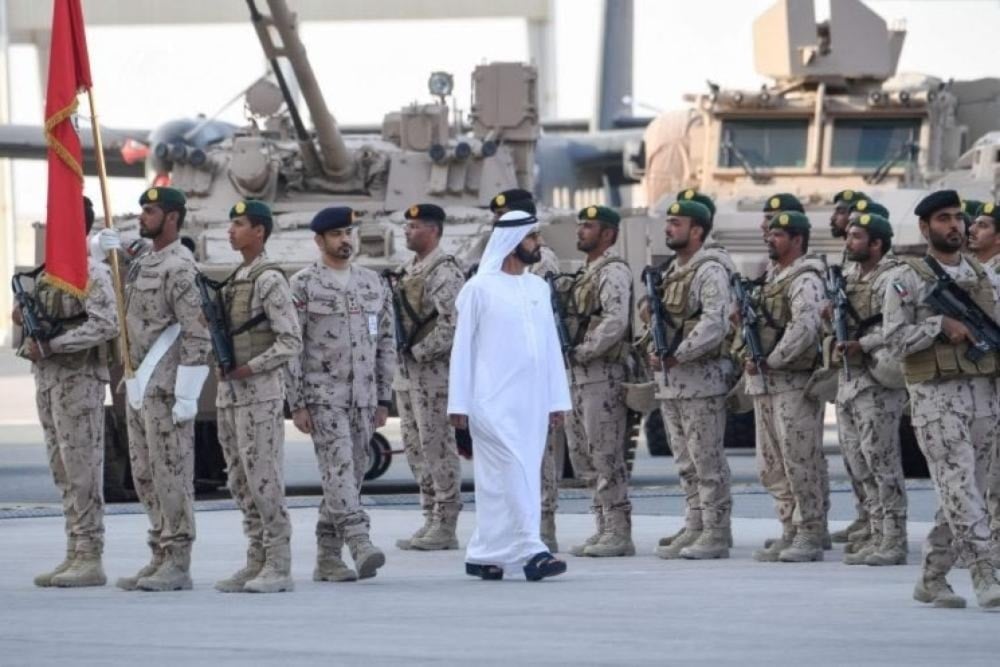
Undated photo of UAE Prime Minister Mohammed bin Rashid al-Maktoum, walking with military personnel during a reception at the Zayed Military City in Abu Dhabi (AFP PHOTO)
The United Arab Emirates and Saudi Arabia carried out multiple military attacks against Iran in secret coordination with the United States and "Israel" during the opening phase of the war, a Wall Street Journal investigation on Saturday has revealed, shattering a fragile regional equilibrium and exposing the deep involvement of the Gulf monarchies in the US‑Israeli aggression on Iran.
The report says the UAE conducted multiple strikes in coordination with the United States and “Israel,” using warplanes and Chinese-made drones. Among the targets was reportedly a refinery on Iran’s Lavan Island in the Gulf.
Saudi Arabia, meanwhile, is said to have carried out airstrikes targeting alleged Iranian drone and missile launch sites, as well as positions in Iraq linked to resistance factions.
Neither Riyadh nor Abu Dhabi has officially confirmed the operations, and US officials also declined to comment on the reported strikes.
Shift from restraint to direct confrontation
The attacks represent a major shift in Gulf policy, coming after years in which direct military confrontation with Iran was widely considered unlikely due to the risk of regional escalation and economic disruption.
In recent years, Gulf states have moved toward cautious rapprochement with Tehran. Saudi Arabia restored diplomatic relations with Iran in 2023 through a China-brokered agreement, while Gulf governments repeatedly urged Washington to avoid a direct war.
However, the outbreak of the US-Israeli aggression on Iran in February, alongside Iranian missile and drone strikes on Gulf infrastructure, appears to have altered that calculus.
Diverging Gulf strategies toward Iran
The report highlights growing divergence between Saudi Arabia and the UAE in their approach to Iran as the war continues.
The UAE has adopted the most aggressive stance, including bombing an Iranian refinery.
Yasmine Farouk, project director for the Gulf and Arabian Peninsula at the International Crisis Group, told the Journal that the UAE is trapped, unable to defend its own interests without the American military threat hanging over Iran's head.
Saudi Arabia has adopted a more conciliatory stance, pushing for diplomatic solutions to a war that has endangered its massive energy infrastructure while domestic financial pressures mount.
Analysts say the war has further exposed regional unease over long-term reliance on US security guarantees, prompting some Gulf states to act more independently in responding to Iranian threats.
Strait of Hormuz tensions remain central
The escalation comes amid ongoing instability in the Strait of Hormuz, a critical global oil shipping route that has seen repeated disruptions since the start of the war.
Iran’s leverage over the waterway, combined with retaliatory strikes across the Gulf, has heightened fears of prolonged instability in global energy markets.
Rather than uniting the Gulf states, the war has deepened the divide between Riyadh and Abu Dhabi. The UAE has thrown its weight behind Western and Israeli alliances, while Saudi Arabia increasingly seeks a diplomatic off‑ramp from the war.


