
UAE pushed Gulf military action against Iran, report reveals
 3 Min Read
The UAE reportedly urged Gulf states to coordinate an aggression against Iran during the US-Israeli war on the Islamic Republic, but Saudi Arabia, Qatar, and other Gulf countries resisted escalation.
-
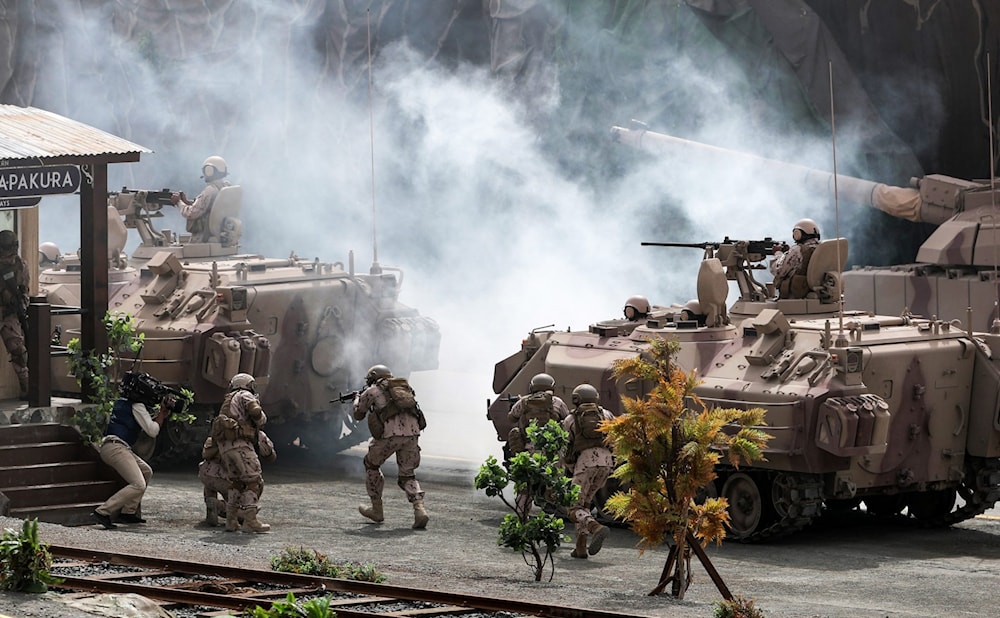
Emirati armed forces during a military show at the opening of the International Defence Exhibition and Conference (IDEX) in Abu Dhabi on February 19 2017. (Karim Sahib/AFP)
The United Arab Emirates reportedly attempted to persuade Gulf states, including Saudi Arabia and Qatar, to participate in a coordinated military response against Iran following the launch of the US-Israeli war on the Islamic Republic.
According to Bloomberg, UAE President Mohammed bin Zayed Al Nahyan held urgent calls with regional leaders shortly after the United States and "Israel" began strikes on Iran on Feb. 28.
The report said MBZ believed Gulf states needed a unified military response after Tehran's retaliatory strikes on US military installations and infrastructure used to strike Iran on their territory.
According to a source cited by Bloomberg, the UAE leadership quickly aligned itself with Washington and "Israel" during the confrontation.
Saudi Arabia and Qatar resisted escalation
Despite pressure from Abu Dhabi, several Gulf states reportedly refused to join a coordinated military aggression against Iran.
According to Bloomberg, Saudi Crown Prince Mohammed bin Salman and other Gulf leaders argued that the war was not their own.
The refusal reportedly deepened tensions between the UAE and Saudi Arabia, whose relations had already deteriorated over economic competition and disagreements surrounding Yemen and Sudan.
During discussions with Gulf leaders, MBZ reportedly reminded counterparts that the Gulf Cooperation Council was originally established in 1981 partly in response to fears surrounding the aftermath of Iran’s Islamic Revolution.
The report also stated that Bahrain, Kuwait, and Oman declined to join military escalation against Iran, while Qatar ultimately prioritized mediation and de-escalation efforts.
Doha reportedly considered retaliatory action after Iran struck Ras Laffan, one of the world’s largest liquefied natural gas facilities, before stepping back from direct action.
Read more: Mossad chief made two secret visits to UAE during war on Iran: WSJ
Abu Dhabi deepened military coordination with the Israeli regime
Bloomberg notes that the UAE and "Israel" expanded military and intelligence coordination during the war.
According to sources cited by Bloomberg, the two sides cooperated on intelligence sharing, interception efforts, and coordination related to targeting inside Iran.
"Israel" reportedly transferred air defense systems and personnel to the UAE during the confrontation.
A phone call between MBZ and Israeli Prime Minister Benjamin Netanyahu was also publicly acknowledged by both governments earlier this month.
The UAE, which normalized relations with the Israeli regime under the US-sponsored normaliztion accords in 2020, reportedly viewed itself as the Gulf state most heavily targeted during the war.
Bloomberg reported that Iran launched nearly 3,000 drones and missiles toward the UAE before a fragile ceasefire took hold in April.
Iran’s strikes exposed fractures across Gulf alliances
The war on Iran exposed major strategic divisions across Gulf capitals, including over how to manage relations with Washington and "Israel".
While the UAE reportedly favored direct military coordination alongside the US and the Israeli occupation, other Gulf governments feared broader regional escalation and potential economic collapse.
Saudi Arabia reportedly shifted toward diplomatic mediation efforts involving Pakistan after initially conducting limited strikes against Iran in March.
According to the report, Abu Dhabi later expressed frustration that it had not been adequately consulted regarding Pakistan-led mediation initiatives between Tehran and Washington.
The tensions coincided with the UAE’s decision to withdraw from OPEC in late April, a move widely viewed as reflecting deeper political and economic disputes with Saudi Arabia.


