
Mossad chief made two secret visits to UAE during war on Iran: WSJ
 5 Min Read
Mossad director David Barnea made covert trips to the UAE during the war on Iran in March and April to coordinate war efforts amid growing security ties.
-
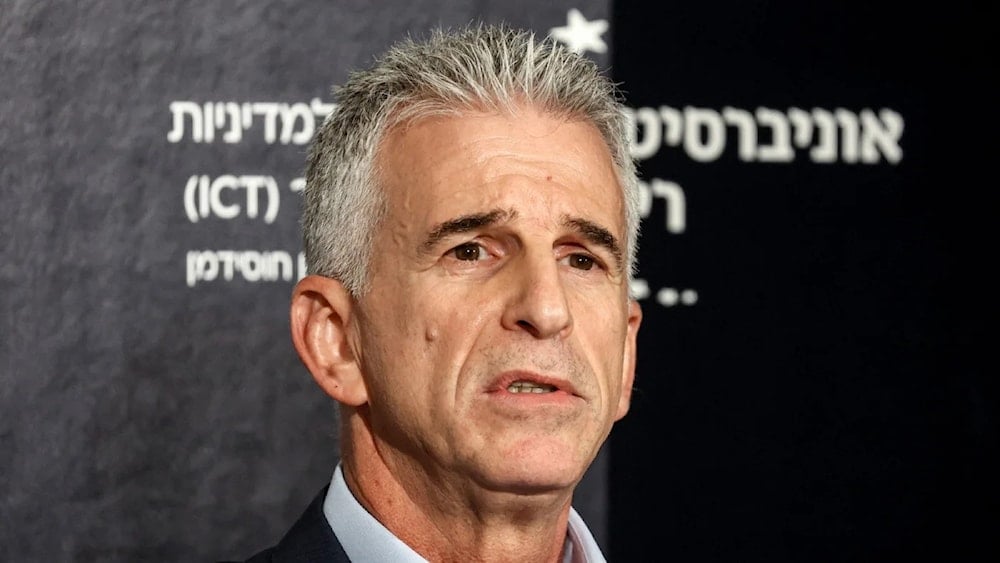
Israeli Mossad chief David Barnea speaks during the International Institute for Counter-Terrorism (ICT) World Summit in the central coastal city of Herzliya, "Israel", September 10, 2023 (AFP)
The head of the Israeli spy agency Mossad made at least two secret visits to the United Arab Emirates during the war on Iran to help coordinate military and security efforts, according to an exclusive report by The Wall Street Journal.
Citing Arab officials and a person familiar with the matter, the report said Mossad chief David Barnea traveled to the UAE on separate occasions in March and April amid escalating regional tensions.
According to the WSJ, the visits reflected growing security cooperation between the UAE and "Israel" during the war.
The newspaper reported that coordination between the two sides included joint defensive and military efforts, with "Israel" reportedly sending Iron Dome batteries and military personnel to the UAE to assist in intercepting Iranian projectiles.
The report also said the UAE carried out strikes inside Iran during the war, including an attack targeting a refinery on Lavan Island in the Gulf.
Inside UAE’s expanding partnership with 'Israel'
Israeli Iron Dome deployment to UAE
US Ambassador to "Israel" Mike Huckabee confirmed Tuesday that "Israel" had deployed Iron Dome air defense batteries and military personnel to the UAE, publicly acknowledging expanding military coordination between Tel Aviv and Abu Dhabi during the war on Iran.
Speaking at an event in Tel Aviv, Huckabee said the systems were sent to assist the UAE in intercepting Iranian projectiles, describing the move as part of the “extraordinary relationship” established under the 2020 normalization agreement between the UAE and "Israel".
A source familiar with the matter told Reuters that the air defense systems were deployed urgently as Iranian strikes increasingly targeted Emirati territory. Since the outbreak of the US-Israeli war on Iran on February 28, the UAE has reportedly faced more Iranian attacks than any other country in the region.
The remarks came weeks after senior Emirati official Anwar Gargash, an advisor to the UAE president, said Iranian attacks on Arab states would deepen ties between "Israel" and Arab governments that normalized relations with Tel Aviv. Speaking on March 17, Gargash suggested the war had reinforced strategic cooperation between Abu Dhabi and the Israeli occupation, amid growing regional tensions linked to the war.
Secret UAE strikes on Iran
Another WSJ report on Tuesday stated that the UAE secretly carried out strikes on Iran during the US-Israeli war on the Islamic Republic, marking a previously undisclosed escalation in Gulf involvement in the war.
The report said one strike targeted an oil refinery on Lavan Island in the Gulf in early April, sparking a major fire and temporarily disrupting production. Iran later said the facility had been hit by an "enemy attack" before launching retaliatory missile and drone strikes against the UAE and Kuwait.
According to the report, analysts viewed the strikes as evidence of a more direct Emirati military role in the war, amid growing regional tensions and economic fallout linked to the war.
UAE urges action against Iran
Earlier this month, Israeli media Kan 11 reported that the UAE is no longer limiting its response to diplomatic condemnations and is instead actively pressing Washington to take military action against Iran, arguing that Tehran should be “punished” over missile attacks that Iran denies carrying out.
The report further claims that a senior Emirati official conveyed this position directly to "Israel’s" ambassador in Abu Dhabi, Yossi Shelley, urging efforts to “make the American administration act” and stressing that the Iranian government “must be punished” without tolerance.
Iranian MP warns UAE against alignment with US, 'Israel'
On May 11, Ebrahim Rezaei, spokesperson for the National Security and Foreign Policy Committee in the Iranian Parliament, said that several regional countries have reportedly reassessed earlier miscalculations and have sent messages to Iran.
In comments to Tasnim News Agency, Rezaei said Bahrain and the United Arab Emirates are still following "an incorrect path," adding that Tehran would not allow the formation of a “UAE–Israel” axis in the region.
He also said the war has not ended and that no real ceasefire exists, noting there are no clear prospects at present for a political agreement with the United States.
Separately, Iranian parliament presidium member Rouhollah Motefakker Azad warned the United Arab Emirates against involvement in the war, saying Abu Dhabi should avoid aligning with Israeli and US interests.
He added that if the UAE acted with “strategic rationality”, it would not place itself in a position beyond its capacity for the sake of the interests of "Israel" and the United States, which he said have failed in the current confrontation.


