
KSA and Turkey issue joint statement on Gaza, Syria, regional security
 4 Min Read
Saudi Arabia and Turkey issued a joint statement during President Erdogan’s visit to Riyadh, calling for a Gaza ceasefire, an end to the occupation, and the restoration of the Palestinian Authority's role in the Strip.
-
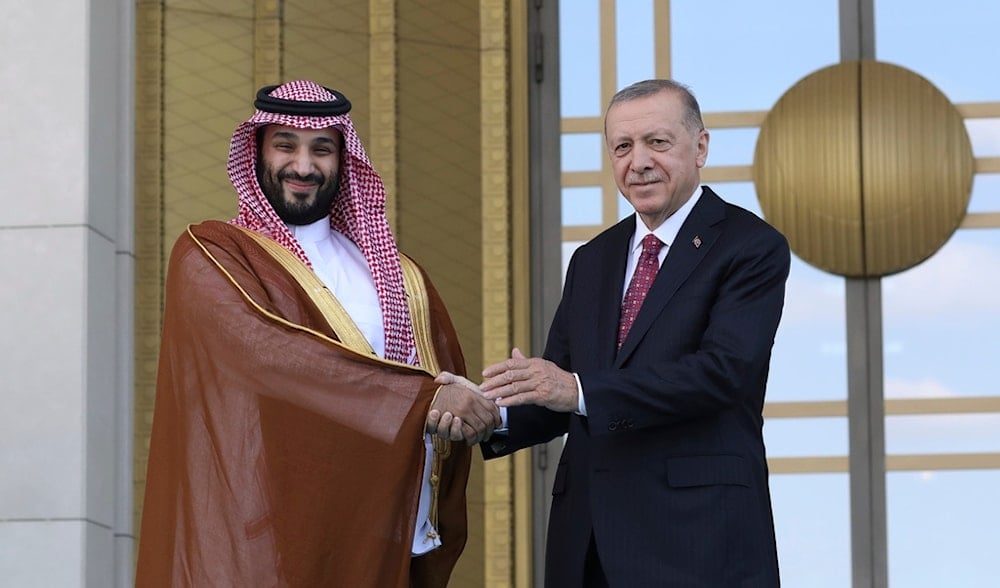
Turkish President Recep Tayyip Erdogan, right, and Saudi Crown Prince Mohammed bin Salman shake hands during a welcome ceremony in Ankara, Turkey, June 22, 2022. (AP)
Saudi Arabia and Turkey issued a joint statement on Wednesday at the conclusion of Turkish President Recep Tayyip Erdogan’s official visit to Riyadh, emphasizing the urgent need to uphold the ceasefire in Gaza, end the occupation, and pave the way for the return of the Palestinian Authority to assume its responsibilities in the Strip.
According to the statement, published by the Saudi Press Agency (SPA), both sides expressed deep concern over the worsening humanitarian conditions in Gaza due to the ongoing Israeli aggression and the obstruction of humanitarian aid.
Stressing the importance of intensifying relief efforts and opening all crossings to ensure the delivery of aid throughout the entire Strip, Saudi Arabia and Turkey underscored the importance of international pressure on the occupying forces to protect civilians, safeguard vital infrastructure, and adhere to international humanitarian law.
Both sides reiterated their support for launching the second phase of the comprehensive peace plan in Gaza and highlighted their roles in the Peace Council in supporting international mediation efforts.
The statement also commended the humanitarian initiatives led by both Turkey and Saudi Arabia, urging the uninterrupted flow of humanitarian aid and the immediate opening of all crossings into Gaza. They also condemned the continued aggression and the consequent humanitarian catastrophe.
Support for PA role in Gaza
Riyadh and Ankara emphasized the importance of restoring the Palestinian Authority's governance over Gaza as part of a broader effort to achieve lasting peace and unity for the Palestinian people.
This comes in light of its arbitrary exclusion from the so-called "Board of Peace," after Israeli Prime Minister Benjamin Netanyahu unilaterally prohibited the Palestinian Authority (PA) from having any role in governing "post-war Gaza".
“The Prime Minister clarified that the Palestinian Authority will not be involved in administering the [Gaza] Strip in any way,” an Israeli statement read.
The PA's potential role in Gaza was left unclear after US President Donald Trump formed the "Board of Peace," with reports omitting whether the Ramallah-based Palestinian government was invited to partake in the colonial-style initiative.
Regional developments explored
Israeli violations in Syria
Regarding Syria, the transitional government was praised for its efforts to preserve national security and stability. Turkey and Saudi Arabia both reaffirmed support for the implementation of the ceasefire agreement with the Syrian Democratic Forces (SDF), rejecting Israeli violations of Syrian territory, and calling for the immediate withdrawal of occupation forces.
Yemen’s sovereignty and dialogue
On the situation in Yemen, Saudi Arabia and Turkey affirmed their support for Yemeni legitimacy and the preservation of the country’s sovereignty and unity. They stressed the importance of achieving national consensus and resolving the crisis through comprehensive dialogue.
Somalia, Sudan, and Ukraine
Regarding Somalia, the joint statement reaffirmed support for Somali sovereignty and territorial integrity while rejecting any attempts to impose parallel entities in violation of international law. This comes after the Israeli occupation recognized Somaliland as an independent state, in a clear infringement of Somali sovereignty.
In Sudan, both sides expressed support for the country’s unity, security, and stability. They rejected the formation of illegitimate entities and the influx of foreign weapons, while emphasizing the protection of civilians and the facilitation of humanitarian aid.
The two nations also reiterated their backing for a comprehensive settlement of the conflict in Ukraine through negotiations based on international law and the United Nations Charter.
Bilateral agreements activated, enhanced
During the visit, several agreements and memoranda of understanding were signed between the two countries across multiple fields, including energy, justice, space, research, development, and innovation.
Ankara and Riyadh also agreed to activate defense cooperation agreements and enhance joint efforts to ensure regional stability and security. This includes combating terrorism, extremism, and their financing, as well as strengthening cooperation in cybersecurity, training, and knowledge exchange.
Read more: Turkey prepares to repay $5 billion deposit to Saudi Arabia


