
Lula, Flavio Bolsonaro kick off Brazil election campaigns
 4 Min Read
Brazil's presidential race pits President Luiz Inácio Lula da Silva against Flávio Bolsonaro amid US pressure, economic concerns, and a battle for independent voters.
-
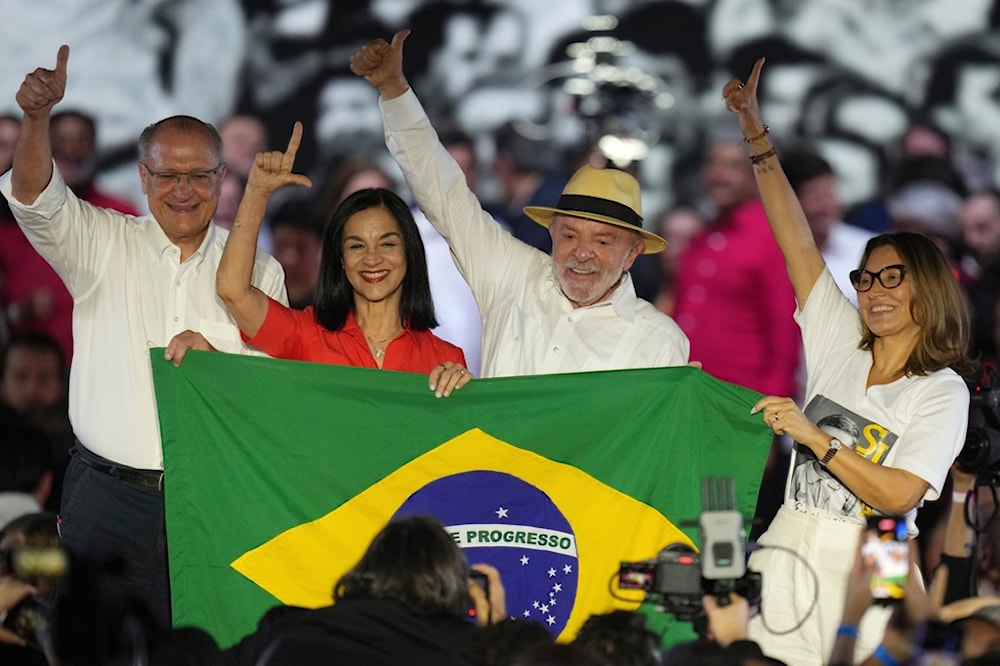
Brazilian President Luiz Inacio Lula da Silva, second right, Vice President Geraldo Alckmin, left, Brazil's first lady Rosangela da Silva, right, and Vice President's wife Lu Alckmin hold a Brazilian flag during the Workers' Party convention, where Lula was confirmed as the party's presidential candidate for the next election, in Sao Paulo, Brazil, Sunday, Aug. 2, 2026 (AP)
Brazil's presidential election campaign officially gets underway on Sunday, with leftist President Luiz Inacio Lula da Silva and right-wing Senator Flavio Bolsonaro launching their campaigns in a contest that is already drawing comparisons with the country's deeply polarized 2022 election.
Lula, 80, is seeking a fourth and final term in office, while Flavio Bolsonaro, 45, has entered the race as the son of former far-right President Jair Bolsonaro. The presidential election is scheduled for October 4, with voters heading to the polls amid persistent political polarization and growing pressure from US President Donald Trump, who has openly backed conservative candidates in recent Latin American elections.
AFP reported that the race features around a dozen presidential candidates, although those trailing the two frontrunners are polling in the single digits. A Quaest poll released Friday showed Lula leading Flavio Bolsonaro by 43% to 40% in a projected runoff.
Both leading candidates face rejection rates exceeding 50%, making independent voters a potentially decisive constituency. AFP reported that Bolsonaro has made gains among this group as the campaign gets underway.
Lula launches campaign amid tensions with Trump
Lula is set to launch his campaign with a rally in Sao Bernardo do Campo in Sao Paulo state, where he began his political career as a metalworker and union leader in the 1970s.
The veteran leftist returned to the presidency in 2023 after previously serving two terms. His political comeback followed a period in which he was imprisoned on corruption convictions that were later annulled.
During his third term, Lula has been credited with expanding social programs, implementing a major tax system overhaul, and reducing deforestation in the Amazon, according to AFP.
Brazilian sovereignty and relations with the United States are expected to feature prominently in Lula's campaign, particularly amid US tariffs and pressure from Trump, who has maintained close ties with Bolsonaro's political camp.
Lula said Friday that he wanted to tell Trump, "Don't meddle in Brazil's affairs, especially regarding the election. If you do meddle, you'll lose."
Lula has also pledged to increase defense spending and make combating organized crime a priority, as security remains a major concern for Brazilian voters.
Flavio Bolsonaro presents himself as a 'moderate alternative'
Flavio Bolsonaro was pushed to the forefront of the Bolsonaro political movement after his father was jailed over an attempt to overturn his defeat to Lula in the 2022 presidential election.
The 45-year-old senator has sought to portray himself as a more "moderate version" of his father while continuing to draw on Jair Bolsonaro's political support and influence.
Flavio Bolsonaro has urged supporters to wear T-shirts bearing his father's image at his campaign rally on Rio de Janeiro's Copacabana beach, a location where the former president regularly attracted large crowds.
The senator has pledged to "rescue" Brazil, emphasizing tougher measures against crime and fiscal responsibility as central elements of his campaign.
Economic gains fail to convince all voters
Brazil's economic indicators provide Lula with several points to highlight during the campaign. The country's statistics agency IBGE reports that poverty rates are at their lowest level since comparable records began in 2012.
The economy has also recorded solid growth, unemployment has fallen to record-low levels, and inflation has declined.
Independent voters, women could prove decisive
Political analysts cited by AFP said the election could ultimately be decided by voters who remain disengaged from the contest.
Mayra Goulart, a political science professor at the Federal University of Rio de Janeiro, told AFP that the main challenge for both Lula and Flavio Bolsonaro would be reaching "disengaged voters" who are highly likely to abstain.
Jairo Nicolau, a professor at the Getulio Vargas Foundation, told AFP that women represent another crucial electoral constituency.
Women account for 53% of Brazil's 158 million registered voters, are more likely to cast ballots, and played an important role in Lula's victory in 2022.
With the campaign now underway, Lula and Flavio Bolsonaro face a familiar political divide, while competing for voters who remain unconvinced by either side and could determine who advances from the October vote to a potential runoff.
Read more: Flavio Bolsonaro launches Brazil bid, touts Milei, Netanyahu support


