
Macron calls on Europe to lessen reliance on US
 4 Min Read
French President Emmanuel Macron urges the EU to boost investment in key sectors to counter the US and China, warning Europe faces marginalization without action.
-
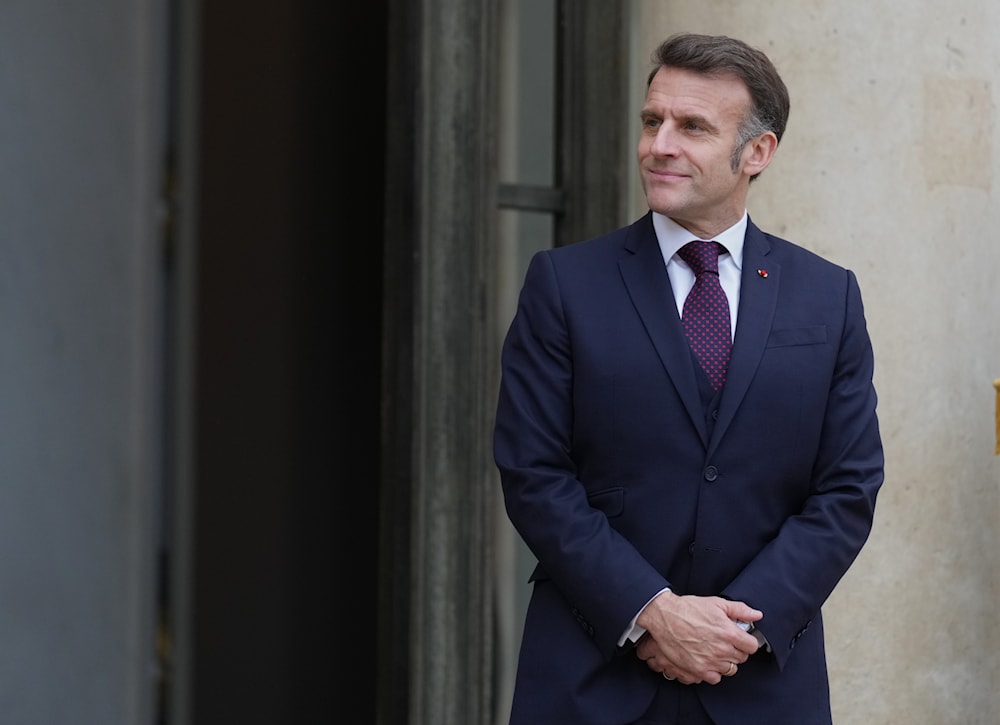
France's President Emmanuel Macron awaits Bahrain's King Hamad bin Isa Al Khalifa at the Elysee Palace in Paris on February 6, 2026. (AP Photo/Thibault Camus)
French President Emmanuel Macron has warned that Europe must urgently increase investment in strategic sectors or risk being "swept aside" amid intensifying global competition from the United States and China. His remarks were published on Tuesday in a joint interview with Le Monde, The Economist, and The Financial Times.
Macron estimated that the European Union needs around €1.2 trillion ($1.4 trillion) annually in public and private investment across critical areas such as green and digital technologies, defense, and security.
The French president also renewed his call for the establishment of common European debt instruments, including Eurobonds, to fund forward-looking projects. "Now is the time to launch a common borrowing capacity for these future expenditures, future-oriented Eurobonds," Macron said.
Caution against US 'threats' and strategic dependence
Warning against complacency, Macron said that threats and pressure from the United States continue, particularly in sectors like pharmaceuticals and digital technology. "There are threats and intimidation. And then, suddenly, Washington backs down. And we think it's over. But don't believe it for a second," he cautioned.
The French leader criticized what he described as Europe’s passive approach to "blatant aggression," saying: "We must not bow down or try to reach a settlement. We tried this strategy for months, and it’s not working. Above all, it leads Europe to increase its dependence."
Macron made the remarks ahead of a European Union summit, where leaders are expected to discuss economic resilience and long-term strategy. He called for simplifying and deepening the EU’s single market and diversifying trade partnerships to reduce reliance on dominant global players.
The French president's vision includes a more autonomous Europe, both economically and strategically, that can withstand geopolitical pressure from external powers while investing in its own future.
EU warns its 'survival' depends on ending reliance on US defense
Last month, Bloomberg reported on January 28 that the EU’s top diplomat has warned of a deepening rupture in transatlantic relations, urging Europe to rapidly rethink its security posture and assume far greater responsibility for its own defense amid a shifting global power balance.
Speaking at the European Defence Agency, EU foreign policy chief Kaja Kallas said growing reliance on "coercive power politics" and what she described as a sustained decline in US strategic attention toward Europe meant the bloc could no longer afford to treat its security as something outsourced. She raised the prospect of developing European defense capabilities independent of Washington and floated the idea of an EU-level military force financed and owned collectively by member states.
Kallas’ remarks come as confidence in Europe’s long-term security partnership with the United States has eroded, driven by repeated political signals questioning the durability of US commitments to its allies. Trump has repeatedly cast doubt on Washington’s dedication to the North Atlantic Treaty Organization, framing collective defense obligations as conditional and transactional. More recently, Trump threatened to take control of Greenland, the semi-autonomous territory of Denmark, a move widely viewed in European capitals as a direct challenge to allied sovereignty.
Beyond Trump’s rhetoric, EU officials have grown increasingly concerned that Washington’s strategic priorities are shifting structurally toward China, the Indo-Pacific, and domestic political pressures, leaving Europe lower on the list of US defense priorities. In that context, Kallas argued, reliance on American security guarantees now represents a vulnerability rather than a safeguard.
“This shift has been ongoing for a while; it is structural, not temporary,” Kallas said. “It means that Europe must step up; no great power in history has ever outsourced its survival and survived.”


