
Macron rejects US threats, 'intimidation' over Greenland
 4 Min Read
Macron, Germany, and the EU reject US tariff threats over Greenland, warning of damage to transatlantic ties and vowing a united response.
-
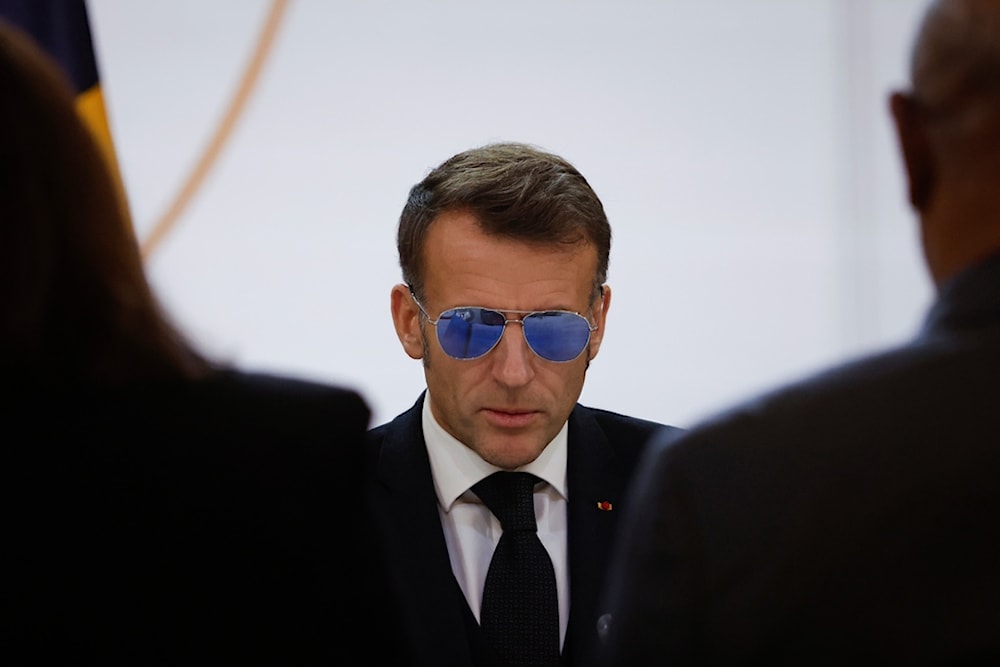
French President Emmanuel Macron speaks during a meeting on the institutional future of New Caledonia at the Elysee Palace in Paris, Friday, January 16, 2026 (AP)
European leaders have issued a coordinated pushback against US President Donald Trump’s threat to impose tariffs on European countries over Greenland, warning that such measures would damage transatlantic relations and pledging a united European response.
French President Emmanuel Macron said France would not be influenced by threats or economic pressure, stressing Paris’s commitment to national sovereignty, international law, and European security. Macron underlined France’s attachment to the principles of the United Nations Charter, noting that this stance guides France’s support for Ukraine and its participation in a Denmark-led military exercise in Greenland.
Macron said France’s decision to join the exercise was driven by concerns over security in the Arctic and Europe’s northern frontiers, adding that “no intimidation or threat” would affect France’s position in Ukraine, Greenland, or elsewhere. He described tariff threats as unacceptable — taking a jab at Trump —, warning that Europeans would respond in a united and coordinated manner if such measures were confirmed, and said Europe would ensure its sovereignty is respected.
Germany increasing coordination
Germany also said it was coordinating closely with European partners following Trump’s remarks. Government spokesman Stefan Kornelius said Berlin had taken note of the US president’s comments and was in close consultation with its European allies, adding that any response would be agreed jointly at the European level.
European Commission President Ursula von der Leyen warned that US tariffs linked to Greenland would undermine and further deteriorate relations between Washington and Europe. She cautioned that such steps could trigger a dangerous downward spiral, while stressing that Europe would remain united, coordinated, and committed to defending its sovereignty.
The statements follow Trump’s warning that several European countries could face tariffs unless a deal is reached for the US purchase of Greenland, a move that has heightened tensions across Europe and raised fresh questions about cohesion within NATO.
Trump escalates push for Greenland
Donald Trump on Saturday escalated his push to acquire Greenland, threatening to impose sweeping tariffs on several European nations unless a takeover deal is reached to purchase the Danish territory, a move that could trigger unprecedented strains within the NATO alliance.
In a post on Truth Social, Trump said that starting February 1, Denmark, Norway, Sweden, France, Germany, the United Kingdom, the Netherlands, and Finland would face a 10% tariff on all goods exported to the United States. He added that the tariff would rise to 25% on June 1, 2026, remaining in place “until such time as a Deal is reached for the Complete and Total purchase of Greenland.”
Trump singled out Denmark, a NATO ally, and criticized European states that have recently deployed troops to Greenland, a vast and mineral-rich territory at the gateway to the Arctic with a population of roughly 57,000. He said those countries were “playing a very dangerous game” by increasing what he described as security risks in the region.
Criticism for troop deployment to NATO
“Therefore, it is imperative that, in order to protect Global Peace and Security, strong measures be taken so that this potentially perilous situation end quickly, and without question,” Trump wrote.
If implemented, the threatened tariffs would mark an extraordinary escalation against Washington’s NATO partners, raising questions about alliance cohesion at a time of heightened geopolitical competition in the Arctic. It was not immediately clear under what legal authority the US president would impose tariffs of up to 25%.
Since returning to office, Trump has rolled out broad tariff measures against a wide range of trading partners, framing them as a response to what Washington describes as unfair trade practices and as leverage to advance US strategic objectives.


