
MAGA feels deceived: Was Trump honest about Iran war?
 3 Min Read
Trump’s Iran strikes spark unease within the MAGA base, as allies question regime change goals and warn of risks tied to prolonged conflict.
-
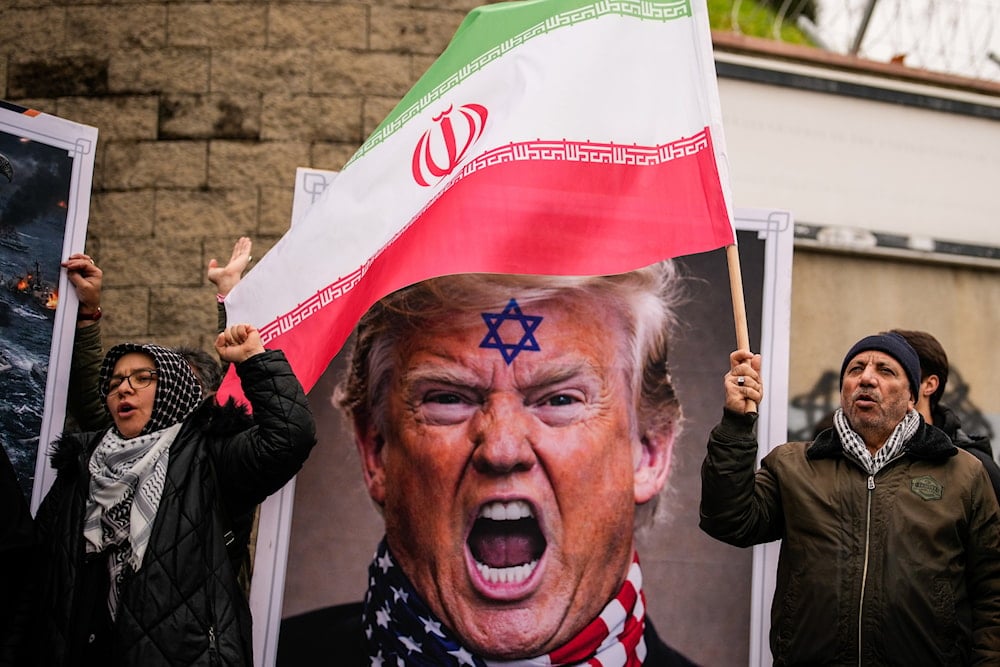
People shout slogans next to a poster of President Donald Trump, outside the US Consulate in Istanbul, Turkey, Sunday, Feb. 1, 2026 (AP)
President Donald Trump’s decision to attack Iran has left segments of his MAGA base feeling uneasy, with prominent allies warning that the move risks dragging the United States into another prolonged conflict in West Asia.
Trump claimed the offensive is necessary to topple the Iranian government, even if it comes at the expense of American lives across the region. Several supporters expressed concern that the administration had not sufficiently explained its broader strategy, particularly when taking into account Trump's pledge of "no new wars" during his tenure.
Andrew Kolvet, spokesperson for Turning Point USA, said on The Charlie Kirk Show that many supporters felt the case had not been clearly presented.
“We have to just be honest that there is a sense this was not sold to the American public sufficiently,” Kolvet said.
Political risks of prolonged conflict
Some advisors reportedly fear that an extended war against Iran could dampen enthusiasm within the MAGA base and shift attention away from domestic priorities ahead of the midterm elections.
While many supporters appear willing to give Trump the benefit of the doubt for now, unease persists about the potential for deeper US involvement in the region.
“The decision has been made,” Blake Neff, a producer for The Charlie Kirk Show, said. “Now we have to hope the president has a good plan.”
Trump's Iran war: Illegal, unpopular, and built on lies
The Guardian's senior international correspondent Julian Borger said on Saturday that the United States' aggression against Iran is unprovoked, legally baseless, and a direct contradiction of Donald Trump's own campaign promises, and of what the American people actually want.
Borger says that the attack amounts to an explicit regime change operation with no legal foundation, launched while diplomatic negotiations over Iran's nuclear program were still ongoing.
Trump's post-strike address, he notes, left little ambiguity about the scale of US ambitions: the IRGC was told to surrender or be killed, Iran's armed forces, missile program, and navy would be destroyed, and the country's ethnic minorities were called upon to rise up and topple the government.
On the question of legality, Borger asserts that with no credible or imminent Iranian threat to the United States, the attack constitutes a clear violation of the UN Charter. Rather than making a substantive case to Congress or the public, Trump offered sweeping rhetorical condemnations of Iran's leadership and invoked nearly five decades of bilateral hostility as justification, at a time, Borger claims, when Iran is weaker and less threatening than at any point in recent memory.
Read more: Trump's case for war on Iran is built on disputed claims: NYT


