
What were Trump's claims on Iran during his congressional speech?
 5 Min Read
Trump defended last year’s Operation Midnight Hammer during his State of the Union address, claiming that Iran is pursuing nuclear weapons while talks remain ongoing.
-
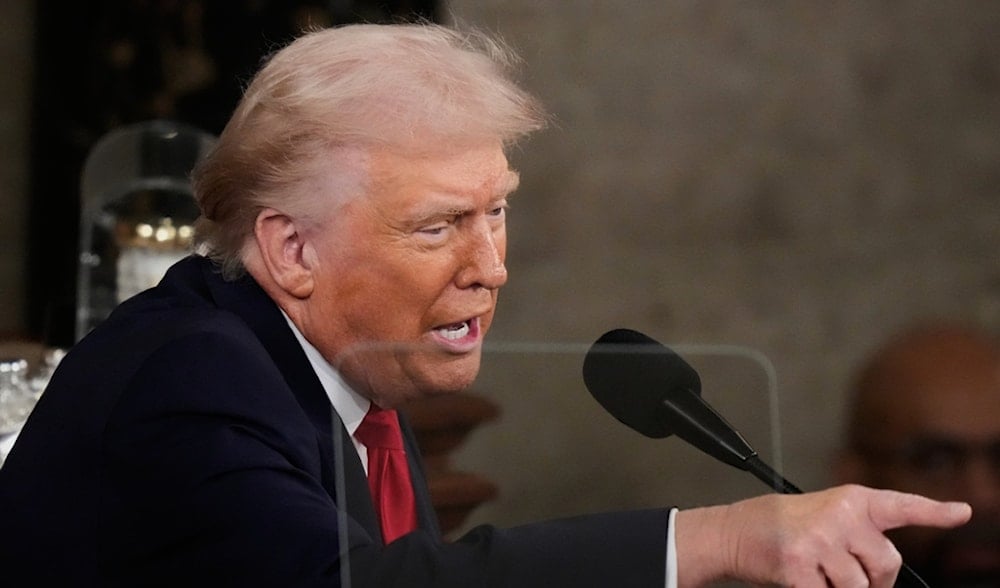
President Donald Trump delivers his State of the Union address to a joint session of Congress in the House chamber at the U.S. Capitol in Washington, Tuesday, Feb. 24, 2026. (AP)
More than an hour into his State of the Union address, US President Donald Trump used his speech to justify Washington’s past military assaults against Iran and reiterated his vow to block Tehran from developing nuclear weapons.
“As President, I will make peace wherever I can, but I will never hesitate to confront threats to America wherever we must. That's why in a breakthrough operation last June, the United States military obliterated Iran's nuclear weapons program with an attack on Iranian soil known as Operation Midnight Hammer.”
The attack was widely condemned as a violation of Iran's sovereignty, and came even as Tehran provided inspections of its nuclear facilities and activity. Iranian leaders have consistently maintained, even in talks, that their nuclear program is for peaceful purposes and that any deal must respect their rights under the Nuclear Non-Proliferation Treaty.
He reiterated long-standing rhetoric on Iran and Resistance groups in the region, saying, "Since they seized control of that proud nation 47 years ago, the regime and its murderous proxies have spread nothing but terrorism and death and hate.”
This comes after a collective death toll of over 75,000 people during US-backed Israeli assaults on Gaza, Lebanon, Yemen, and Iran. Gaza and Lebanon continue seeing a rising death toll as Israeli attacks resume unabated.
On riots in Iran
Trump further accused Iranian authorities of violently suppressing domestic protests, but provided no evidence to back his allegations.
“And just over the last couple of months with the protests, they've killed at least, it looks like, 32,000 protesters. 32,000 protesters in their own country. They shot them and hung them. We stopped them from hanging a lot of them with the threat of serious violence. But this is some terrible people.”
Iranian Foreign Minister Abbas Araghchi has previously demanded proof of Trump's claims, but no evidence was provided. As the situation in Iran died down, Iran’s Foundation of Martyrs and Veterans Affairs reported that a total of 3,117 people lost their lives during the January unrest. In a statement issued on January 21, the foundation said 2,427 of those killed were innocent civilians and security personnel.
Ongoing US-Iran talks
In his speech, Trump, without offering evidence, said that Iran is developing missiles that could hit the United States. "They've already developed missiles that can threaten Europe and our bases overseas, and they're working to build missiles that will soon reach the United States of America," he said, before confirming mediated talks with Iran.
Central to Washington's agenda is curbing Iran's missile program. US envoys and officials have repeatedly stated that this demand was a "red line" for Washington, while Iran maintains that it is its sovereign right.
A few days ago, Omani Foreign Minister Badr Albusaidi confirmed that Geneva will host the next round of talks between Washington and Tehran on February 26.
“We are in negotiations with them. They want to make a deal, but we haven't heard those secret words: ‘We will never have a nuclear weapon.’ My preference is to solve this problem through diplomacy. But one thing is certain: I will never allow the world's number one sponsor of terror, which they are by far, to have a nuclear weapon. Can't let that happen. And no nation should ever doubt America's result.”
Iranian officials, for their part, have stated that a diplomatic agreement remains possible if the process is conducted on mutually respectful terms and have proposed agreeable measures in exchange for recognition of peaceful enrichment rights and sanctions relief.
Meanwhile, the region is witnessing an unprecedented military buildup, alongside speculation about the possibility of carrying out an attack against Tehran. The broader regional military escalation has intensified tensions across several fronts, increasing diplomatic and security sensitivities.
Military strength and defense spending
Trump closed the section by emphasizing military power and calling for increased defense spending, linking deterrence to what he described as a strategy of “peace through strength.”
“We have the most powerful military on Earth. I rebuilt the military in my first term. We're going to continue to do so also, which is to prove the trillion-dollar budget. We have no choice. We have to be strong. because hopefully we will seldom have to use this great power that we built together. It's really called peace through strength, and it's been very, very effective. So thanks to Republicans in Congress, we're investing that record number of dollars, have no choice, in the United States Armed Forces.”
Read more: Fact Check: Trump's claims during State of Union vs. proven records


