
Trump's Iran war: Illegal, unpopular, and built on lies
 4 Min Read
Julian Borger argues in The Guardian that Trump's aggression against Iran has no legal basis, defies the wishes of the American public, and betrays the anti-war platform he ran on.
-
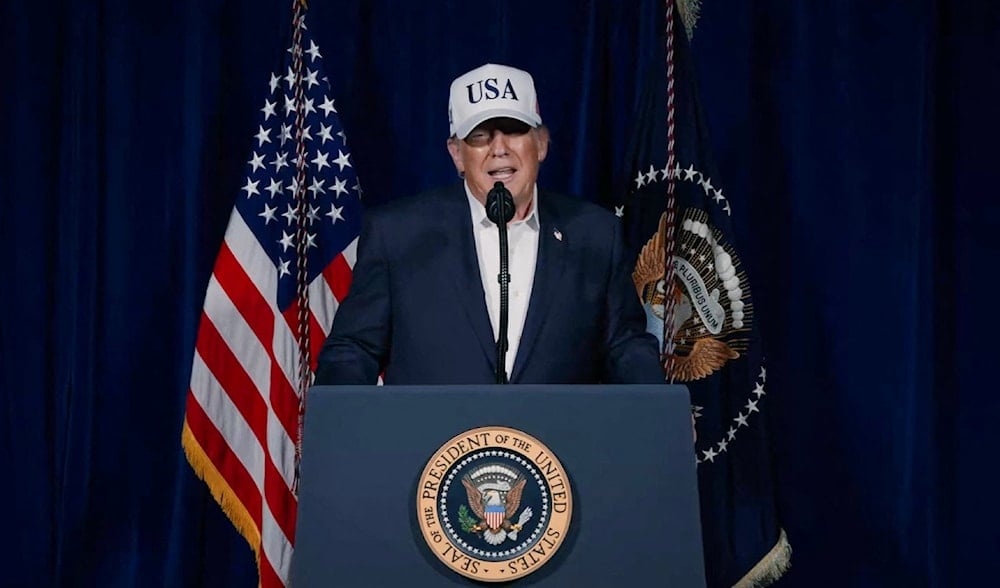
This screen grab from an eight-minute video posted by US President Donald Trump on his X account shows Donald Trump making a statement regarding the United States strikes on Iran, on February 28, 2026. (Truth Social/ @REALDONALDTRUMP via AFP)
The United States' aggression against Iran is unprovoked, legally baseless, and a direct contradiction of Donald Trump's own campaign promises, and of what the American people actually want, The Guardian's senior international correspondent Julian Borger argues in an analysis for in the wake of the joint US-Israeli strikes on Iran.
Borger says that the attack amounts to an explicit regime change operation with no legal foundation, launched while diplomatic negotiations over Iran's nuclear program were still ongoing.
Trump's post-strike address, he notes, left little ambiguity about the scale of US ambitions: the IRGC was told to surrender or be killed, Iran's armed forces, missile program, and navy would be destroyed, and the country's ethnic minorities were called upon to rise up and topple the government.
On the question of legality, Borger asserts that with no credible or imminent Iranian threat to the United States, the attack constitutes a clear violation of the UN Charter. Rather than making a substantive case to Congress or the public, Trump offered sweeping rhetorical condemnations of Iran's leadership and invoked nearly five decades of bilateral hostility as justification, at a time, Borger claims, when Iran is weaker and less threatening than at any point in recent memory.
The negotiations were never real
The strikes came in the midst of active US-Iranian diplomacy, as the latest round of talks had taken place just days earlier, but Borger suggests the negotiations were likely a charade from the start. With the biggest US military force assembled in the region since the 2003 Iraq invasion looming over the talks, he argues that nothing short of full Iranian capitulation could have stopped the assault.
The diplomatic process, in his reading, was not a genuine attempt to reach a settlement but a performance designed to provide political cover for a war that had already been decided. The maximalist nature of Trump's post-strike demands, like regime collapse, ethnic uprisings, and the destruction of Iran's entire military apparatus, only reinforces that assessment.
A betrayal of Trump's own political brand
The strikes also represent a stunning betrayal of Trump's own political brand. The president campaigned twice on ending US military entanglements abroad, made a centerpiece of his criticism of the 2003 Iraq invasion, and lobbied aggressively for a Nobel Peace Prize.
Just 10 days before ordering the strikes, Trump hosted the inaugural meeting of his so-called "Board of Peace," a forum he had sold to the UN Security Council as the route to resolving the war in Gaza. Borger characterizes the body as a "bait-and-switch," functioning in practice as a Trump-controlled rival to the Security Council, with its 27 member states now implicated in a war they never anticipated.
Domestic pressures behind the decision
As for why Trump made this move, Borger points to a confluence of domestic pressures: a Supreme Court rebuke of his tariff powers, sinking approval ratings ahead of the midterms, and lingering scrutiny over his ties to Jeffrey Epstein.
He cites former Commerce Secretary Wilbur Ross, who told the Wall Street Journal that the court defeat made military action more likely. Only around a quarter of Americans, Borger notes, support a new war in West Asia, making this a war waged for the president's benefit, not the public's.


