
Trump escalates Iran threat as US military buildup grows
 5 Min Read
US President Donald Trump has intensified US military deployments in West Asia and renewed threats tied to Iran’s nuclear program, raising regional escalation risks.
-
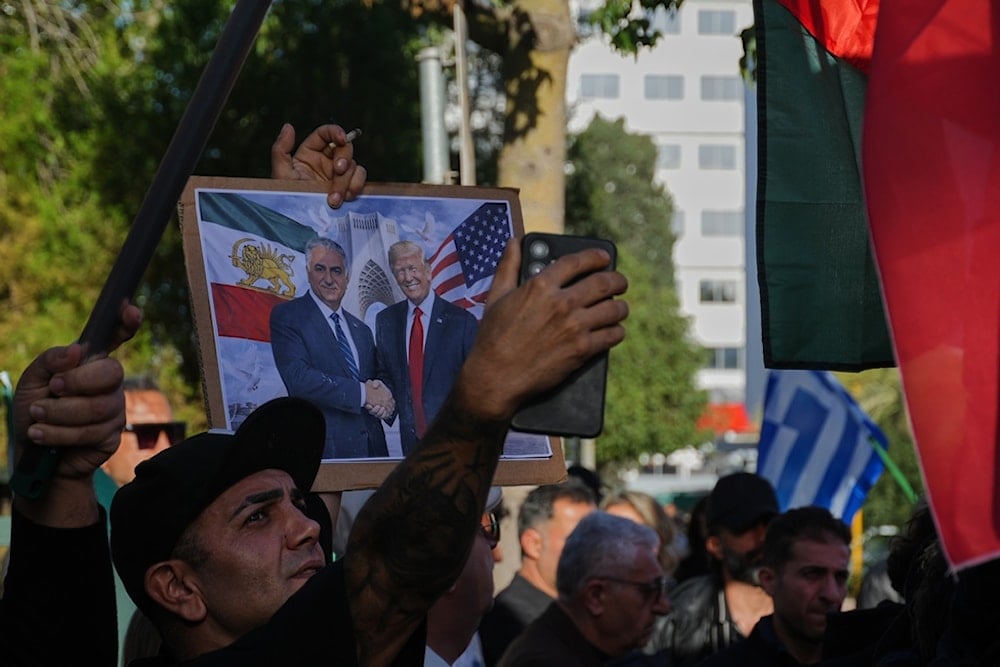
A demonstrator in Cyprus holds an image showing Donald Trump and Reza Pahlavi during a global protest for Iran outside the presidential palace in Nicosia on February 14, 2026. (AP)
US President Donald Trump has pushed the United States closer to a potential war with Iran, ordering a major military buildup and raising the prospect of an extended air campaign even as advisors warn that escalation could distract from economic messaging ahead of this year’s midterm elections.
The Trump administration’s posture has sharpened US-Iran tensions across West Asia, where US forces have expanded their presence amid warnings of strikes tied to Iran’s nuclear program. Yet Trump has not publicly presented a detailed case for war, leaving questions about strategic goals, escalation risks, and how Washington would manage regional fallout.
Trump has ordered a substantial deployment of US forces to West Asia, including aircraft carriers and warplanes, as the administration prepares for the possibility of a multi-week air attack on Iran.
A senior White House official said that despite Trump’s rhetoric, there was still no “unified support” within the administration to go ahead with an attack on Iran. The official said advisors are also concerned about sending a “distracted message” to undecided voters who are more focused on domestic economic concerns.
A second White House official, responding to Reuters, said the president’s approach was producing results and defended the broader agenda. “All of the President's actions put America First – be it through making the entire world safer or bringing economic deliverables home to our country,” the official said.
Read More: Trump faces bipartisan backlash over Iran war rhetoric, buildup
A regional flashpoint with high escalation risk
Trump’s fixation on Iran has emerged as the starkest example of how foreign policy and the expanded use of military force have dominated his agenda in the first 13 months of his second term, often overshadowing domestic issues such as the cost of living.
The administration’s intensified military posture comes after the US targeted nuclear sites in Iran in June, and Iran threatened to retaliate fiercely if attacked again. Trump has repeatedly warned of strikes if Iran does not reach an agreement on its nuclear program, and on Friday, he renewed the threat, saying Tehran “better negotiate a fair deal.”
The reasons Trump has given for potential military action have been vague and varied. He had initially threatened strikes in January in reaction to the Iranian government’s handling of the foreign-backed riots. More recently, Trump has tied threats to demands that Iran end its nuclear program and has floated the idea of “regime change,” but neither he nor his aides have explained how air strikes could achieve that.
The second White House official insisted that Trump “has been clear that he always prefers diplomacy, and that Iran should make a deal before it is too late.” The official added that the president has stressed Iran “cannot have a nuclear weapon or the capacity to build one, and that they cannot enrich uranium.”
Domestic political pressure collides with regional strategy
While foreign policy has historically been a secondary issue for midterm voters, Trump’s posture on Iran could become politically consequential if it leads to a prolonged conflict.
Republican strategists say a Trump-Iran war would test the isolationist instincts within his base, which has long been skeptical of new foreign entanglements. Rob Godfrey, a Republican strategist, said a prolonged conflict would pose significant political peril.
“The president has to keep in mind the political base that propelled him to the Republican nomination - three consecutive times - and that continues to stick by him is skeptical of foreign engagement and foreign entanglements because ending the era of 'forever wars' was an explicit campaign promise,” Godfrey said.
White House advisors and Republican campaign officials have stressed that Trump should focus on the economy, according to a person who attended a private briefing this week with numerous cabinet secretaries where Trump was not present.
Republicans plan to campaign on individual tax cuts enacted by Congress last year, as well as programs to lower housing and some prescription drug costs.
Political constraints and public appetite for another war
Many in Trump’s “Make America Great Again” movement supported the kidnapping of Venezuelan President Nicolas Maduro last month. But Iran is widely viewed as a tougher foe, and deeper involvement could produce greater pushback at home.
Trump won reelection in 2024 on his “America First” platform, in part by promising to reduce inflation and avoid costly foreign conflicts. Yet polls show he has struggled to persuade Americans that he is making progress in bringing down high prices.
Republican strategist Lauren Cooley said supporters could accept military action against Iran if it is decisive and limited. "The White House will need to clearly connect any action to protecting American security and economic stability at home," she said.
Godfrey said independent voters, often crucial in tight races, will be watching closely for clarity on goals and consequences. "Midterm voters and his base will be waiting for the president to make his case," he said.
Read More: Trump 'curious' why Iran hasn't 'capitulated' under pressure: Witkoff


