
Trump 'curious' why Iran hasn't 'capitulated' under pressure: Witkoff
 6 Min Read
US Special Envoy Steve Witkoff says Trump is "curious" why Iran hasn't "capitulated" under American pressure, as nuclear talks stall on core issues and Washington escalates its military posture in the region.
-
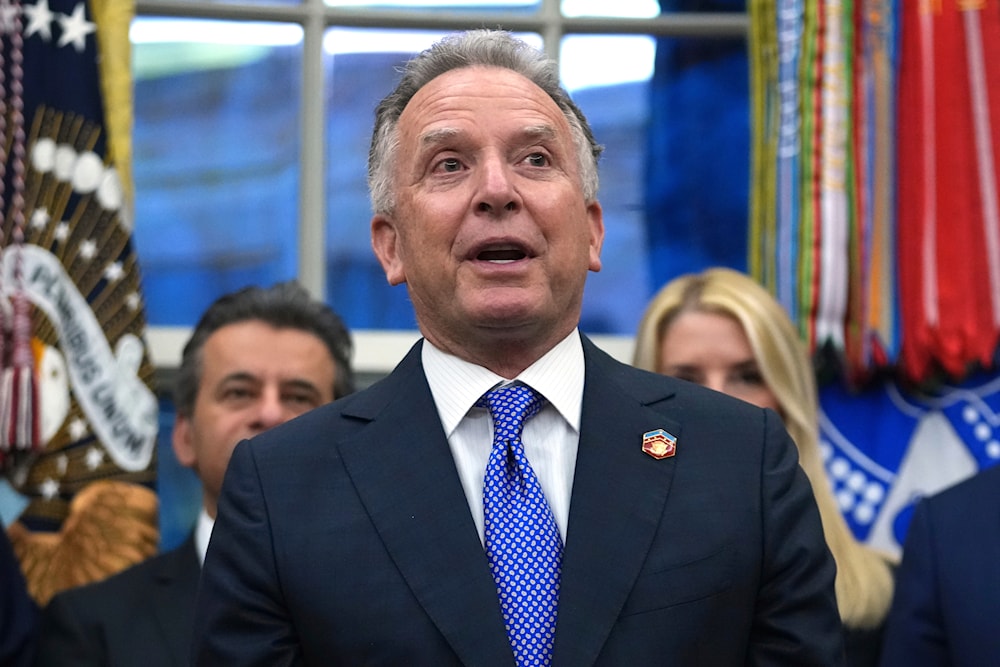
White House Special Envoy to the Middle East Steve Witkoff speaks at an event in the Oval Office of the White House, Thursday, Jan. 29, 2026, in Washington. (AP Photo/Allison Robbert)
US Special Envoy to the Middle East, Steve Witkoff, has revealed that President Donald Trump is asking why Iran has not yielded under mounting US pressure, even as nuclear talks between the two sides remain deadlocked on fundamental issues, and Washington continues to escalate its military posture in the region.
Speaking in an interview with Fox News, Witkoff said Trump raised the question with him directly on the morning of the interview. "The president asked me that this morning, and he's, I don't want to use the word, frustrated… because he understands he's got plenty of alternatives, but he's curious as to why they haven't, I don't want to use the word capitulated, but why they haven't capitulated," Witkoff said.
Witkoff on Iran: The president is curious as to why -- I don’t want to use the word capitulated but why they haven't capitulated. Why under this pressure with the amount of naval power over there, why they haven't come to us and said we profess we don't want a weapon… pic.twitter.com/gdv9CXjwBW
— Acyn (@Acyn) February 22, 2026
Witkoff pointed to the significant US naval and sea power deployed in the region as the basis for Washington's expectations, suggesting that such pressure should have been sufficient to compel Tehran to formally declare it does not seek a nuclear weapon and outline concrete steps to prove it.
"Why, under this sort of pressure, with the amount of sea power, naval power that we have over there, why they haven't come to us and said, we profess that we don't want to be, we don't want a weapon, so here's what we're prepared to do," he said.
Sayyed Khamenei answers
Iranian Leader Sayyed Ali Khamenei offered what amounts to an answer to that question earlier this week. Addressing hundreds from East Azerbaijan, Sayyed Khamenei said the warships Washington has deployed would not intimidate Tehran.
"The warships are certainly dangerous," he said, "but what is more dangerous than the warship is the weapon that can sink it to the bottom of the sea."
The leader of the Islamic Revolution also cited Trump's own admission that the US had failed to topple Iran's government over 47 years, declaring: "You will not be able to do this either."
Red lines on both sides
On the nuclear file, Witkoff laid out Washington's red lines in unambiguous terms. "Zero enrichment. We have to have the material back," he said, again claiming that Iran is "probably a week away from having industrial-grade bomb-making material" given its enrichment levels of up to 60 percent. "That's really dangerous. So they can't have that."
"Israel" and pro-Israeli politicians has been using the narrative of Iran being weeks away from developing a nuclear weapon for decades, with Tel Aviv using it as an excuse for its unprovoked aggression against Iran in June 2025.
Those demands, however, run directly into Iran's stated positions. A diplomatic source familiar with the indirect talks told Iran's ISNA on Friday that Tehran had made clear nuclear material would not be removed from the country, including highly enriched uranium. The source added that while Iran would consider reducing enrichment levels, it would show "no flexibility" regarding zero enrichment, the very condition Witkoff described as a non-negotiable red line.
Talks stall after Geneva
The gap was also evident following the second round of indirect talks in Geneva this week. While Iranian Foreign Minister Abbas Araghchi said both sides had agreed on "guiding principles" and would work toward a draft framework, the White House said significant gaps remain. A US official said Iran is expected to submit a written counterproposal within days.
The question of regime change surfaced during the interview when Lara Trump raised the role of Reza Pahlavi, the son of Iran's ousted Shah, noting that he had laid out steps for a potential regime change.
Witkoff confirmed he had met with Pahlavi at Trump's direction. "I've met him at the direction of the president… I think he's strong for his country, cares about his country," Witkoff said, while adding that any outcome would reflect "President Trump's policies, not Mr. Pahlavi's policies."
The confirmation comes after Pahlavi used the Munich Security Conference earlier this month to call openly for US military aggression on Iran, saying an attack could "expedite the process" of regime change.
In a 2023 interview, Pahlavi said that his entire life, social circle, and family are in America. "My life is here in America… my children and everyone I know are here… if I went back to Iran, what would I go back to?" he said, pushing many to call into question his credentials as leader of the Iranian opposition diaspora.
Trump himself has previously expressed doubt about Pahlavi's viability inside Iran, saying, "I don't know how he'd play within his own country."
Military buildup and a ticking clock
The diplomatic maneuvering is unfolding against an increasingly militarized backdrop. Satellite imagery cited by The New York Times shows more than 60 US attack aircraft now stationed at Muwaffaq Salti Air Base in Jordan, roughly three times the usual number, including F-35 stealth jets, drones, helicopters, and newly deployed air defense systems.
Trump has set a timeline of 10 to 15 days to determine whether to pursue diplomacy or order military action against Iran.
The pressure extends beyond military deployments. Reports emerged this week that US officials had presented Trump with a plan to assassinate Sayyed Khamenei and his son Mojtaba, with an adviser to the president telling Axios that "they have something for every scenario, one scenario takes out the Ayatollah and his son." The reports have not been officially confirmed or denied by Washington.
Iran's Mission to the United Nations warned this week that the military buildup, combined with Washington's escalatory rhetoric, signals a "real risk of military aggression, the consequences of which would be catastrophic for the region and would constitute a grave threat to international peace and security."


