
Maliki slams US interference in Iraq's government formation
 4 Min Read
Former Iraqi prime minister Nouri al-Maliki has denounced US warnings against his return to office as illegitimate interference in Iraq's sovereign political process, sparking backlash from Iraqi leaders who say Washington is attempting to dictate the country's leadership.
-
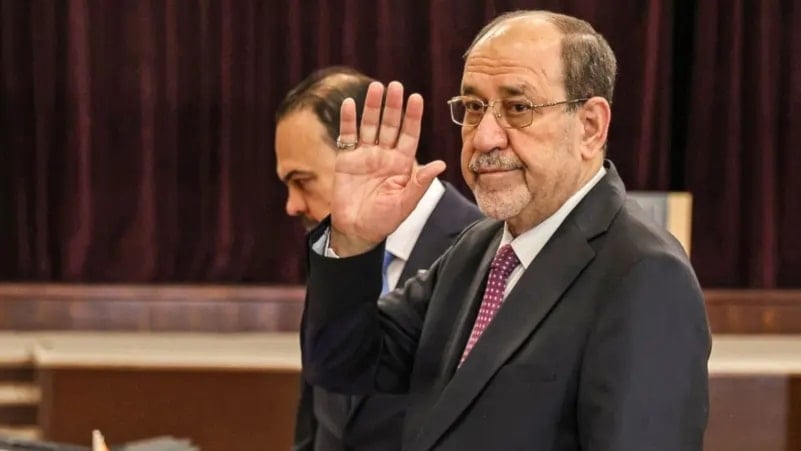
Former Iraqi Prime Minister Nouri al-Maliki arrives to cast his ballot at a polling station in Baghdad on November 11, 2025, during Iraq’s parliamentary elections. (AFP)
Former Iraqi prime minister Nouri al-Maliki has escalated his rejection of US pressure over Iraq’s government formation process, denouncing Washington’s warnings against his return to office as a direct violation of Iraqi sovereignty and democratic choice.
The confrontation erupted after US President Donald Trump described Maliki’s possible return to the premiership as a “very bad choice,” warning that Washington would no longer “help Iraq” if he were selected. Iraqi political forces framed the remarks as political coercion aimed at imposing an external veto over Iraq’s leadership.
Rejecting foreign interference
In a public statement, Maliki said that “the blatant American interference constitutes an encroachment on the Coordination Framework’s decision to select its candidate for the post of prime minister,” adding that it represents an infringement on Iraq’s sovereignty.
He stressed that the nomination process reflects an internal political consensus, stating, “Out of respect for the national will and the Coordination Framework’s decision, I will continue to work until we reach the end in a way that serves the interests of our people.”
Maliki also rejected the use of pressure and threats in international relations, saying that “the language of dialogue between states is the only political option in dealing with one another, not resorting to the language of dictates and threats.”
His remarks come after the Coordination Framework, Iraq’s dominant Shiite political bloc, endorsed him as its candidate following prolonged political deadlock and the failure of outgoing Prime Minister Mohammed Shia al-Sudani to secure a new governing majority. While internal debate preceded the decision, Iraqi political sources say the bloc ultimately settled the issue through majority consensus.
Longstanding US meddling
Washington’s opposition to Maliki has deep roots. During his two terms between 2006 and 2014, he increasingly fell out with the United States over Baghdad’s deepening relations with Iran and accusations of sectarian governance. Despite that rift, Maliki remained a central figure in Iraqi politics, rebuilding influence and positioning himself as a key power broker in post-2003 governments.
US officials have long sought to shape Iraq’s post-invasion political trajectory, often leveraging security cooperation, financial assistance, and diplomatic pressure. In recent weeks, American officials reportedly intensified lobbying efforts against Maliki’s candidacy, warning Iraqi leaders that his return would complicate relations with Washington.
Trump’s intervention followed a phone call by Secretary of State Marco Rubio with Iraqi officials, during which similar concerns were raised. Political sources said Washington also circulated messages to Iraqi lawmakers expressing opposition to Maliki’s nomination, moves widely interpreted in Baghdad as an attempt to predetermine the outcome of Iraq’s political process.
The United States is pressing the next Iraqi government to disarm or marginalize Axis-aligned armed factions, many of which it designates as terrorist groups. Iraqi officials and diplomats previously acknowledged that Washington demanded the exclusion of Axis-backed groups from the incoming government, a position Iraqi actors say amounts to rewriting domestic political balances from abroad.
Sovereignty asserted domestically
Former prime minister Adel Abdul Mahdi echoed Maliki’s stance, stressing that “Iraqis are free to choose their government, just as they were in 2003,” underscoring Iraq’s right to sovereign decision-making without foreign dictates.
In sharper language, Abu Alaa al-Walae, secretary-general of Kataib Sayyed al-Shuhada, accused Trump of attempting to eliminate political opponents through pressure, saying the US president had “assassinated the leaders of victory physically” in the past and now seeks to “assassinate Nouri al-Maliki politically” by rejecting his nomination.
Al-Walae said such interference undermines Iraq’s post-2003 democratic experience and “kidnaps the will of voters” to produce a government aligned with American interests rather than the choices of Iraqis themselves.
The escalating dispute highlights broader resistance within Iraq to continued US tutelage more than two decades after the invasion that reshaped the country’s political system. As Iraqi factions press forward with internal negotiations, the standoff has become a test of whether Baghdad can assert political autonomy in the face of external pressure over its leadership and future direction.
Read more: Iraq: Al-Maliki calls for an inclusive government


