
Minister of Information: Lebanon’s rights will not be relinquished
 4 Min Read
Lebanese Minister of Information Paul Morcos, in an exclusive interview with Al Mayadeen, outlines national priorities, including ending Israeli aggression, reconstruction, and the return of forcibly displaced people.
-
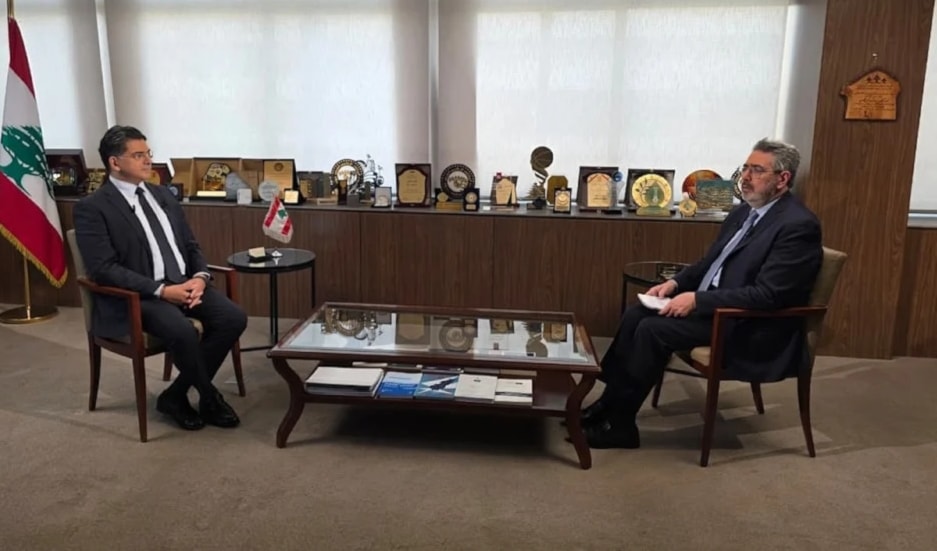
A screengrab from Lebanese Minister of Information Paul Morcos' interview for Al Mayadeen (Al Mayadeen)
Lebanese Minister of Information Paul Morcos confirmed in an exclusive interview for Al Mayadeen that President Joseph Aoun “will not relinquish Lebanon’s rights,” noting that the Lebanese state’s priorities include “a ceasefire, an end to Israeli violations, withdrawal from the occupied southern villages and towns, the return of detainees, reconstruction, and the return of forcibly displaced persons.”
Morcos said the President of the Republic is “very, very keen on maintaining a cohesive state position that reflects national unity,” stressing that he “publicly emphasizes the importance of preserving civil peace,” and that “success, experience, and patriotism lie in safeguarding it and ensuring it is not compromised.”
He explained that the Ministry of Information had secured, prior to the renewed Israeli aggression on Lebanon in October 2025, a Cabinet decision “to study available legal options,” noting that the Lebanese Ministry of Justice had already begun implementing it.
International contacts and accountability efforts
The Lebanese minister of information added that the International Humanitarian Law Committee, chaired by Deputy Prime Minister Tarek Mitri, is working on “collecting evidence and the necessary documentation to submit complaints before international forums,” pointing out that the Ministry of Information has provided the committee with “data, testimonies, evidence, and indications.”
Morcos said: “International organizations told us they cannot obtain guarantees from the Israeli side,” adding: “No matter what we do together, we still fall short in the face of the scale and horror of this Israeli crime.”
He revealed that the ministry has been in contact with several international bodies, including UNESCO, the Human Rights Council, UNIFIL, and the International Committee of the Red Cross, submitting formal protest notes regarding Israeli killing of journalists and media workers in Lebanon.
Morcos also said the ministry cooperated with Al Mayadeen “to compile all this data,” stressing that the channel “was fully cooperative to the greatest extent possible” in providing documents and information to the central committee of the Lebanese state.
Seven of at least 28 journalists and media workers martyred during the Israeli aggression on Lebanon were from the Al Mayadeen family, according to the Editors’ Syndicate. They were Farah Omar and Rabih Me’mari, martyred in Tayr Harfa in November 2023; Ghassan Najjar and Mohammad Reda, killed in Hasbaya in October 2024; Fatima Ftouni and cameraman Mohammad Ftouni, whose vehicle was struck and burned; and Hadi al-Sayyed, martyred in Burj Rahhal. Each of them was in the field, carrying a camera, a microphone, or a message, documenting reality as it is. They were targeted directly, silenced as they witnessed Israeli brutality firsthand.
Hate speech and social impact
On the issue of hate speech, Morcos said the file “has become a global issue,” but one that “intensifies during crises or wars,” noting that the Israeli aggression on Lebanon and the resulting mass displacement, along with the killing and wounding of civilians, “lead to social repercussions and an escalation of internal discourse.”
He added that the Ministry of Information “has no authority over social media platforms,” but plays “a role and responsibility in limiting hate speech” through meetings with influencers and media outlets, as well as awareness campaigns conducted in cooperation with UNESCO and the United Nations Development Program.
🔷خطاب الكراهية أصبح قضية عالمية لكنه يحتدم في وقت الأزمات.
— قناة الميادين (@AlMayadeenNews) May 18, 2026
🔷عدم ارتداع "إسرائيل" عن الاستمرار بعدوانها يؤدي إلى تأثيرات مجتمعية واحتدام الخطاب الداخلي.
وزير الإعلام اللبناني بول مرقص في #حوار_خاص مع #الميادين.@alpha_rony @DrPaulMorcos pic.twitter.com/YX9p9qcGgU
Morcos stressed that the ministry “does not perform a judicial role,” clarifying that it “does not summon individuals, open investigations, or carry out prosecutions,” but rather confines its role to “social responsibility and maintaining balanced public discourse.”
He pointed out that the ministry activated, during the war, a “media disinformation monitoring unit” tasked with tracking misleading content and countering “fake news” and “disinformation,” in order to prevent their influence on public opinion and the escalation of internal tensions.
Regarding his role within the government, Morcos said he may object to certain decisions in Cabinet, but once they are issued he adheres to the principle of “ministerial solidarity,” explaining that his role as Minister of Information requires him to “faithfully and accurately relay and explain these decisions.”


