
NATO allies reject Trump push to join Iran war
 3 Min Read
NATO allies refuse Trump’s call to join the Iran war, exposing deep divisions as European leaders resist involvement in the Strait of Hormuz crisis.
-
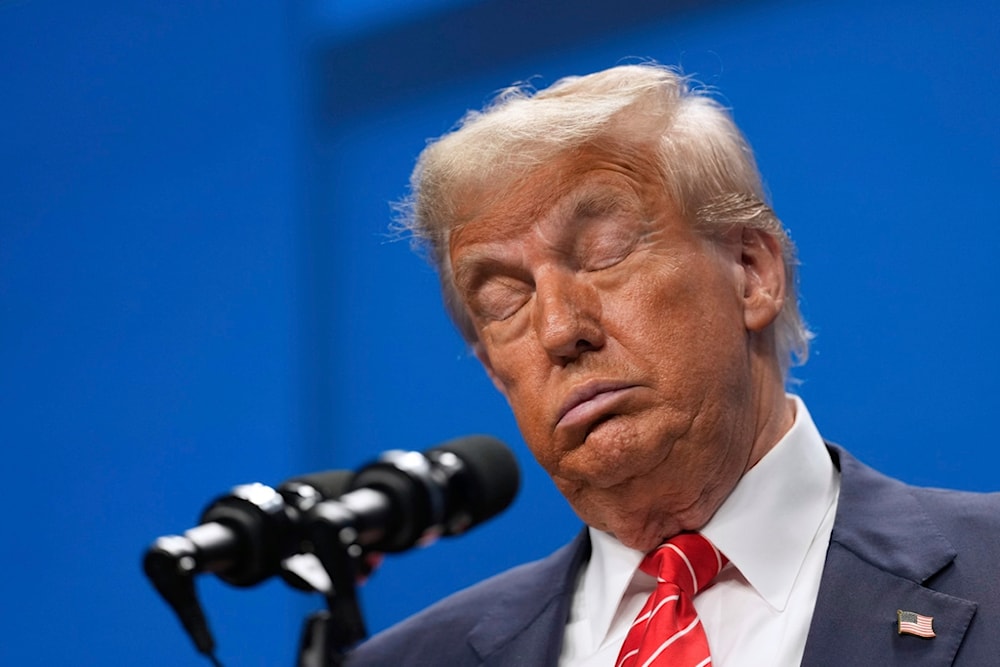
US President Donald Trump pauses before speaking during a media conference at the NATO summit in The Hague, Netherlands, Wednesday, June 25, 2025 (AP Photo/Matthias Schrader)
European allies have openly resisted calls from US President Donald Trump to join the war on Iran, marking a rare and direct challenge to Washington’s leadership within NATO.
Promises of the US-Israeli war on Iran being quick were quickly debunked in the early days of the aggression against the Islamic Republic. With Trump stating that he will succeed in implementing regime change and Iran's surrender.
Tehran responded to aggression with attacks targeting US and Israeli assets in the region and utilizing its leverage over the Strait of Hormuz to attack hostile forces economically as well.
As the war continued, Trump urged allies to deploy naval forces to secure the Strait. However, European leaders rejected the request in unusually firm terms.
German Chancellor Friedrich Merz stated that the war was “not a matter for NATO,” while EU foreign policy chief Kaja Kallas said no country was prepared to risk lives in the Strait of Hormuz.
Spanish Prime Minister Pedro Sánchez took a firmer stance than his EU counterparts against the aggression on Iran, describing the war as “illegal, absurd, cruel."
UK Prime Minister Keir Starmer also distanced London from joining the US-Israeli war on Iran, stating, “This is not our war ... and we’re not going to be dragged into it.”
Read more: Beyond rescue: The hidden objectives behind the US mission in Isfahan
Strategic and political concerns shape stance
Both strategic and domestic considerations drove European reluctance.
Officials questioned the rationale behind the war, citing a lack of evidence that Iran posed an imminent threat. They also warned that military engagement would strain already limited defense resources and divert attention from other NATO priorities, including strengthening influence on Russia's border in Ukraine.
Domestically, public opposition to the war has been strong across Europe, with political leaders wary of the electoral consequences of supporting another US conflict.
Transatlantic tensions deepen
Trump’s criticism of NATO allies, including calling them “cowards,” further strained transatlantic relations. He has also renewed threats to withdraw the US from NATO, raising concerns about the alliance's future.
European policymakers increasingly question the reliability of US security commitments, particularly amid shifting priorities and unilateral decision-making in Washington.
Tensions between the United States and its NATO allies had been building prior to the war on Iran, particularly over defense spending, trade disputes, and strategic priorities.
The current situation accelerated these divisions, with European states showing greater willingness to challenge US policy after years of compliance, especially when wars are initiated without consultation or clear strategic objectives.
Read more: UK seeks role in Iran ceasefire as Starmer visits Gulf


