
NATO unity masks deep divisions over alliance's future: Analysis
 3 Min Read
An analysis argues the latest NATO summit exposed growing divisions over the alliance's future despite public unity and increased military spending commitments.
-
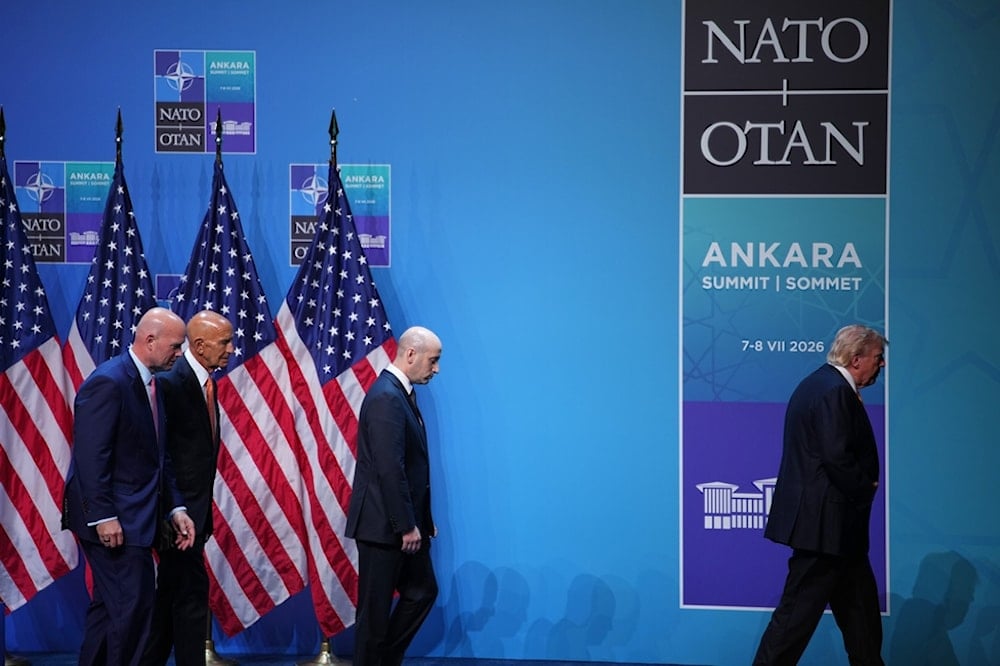
US President Donald Trump leaves the stage after a media conference at the NATO summit in Ankara, Turkey, Wednesday, July 8, 2026. (AP Photo/Emrah Gurel)
Despite being widely portrayed as a successful gathering, the latest NATO summit highlighted deep strategic divisions over the alliance's future, according to an analysis by Emma Ashford, senior fellow at the Stimson Center, published in Foreign Policy.
Ashford argues that while NATO leaders succeeded in projecting unity and avoiding public disagreements with US President Donald Trump, the summit exposed competing visions over whether Europe should continue relying on Washington or pursue greater strategic independence.
The Foreign Policy correspondent says that NATO leaders left the summit claiming progress on defense spending and reaffirming their commitment to collective security under Article 5.
The alliance's joint communiqué reiterated longstanding commitments to collective defense and deterrence while avoiding contentious issues that have complicated previous summits under Trump's leadership.
Ashford argues, however, that the carefully managed atmosphere concealed unresolved disagreements over the alliance's long-term direction.
NATO leaders did not announce a date for next year's summit, suggesting continued concerns over potential political tensions surrounding future meetings.
Read more: NATO at a breaking point: Europe pushes back as US pressure mounts
Competing visions emerge for NATO's future
Ashford identifies two competing approaches shaping the alliance's future. On one side is NATO Secretary-General Mark Rutte, who has argued that increased European military spending is primarily intended to preserve Washington's long-term security commitments to Europe.
According to the analysis, Rutte has encouraged NATO members to expand defense budgets while maintaining close military integration with the United States, including continued purchases of American military equipment.
In contrast, Canadian Prime Minister Mark Carney has promoted a different vision, arguing that NATO's European members and other middle powers should develop greater strategic autonomy as Washington increasingly reassesses its global priorities.
Ashford argues that Carney views stronger independent defense capabilities as a hedge against growing uncertainty in US foreign policy rather than simply a complement to American military power.
Military spending no longer the alliance's main dispute
The analysis argues that burden-sharing is no longer NATO's primary point of contention; instead, the debate has shifted toward determining what expanded defense budgets should ultimately accomplish.
Ashford writes that while European governments increasingly agree on raising military spending, they remain divided over whether those investments should reinforce US leadership or gradually reduce dependence on Washington.
The analysis points to France as a longstanding advocate of European strategic autonomy, while Britain remains among those supporting continued close military alignment with the United States.
US leadership faces growing scrutiny within NATO
According to Ashford, Trump's return to office has accelerated debates over the alliance's future by prompting allies to reassess Washington's reliability.
Rather than focusing solely on military spending targets, NATO members are increasingly confronting broader questions about Europe's security architecture and the extent to which it should remain dependent on US military power.
The analysis concludes that although the summit avoided a public political crisis, it did little to resolve the strategic disagreements that continue to shape NATO's future.


