
Netanyahu bars Turkish, Qatari role as US-backed Gaza plan advances
 5 Min Read
"Israel" has rejected Turkish and Qatari involvement in post-war Gaza while backing a US-imposed governance plan led by Donald Trump that critics say entrenches Israeli aggression and sidelines Palestinian self-determination.
-
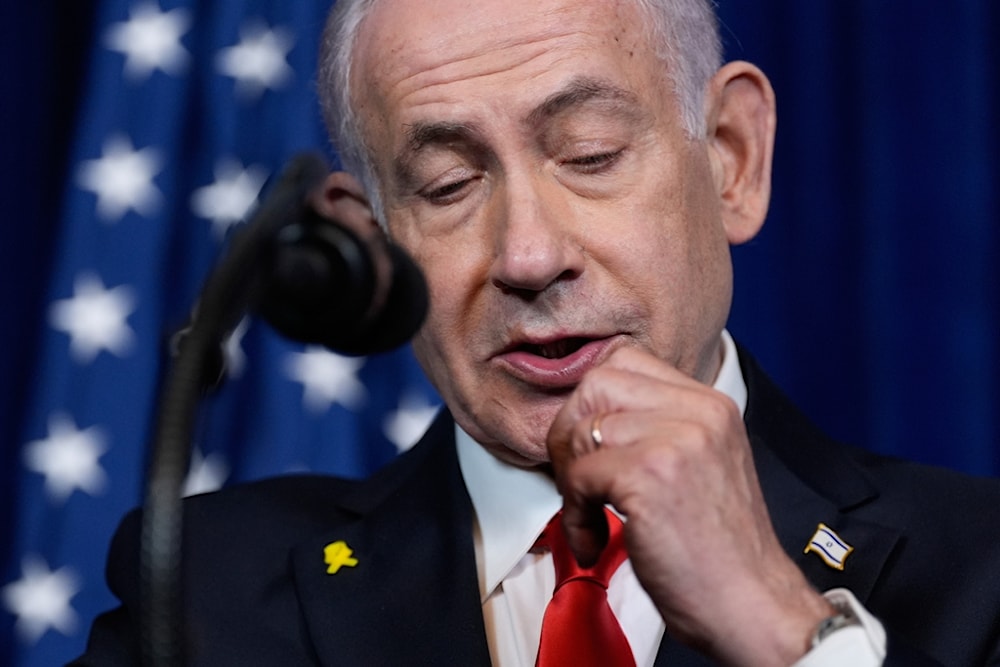
"Israel's" Prime Minister Benjamin Netanyahu speaks during a news conference with President Donald Trump at Mar-a-Lago, Monday, Dec. 29, 2025, in Palm Beach, Fla. (AP Photo/Alex Brandon)
Israeli Prime Minister Benjamin Netanyahu on Monday rejected any role for Turkish or Qatari forces in Gaza after the war, as "Israel" presses ahead with efforts to impose a new political and security order on the besieged territory under a US-backed framework widely criticised as externally engineered and devoid of Palestinian legitimacy.
Speaking before the Knesset, Netanyahu said "Israel" was approaching what he described as the second stage of a US plan for Gaza advanced by President Donald Trump, framing the next phase as centered on forcibly dismantling armed resistance in the strip after more than a year of devastating Israeli attacks.
“In the Gaza Strip, we are on the eve of phase two of the Trump plan. Phase two means one simple thing: Hamas will be disarmed, and Gaza will be demilitarised,” Netanyahu told parliament.
“There will be no Turkish or Qatari soldiers in the Gaza Strip,” he added.
Netanyahu’s remarks come as Washington accelerates the rollout of its controversial 20-point proposal to reshape Gaza’s future following "Israel’s" war, which has killed tens of thousands of Palestinians and left the territory largely uninhabitable. The plan shifts focus away from ceasefire accountability toward reconstruction and what US officials describe as “demilitarization,” without addressing "Israel’s" ongoing occupation, blockade, or responsibility for the destruction.
Unaccountable Peace Architecture
On January 17, the Trump administration formally announced the members of a newly created “Board of Peace,” a body chaired by Trump himself and presented as the central authority overseeing Gaza’s transition. The board includes US Secretary of State Marco Rubio, special envoy Steve Witkoff, and Trump’s senior advisor and son-in-law Jared Kushner, alongside figures such as former UK prime minister Tony Blair, World Bank president Ajay Banga, and US businessman Marc Rowan.
None of the appointees are elected Palestinian representatives, and the body has been widely seen as an instrument for managing Gaza’s post-war political economy rather than restoring Palestinian self-determination. While initially framed as a reconstruction authority, the board’s charter does not restrict its mandate to Gaza alone, raising concerns over broader political intrusion under the guise of peacebuilding.
Another key element of the plan is the establishment of an International Stabilisation Force (ISF), a US-led multinational unit tasked with security operations and training a new police force to replace Hamas. On Friday, Trump appointed US Major General Jasper Jeffers as commander of the force. Washington has yet to clarify which states will contribute troops, though Netanyahu has publicly ruled out any Turkish or Qatari participation.
"Israel" has also objected to the advisory structures accompanying the plan.
“We have a certain disagreement with our friends in the United States regarding the composition of the advisory council that will accompany the processes in Gaza,” Netanyahu said.
Those objections were formalised over the weekend, when Netanyahu’s office announced opposition to the composition of the Gaza Executive Board, an advisory body linked to the Board of Peace. The board includes Turkish Foreign Minister Hakan Fidan and Qatari diplomat Ali Al-Thawadi, alongside US and international figures.
“The Prime Minister has instructed the Foreign Affairs Minister to contact the US Secretary of State on this matter,” the statement said.
The Israeli regime did not specify its rationale, but it has repeatedly rejected any Turkish role in Gaza, with relations between Tel Aviv and Ankara deteriorating sharply since the war began in October 2023.
Pay-to-Play Peace
Further questions over the legitimacy of the US framework emerged on January 18, when Bloomberg reported that countries seeking a permanent seat on the Board of Peace would be required to contribute more than $1 billion in cash during the board’s first year. According to a draft charter cited in the report, Trump will serve as the board’s first chairman, personally determine participating states, and retain final approval authority over decisions, reinforcing perceptions of a pay-to-play mechanism driven by US geopolitical and financial priorities.
At the same time, Egypt, Qatar, and Turkey announced the formation of a separate Palestinian technocratic committee to manage Gaza’s internal affairs during the transition. The committee, led by Palestinian technocrat Ali Shaath, held its first meetings last week in Cairo, highlighting growing fractures between regionally backed Palestinian initiatives and a US-led structure viewed by many Palestinians as imposed, unaccountable, and detached from realities on the ground.
Read more: Kazakhstan accepts Trump's Gaza 'BOP' offer, Putin, Germany invited


