
Netanyahu claims direct call with al-Sharaa amid Sweida clashes
 4 Min Read
Israeli Prime Minister Benjamin Netanyahu claims he called Syria's Ahmad al-Sharaa during the deadly Sweida clashes last July, saying he told the Syrian leader to 'halt the attacks.'
-
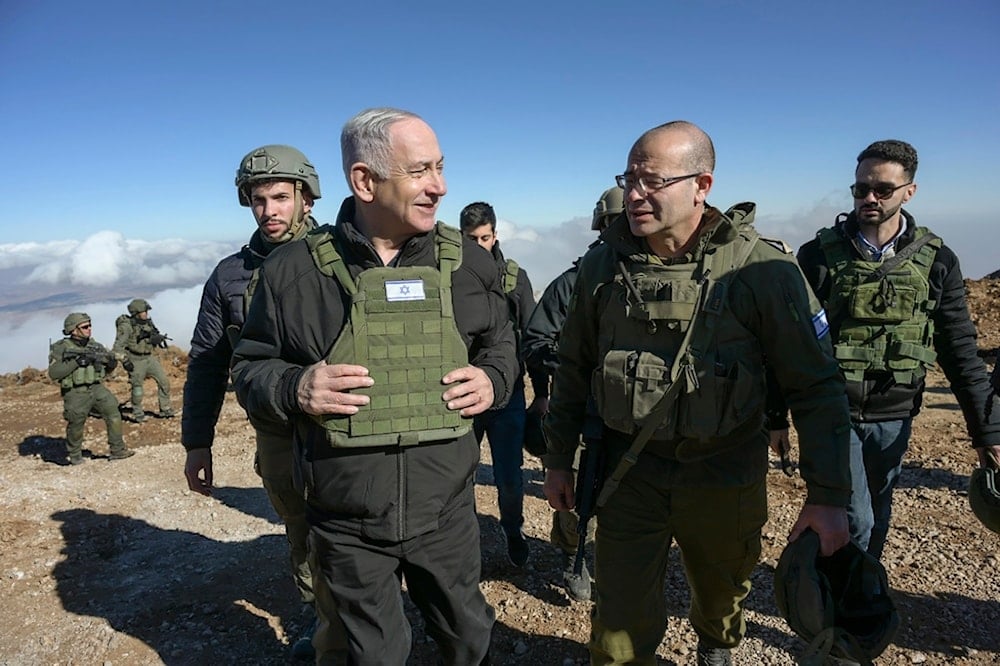
Israeli Prime Minister Benjamin Netanyahu, left, visits Israeli occupation forces inside Syria, Tuesday, Dec. 17, 2024 (AP photo)
Israeli occupation Prime Minister Benjamin Netanyahu claims he spoke directly with Syrian transitional President Ahmad al-Sharaa shortly after Israeli forces bombed government targets in Damascus in July 2025, invoking "the need to protect the Druze community amid deadly sectarian violence in Sweida."
Speaking on Thursday at a Likud party conference dedicated to the Druze community in the northern occupied Palestinian town of Yarka, Netanyahu said he contacted al-Sharaa during the bloodshed and urged him to halt the attacks, according to a report by The Times of Israel.
“I picked up the phone to Sharaa,” Netanyahu said, describing the exchange as “a very short and very sharp conversation.” He added, “And the slaughter stopped.”
Netanyahu also pledged to protect the Druze, telling conference attendees, “I will do everything I can to protect our brothers and your brothers.”
The remarks mark the first public account of a direct conversation between Netanyahu and al-Sharaa, who assumed power in late 2024 after the collapse of Syrian President Bashar al-Assad's government. If confirmed, the call could represent a rare direct exchange between leaders of two countries that have fought multiple wars and maintain no diplomatic relations.
Netanyahu did not disclose when precisely the conversation took place or provide further details about its contents.
Sweida bloodshed preceded Israeli attacks on Damascus
The alleged conversation came amid deadly clashes in Syria's predominantly Druze Sweida province in July 2025, where fighting between armed Druze factions and Bedouin fighters killed more than 2,000 people, including 789 Druze civilians, according to the Syrian Observatory for Human Rights.
Syrian government security forces intervened during the fighting on the side of Bedouin fighters and faced accusations of executing Druze civilians and committing other abuses.
Using the excuse of protecting Syrian Druze, Israeli forces subsequently struck Syria's Defense Ministry and areas near the presidential palace in Damascus. The attacks came as violence in Sweida intensified, prompting protests by members of the Druze community and their supporters, including demonstrations outside the US Embassy in occupied al-Quds.
“Israel” has a Druze population of around 150,000, many of whom maintain deep familial and communal ties with Druze communities in Syria. The violence in Sweida generated domestic pressure on Netanyahu's government to intervene.
However, the Israeli occupation's military aggression in Syria extend beyond the stated protection of the Druze community.
Israeli occupation expands military presence in Syria
Since armed groups led by al-Sharaa ousted Assad in December 2024, Israeli forces have seized a buffer zone on the Syrian side of the border and carried out hundreds of attacks across the country.
The Israeli occupation has justified its military aggression by claiming that it seeks to prevent armed groups from exploiting Syria's instability to establish a presence near the border. Damascus, meanwhile, has called for an end to Israeli military operations and a full withdrawal from occupied Syrian territory.
The two sides have held several rounds of direct talks since September 2025 over a potential security agreement, with Syria demanding a complete Israeli withdrawal.
In August, Israeli Mossad chief Roman Gofman met Syrian Foreign Minister Asaad al-Shaibani in Jordan in an effort to ease tensions following an Israeli attack on a base in northern Syria. The Israeli side said it had identified preparations for Turkish military activity at the site.
Al-Sharaa had confirmed in May 2025 that Syria was engaged in indirect talks with “Israel” through an Emirati backchannel aimed at reducing tensions.
Al-Sharaa leaves door open to peace but rejects Israeli claims over Golan
Addressing the United Nations last month, al-Sharaa indicated that peace with “Israel” remained possible while condemning its military operations inside Syria.
He also reaffirmed Syria's claim to the occupied Golan Heights, which Israeli forces seized from Syria during the 1967 war.
Al-Sharaa said in mid-April that his government could entertain "long-term negotiations" with "Israel" over the Golan Heights if it agrees to pull back from recently captured Syrian lands, during an address at a diplomatic forum in the Turkish city of Antalya.


