
Netanyahu has 'certainly gotten some things wrong', US VP says
 4 Min Read
US Vice President JD Vance said Washington will continue working with "Israel" but will prioritize American interests whenever they diverge from those of the Israeli government.
-
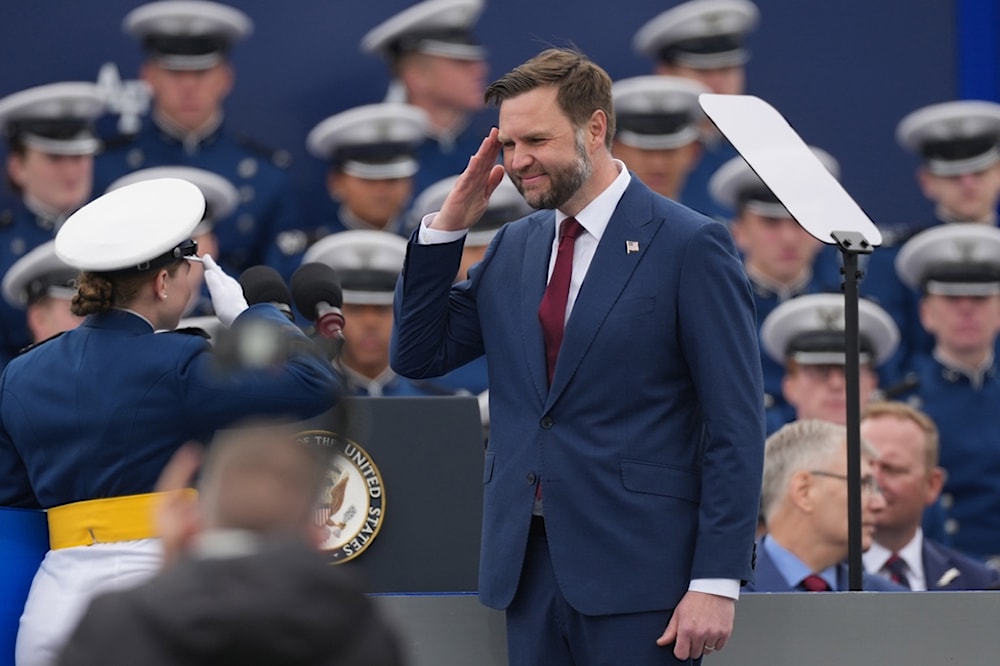
US Vice President JD Vance salutes a cadet during the graduation ceremony Thursday, May 28, 2026, at the Air Force Academy, Colo. (AP)
US Vice President JD Vance has acknowledged that Washington and Tel Aviv do not always share identical strategic objectives, stating that the United States will pursue its own national interests whenever disagreements arise with the Israeli entity.
Speaking in an interview with CBS' Sunday Morning, Vance discussed relations with Israeli Prime Minister Benjamin Netanyahu amid heightened regional tensions and ongoing debates within the Trump administration over policy toward Iran.
"Prime Minister Netanyahu, look, he governs a country that has obviously been a very close partner of the United States. But, even when we've been close partners, sometimes we have interests that are perfectly aligned and sometimes we have interests that are misaligned," Vance said.
Vance signals rift
The vice president described Netanyahu as a leader focused on advancing Israeli priorities but stressed that US President Donald Trump remains guided by what he considers beneficial for the United States.
"Sometimes that means we're on the same page and sometimes it means that we're not," Vance said, adding that "where that diverges, we, unfortunately for the Israelis, have to choose the side of the American people, which we always do."
The remarks come as questions continue to surface regarding differences between Washington and Tel Aviv over how to respond to Iran and manage the latest US aggression in the region.
Asked whether Netanyahu had mishandled aspects of his relationship with the United States concerning Iran, Vance indicated that mistakes had been made but declined to elaborate publicly.
"He's certainly gotten some things wrong," Vance said.
The vice president said he would not provide details, arguing that such discussions should remain private between the two governments.
Partnership despite differences
Vance nevertheless characterized Netanyahu as an important partner and signaled that cooperation between the two sides would continue despite policy disagreements.
"But what I would say is that he's been a good partner," Vance said. "We're gonna keep on working together. But where interests diverge, the United States is gonna pursue the best interests of our nation, and that's how it's gonna be."
The interview follows recent comments by Trump stressing that he intends to personally direct US efforts related to negotiations with Iran and expects Netanyahu to respect that approach.
Tehran rejects rift
Iranian officials, however, have repeatedly dismissed suggestions of a fundamental split between Washington and Tel Aviv. Tehran argues that public disagreements between US and Israeli officials do not alter what it views as a longstanding strategic partnership underpinning regional policies.
Iranian Foreign Ministry spokesman Esmaeil Baghaei rejected attempts to portray the United States and the Israeli entity as pursuing separate tracks, arguing that regional audiences are unlikely to be persuaded by claims of serious divisions between the two allies.
"No one believes that the Israeli regime would take any action without coordination with the United States," Baghaei told journalists in Tehran. "The United States bears responsibility for the Israeli regime's aggression, and it will also be responsible for the consequences of any escalation in tensions."
Baghaei also stressed that Israeli military actions in the region "cannot be looked at in isolation from the United States," maintaining that Washington bears direct responsibility for actions carried out by its closest regional ally.
Iranian officials have consistently maintained that Israeli military actions are enabled by American political, military, and diplomatic backing and that any tactical disagreements between Washington and Tel Aviv do not amount to a meaningful divergence in their broader strategic objectives. From Tehran's perspective, continued US support for "Israel", particularly amid the wars on Gaza and Lebanon, undermines claims that the two sides are fundamentally at odds over regional security issues.
Read more: US aggression against Iran drives oil prices higher, drags gold lower


